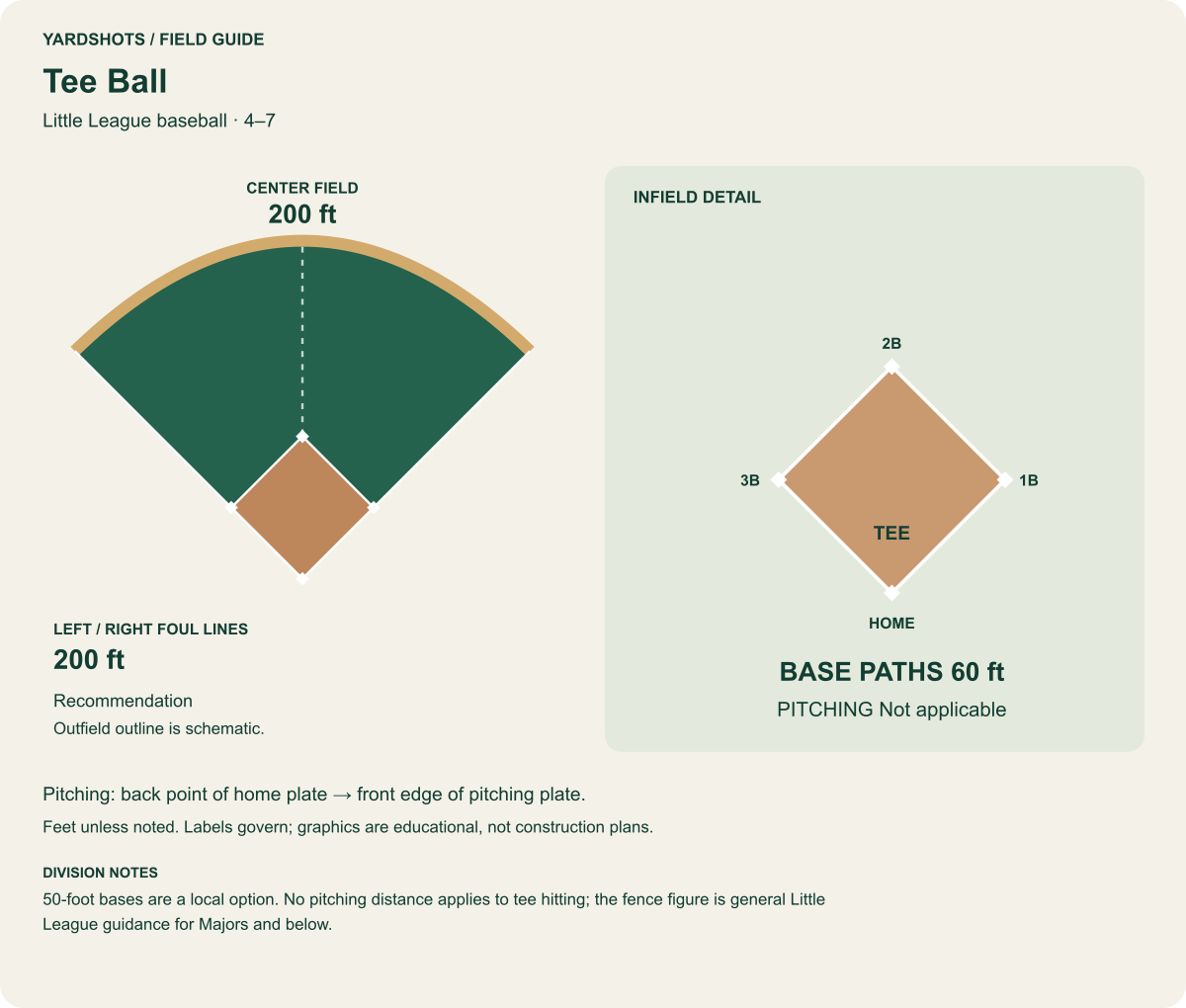
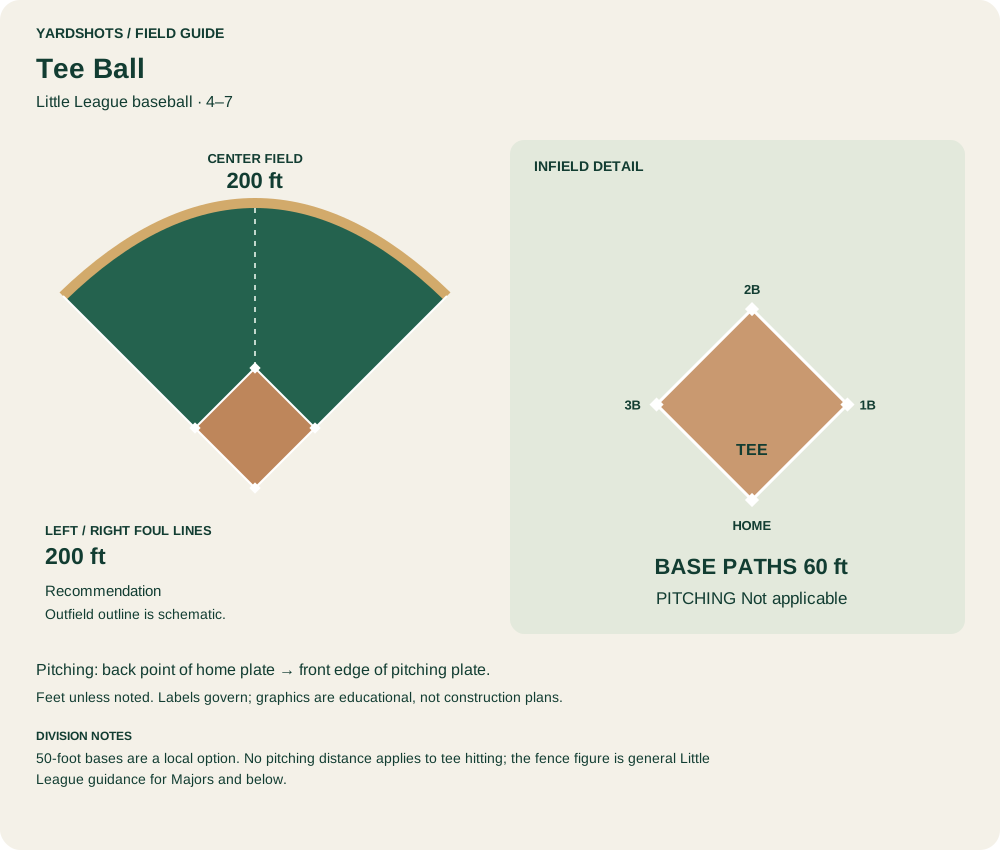
50-foot bases are a local option. No pitching distance applies to tee hitting; the fence figure is general Little League guidance for Majors and below.
Little League field specifications · Little League baseball divisions
Download SVG · Download PNGBaseball & softball field dimensions, from the first tee to the professional game.
Field reference reviewed September 30, 2026 · U.S. leagues and rule sets
High school, NCAA and professional baseball use 90-foot base paths and a pitching distance of 60 feet, 6 inches. Little League Majors uses 60-foot bases and a 46-foot pitching distance. Outfield dimensions vary by league and venue; the tables below distinguish recommendations from requirements.
From a first swing off a tee to a college or professional game, field size changes the way baseball and softball feel. The quickest way to understand a diamond is to check three things: the distance between bases, the pitching distance, and the distance from home plate to the outfield fence.
A 46/60 field has a 46-foot pitching distance and 60-foot base paths. A 50/70 field uses 50 and 70 feet. “60/90” is common shorthand for a full-size baseball field, but the actual pitching distance is 60 feet, 6 inches. Softball follows its own progression: many fastpitch divisions keep 60-foot bases while the pitching plate moves back with age.
There is no single reliable “average fence distance” across these leagues. Most rulebooks provide a recommendation, a minimum, or a permitted range—not a measured average of real parks. Yardshots lists those reference figures and identifies what each one means. A range in both fence columns describes the permitted or recommended boundary range; it does not mean the foul lines use the low end and center field uses the high end.
Every entry has its own labeled graphic. Measurements are in feet; ages follow each organization’s eligibility rules.
| Division | Age / level | Bases | Pitching | Foul lines | Center | Fence status |
|---|---|---|---|---|---|---|
| Tee Ball | 4–7 | 60 ft | Not applicable | 200 | 200 | Recommendation |
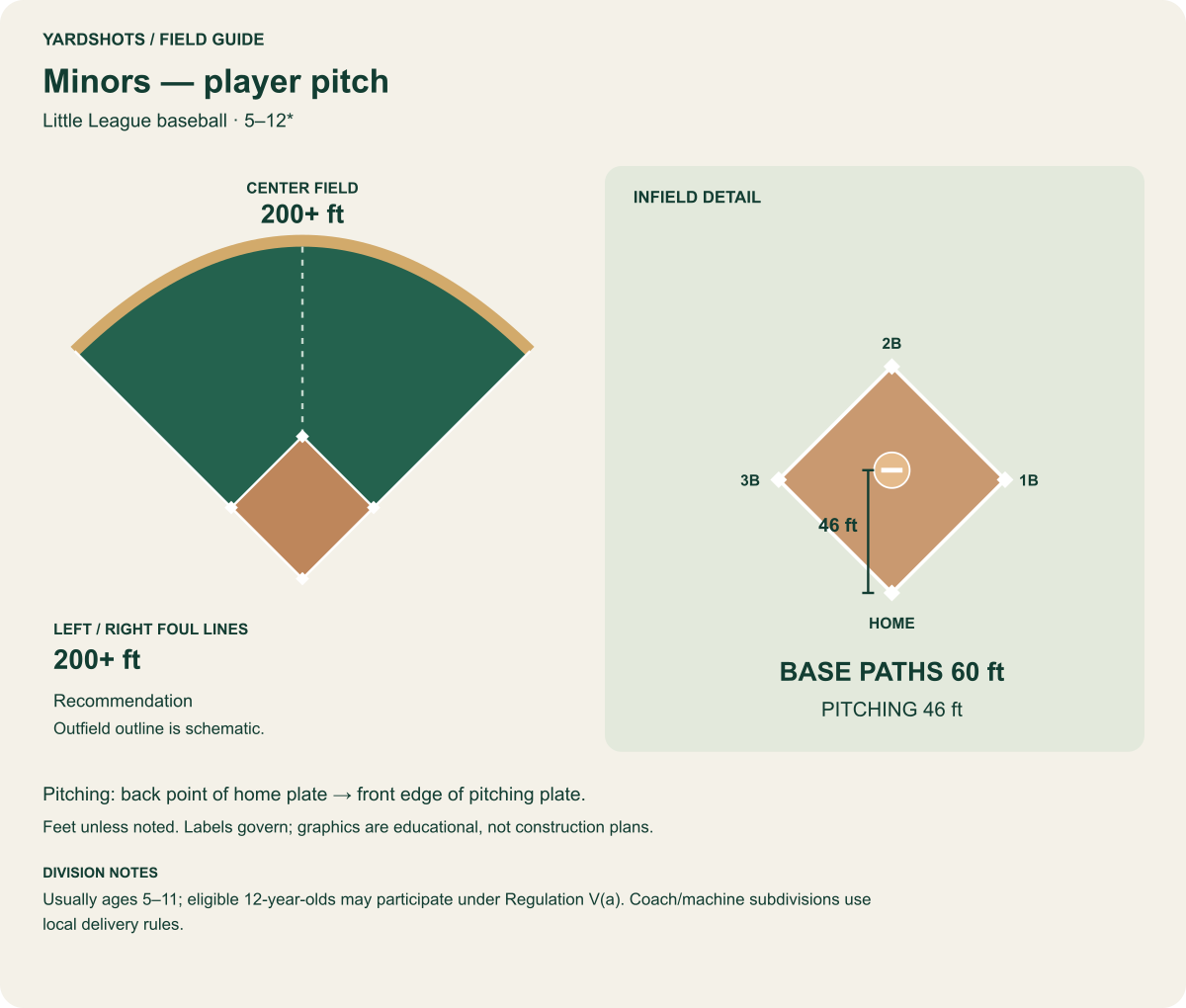
| Minors — player pitch | 5–12* | 60 ft | 46 ft | 200+ | 200+ | Recommendation |
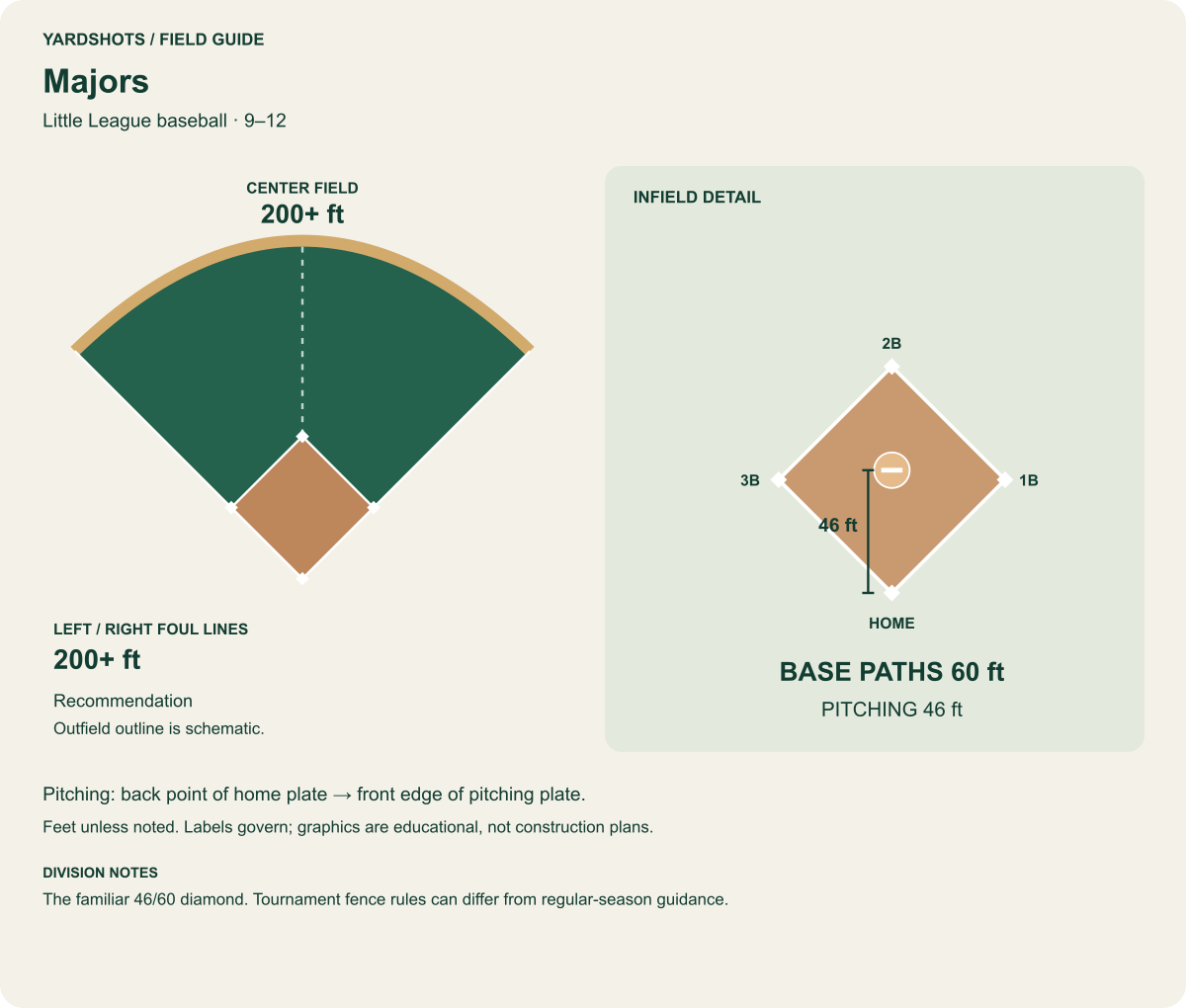
| Majors | 9–12 | 60 ft | 46 ft | 200+ | 200+ | Recommendation |
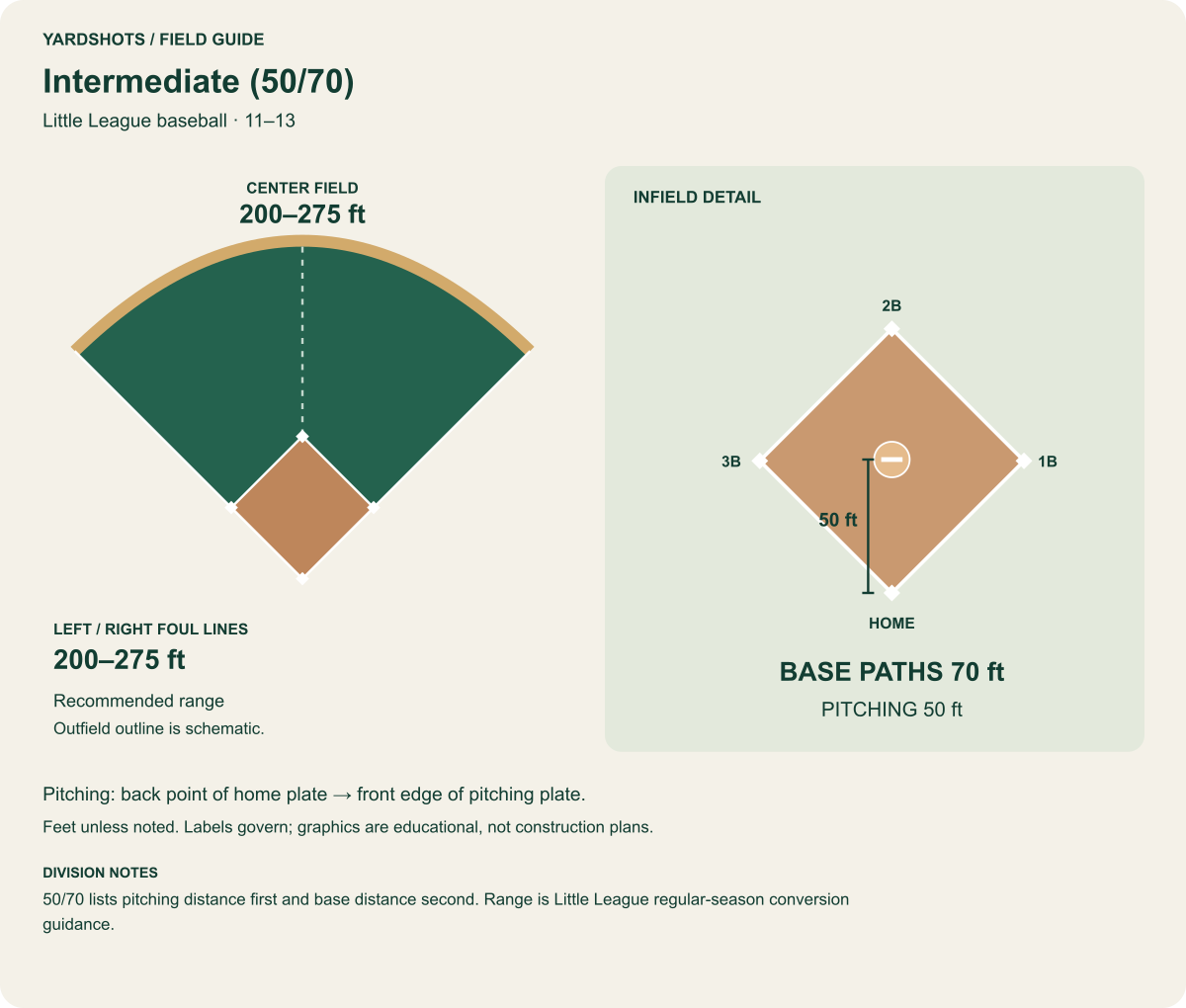
| Intermediate (50/70) | 11–13 | 70 ft | 50 ft | 200–275 | 200–275 | Recommended range |
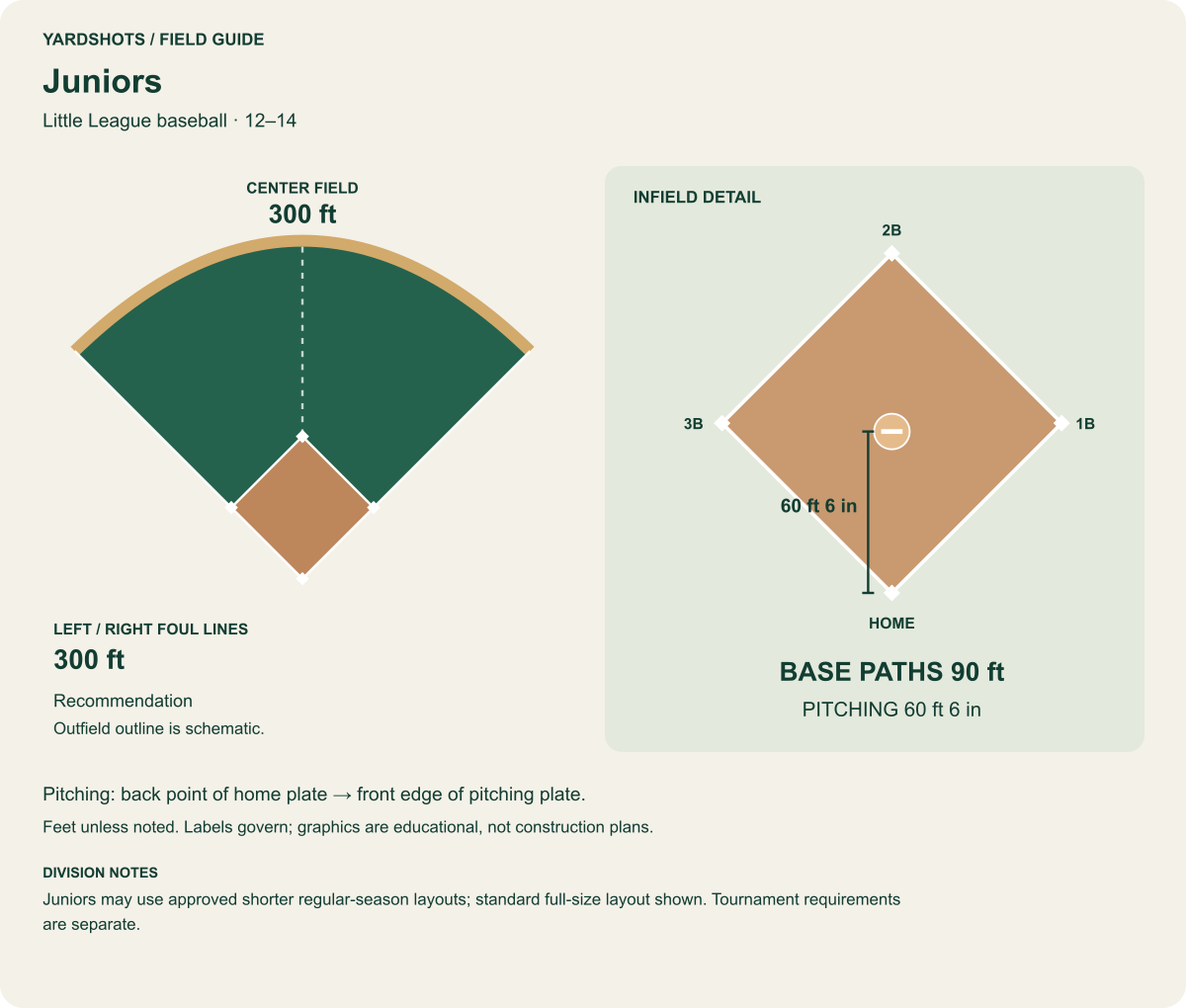
| Juniors | 12–14 | 90 ft | 60 ft 6 in | 300 | 300 | Recommendation |
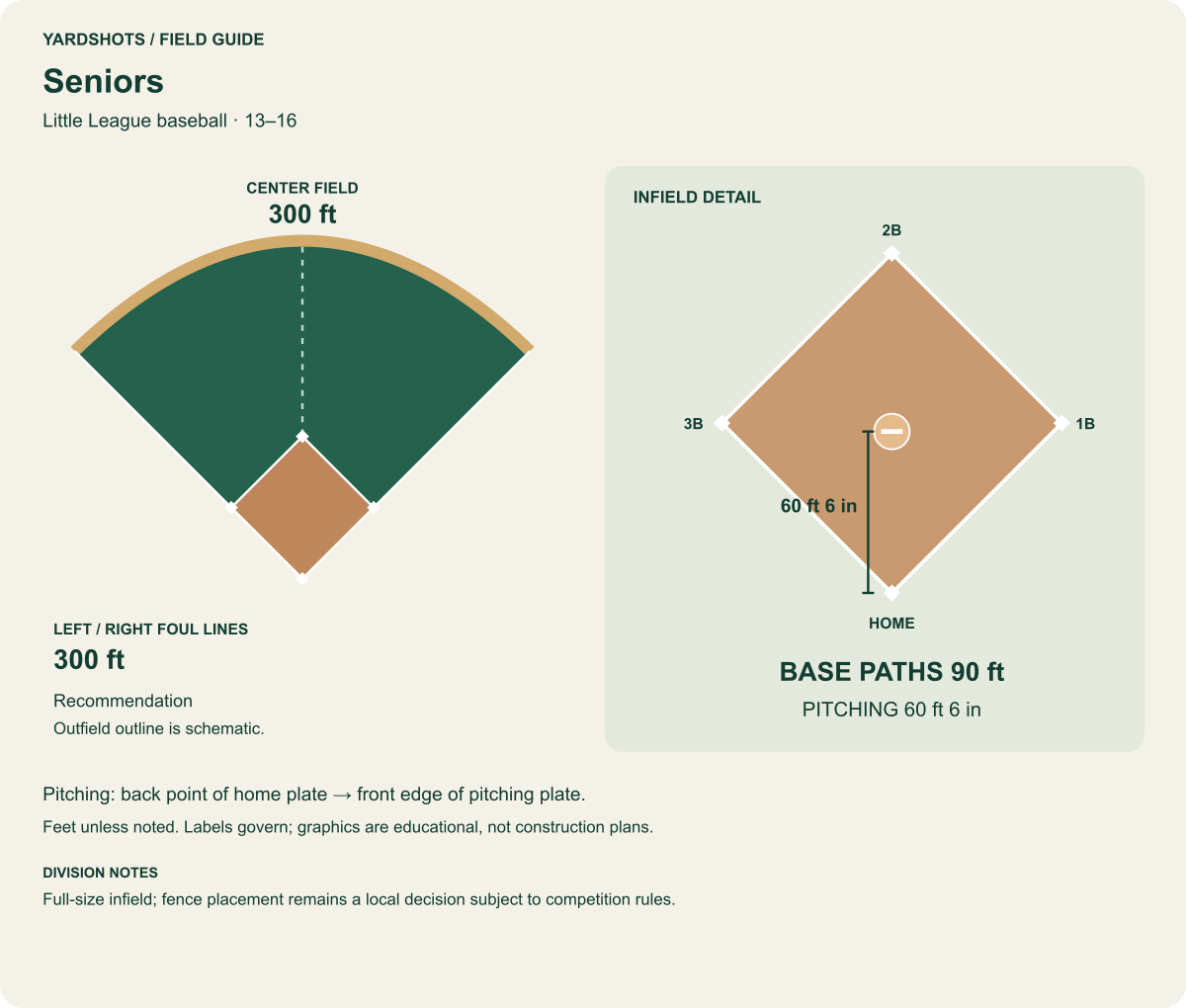
| Seniors | 13–16 | 90 ft | 60 ft 6 in | 300 | 300 | Recommendation |
50-foot bases are a local option. No pitching distance applies to tee hitting; the fence figure is general Little League guidance for Majors and below.
Little League field specifications · Little League baseball divisions
Download SVG · Download PNG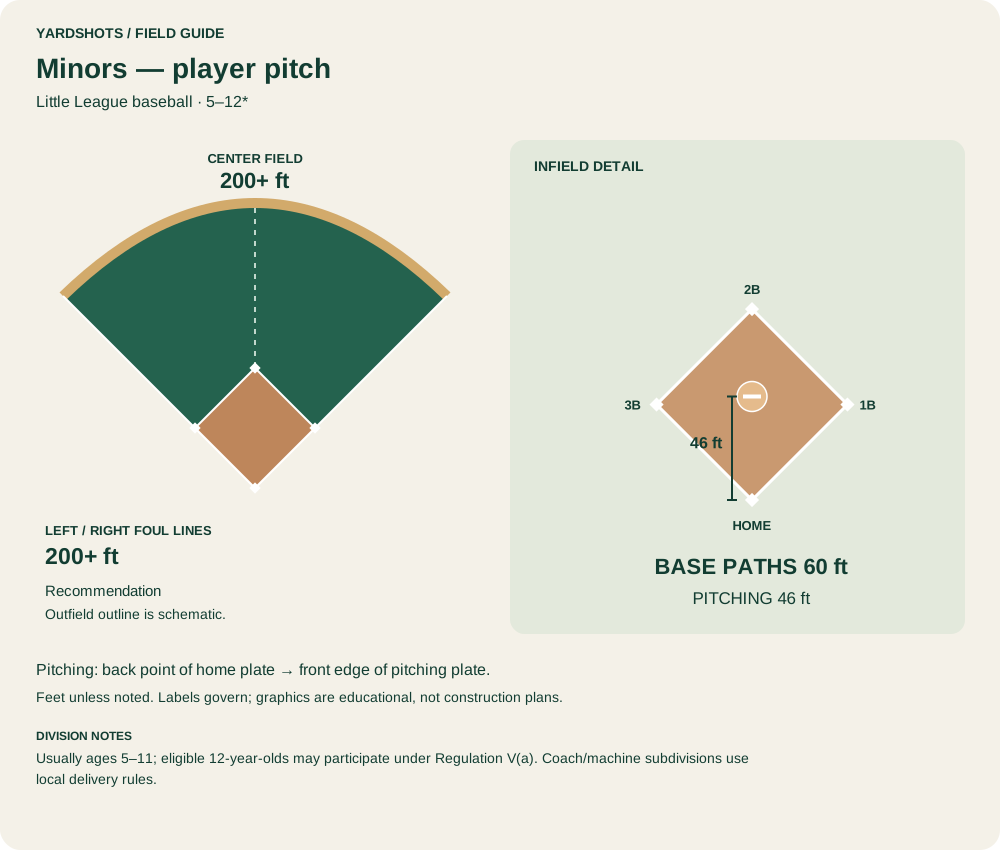
Usually ages 5–11; eligible 12-year-olds may participate under Regulation V(a). Coach/machine subdivisions use local delivery rules.
Little League baseball divisions · Little League field specifications
Download SVG · Download PNG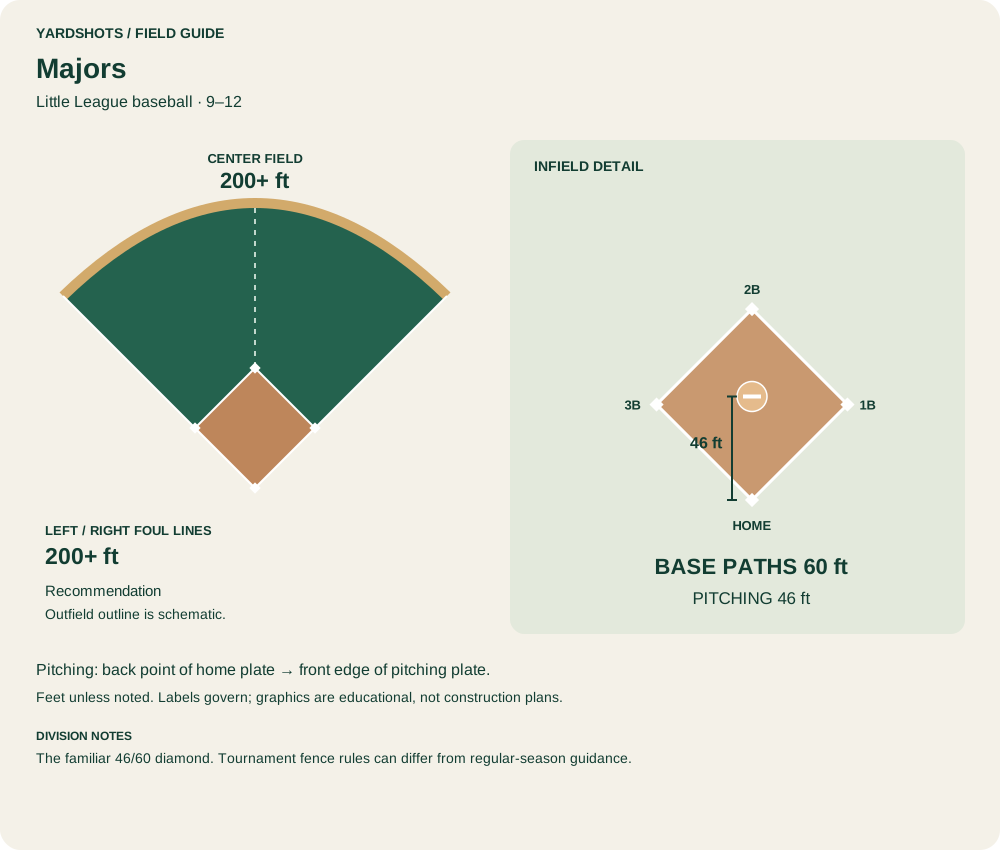
The familiar 46/60 diamond. Tournament fence rules can differ from regular-season guidance.
Little League baseball divisions · Little League field specifications
Download SVG · Download PNG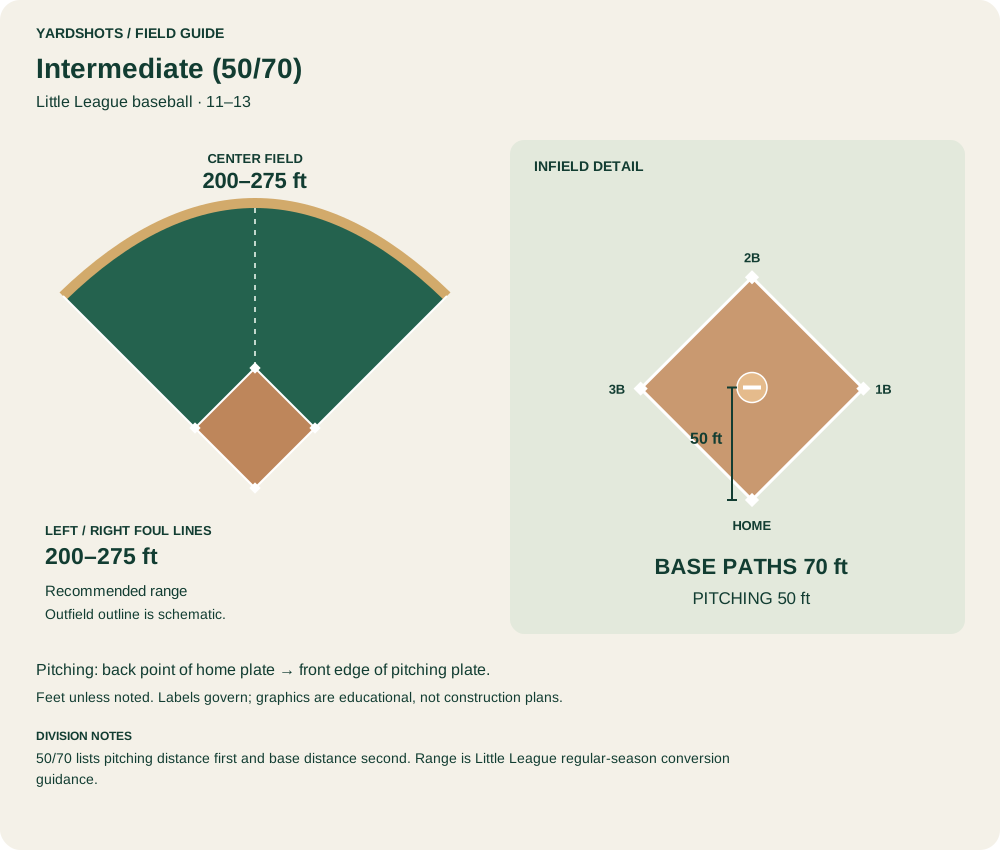
50/70 lists pitching distance first and base distance second. Range is Little League regular-season conversion guidance.
Little League baseball divisions · Little League Intermediate field conversion
Download SVG · Download PNG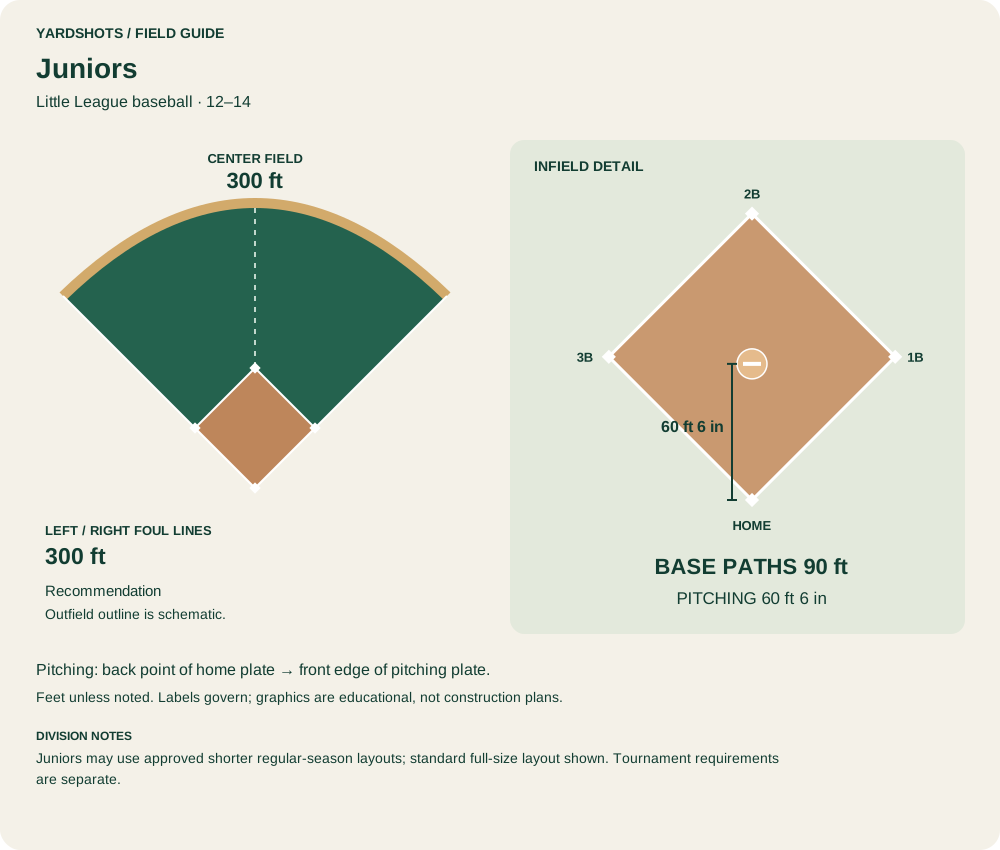
Juniors may use approved shorter regular-season layouts; standard full-size layout shown. Tournament requirements are separate.
Little League field specifications · Little League baseball divisions
Download SVG · Download PNG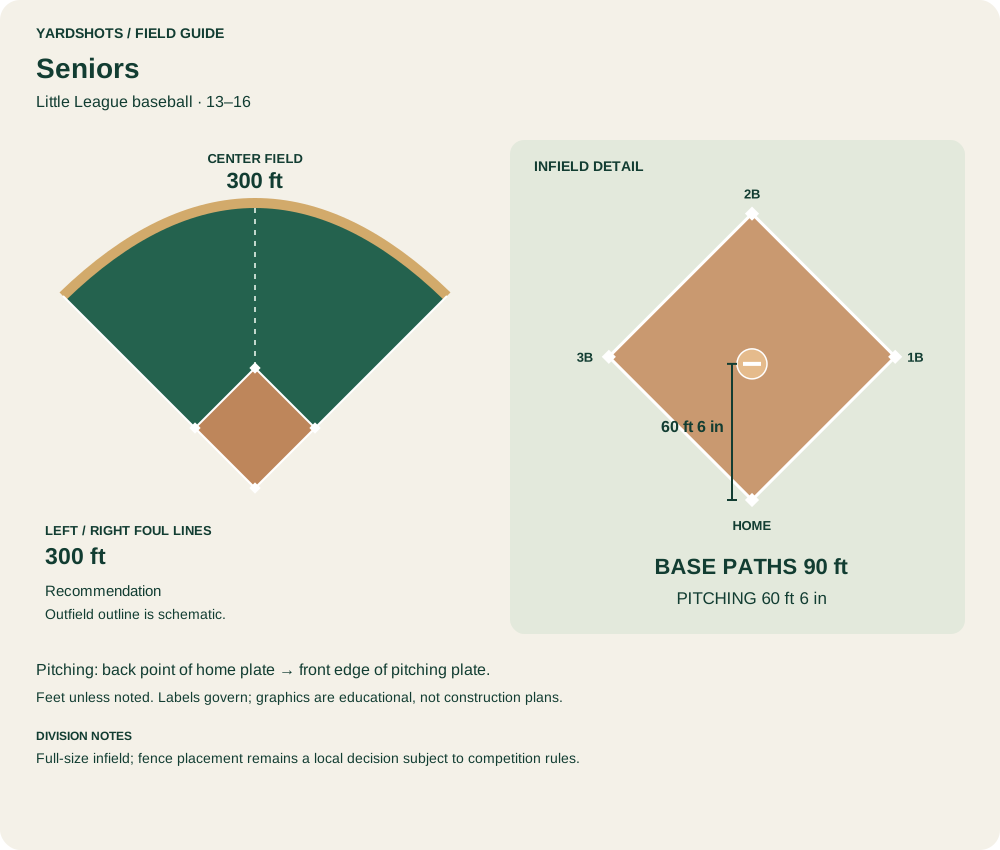
Full-size infield; fence placement remains a local decision subject to competition rules.
Little League field specifications · Little League baseball divisions
Download SVG · Download PNG| Division | Age / level | Bases | Pitching | Foul lines | Center | Fence status |
|---|---|---|---|---|---|---|
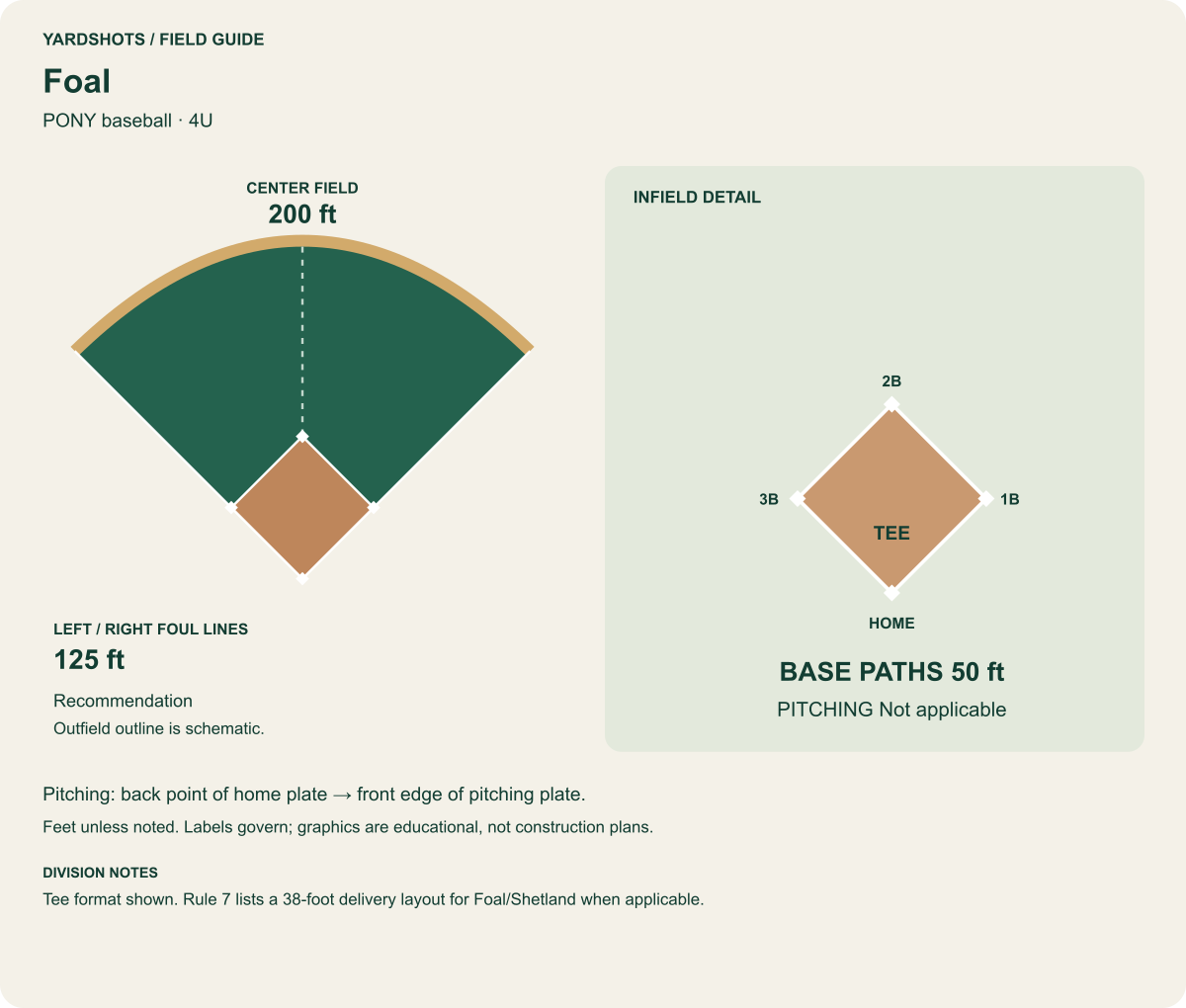
| Foal | 4U | 50 ft | Not applicable | 125 | 200 | Recommendation |
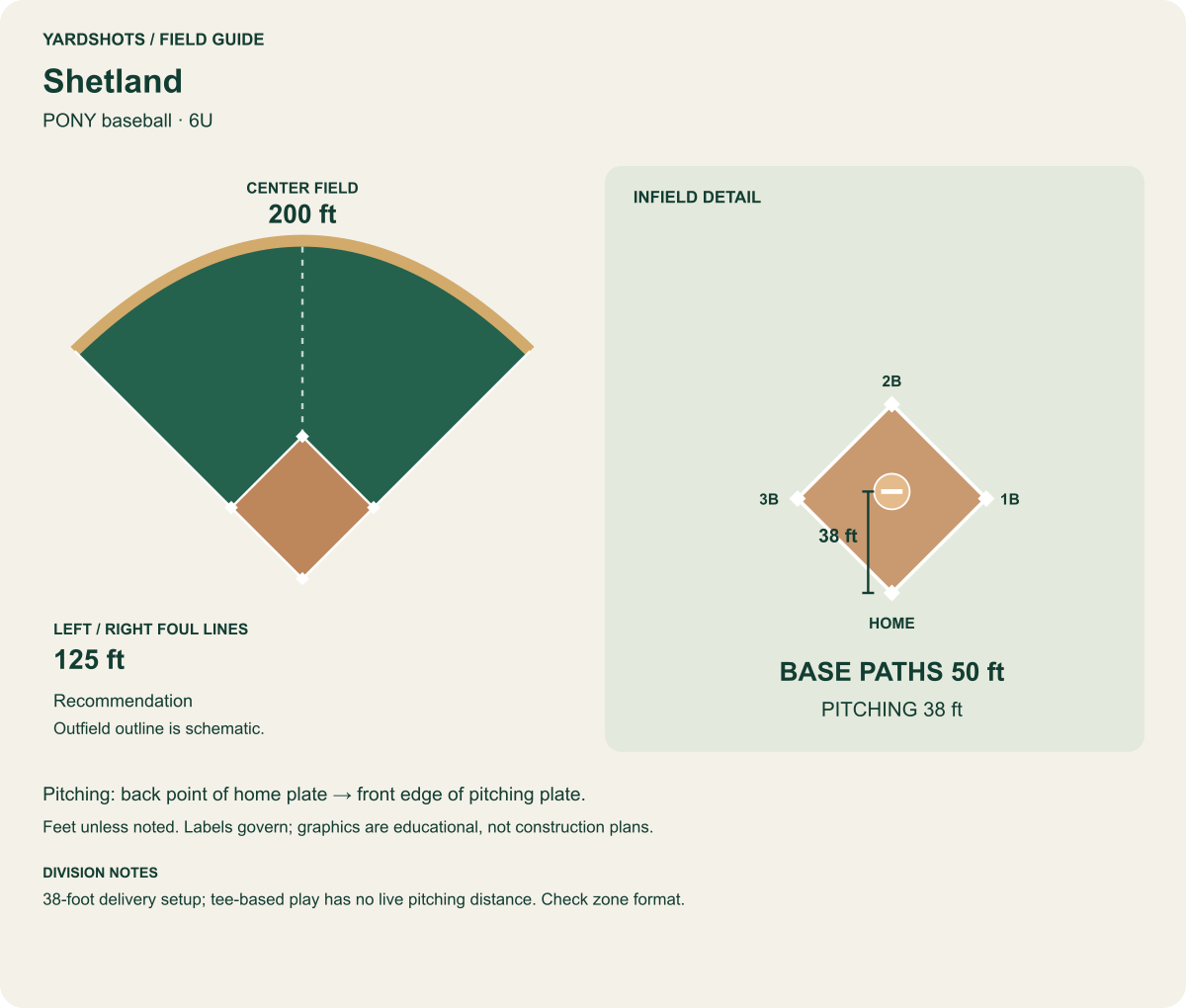
| Shetland | 6U | 50 ft | 38 ft | 125 | 200 | Recommendation |
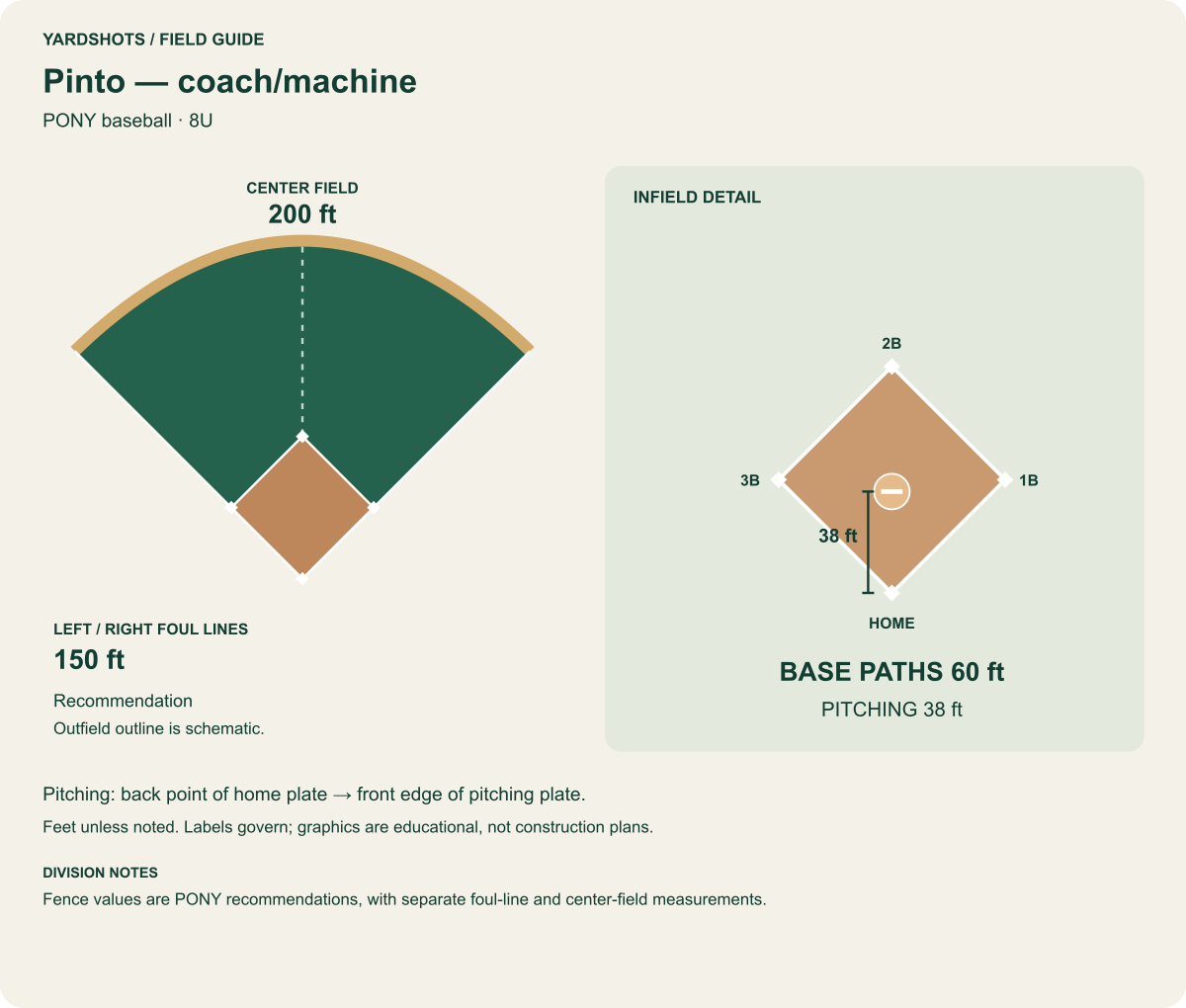
| Pinto — coach/machine | 8U | 60 ft | 38 ft | 150 | 200 | Recommendation |
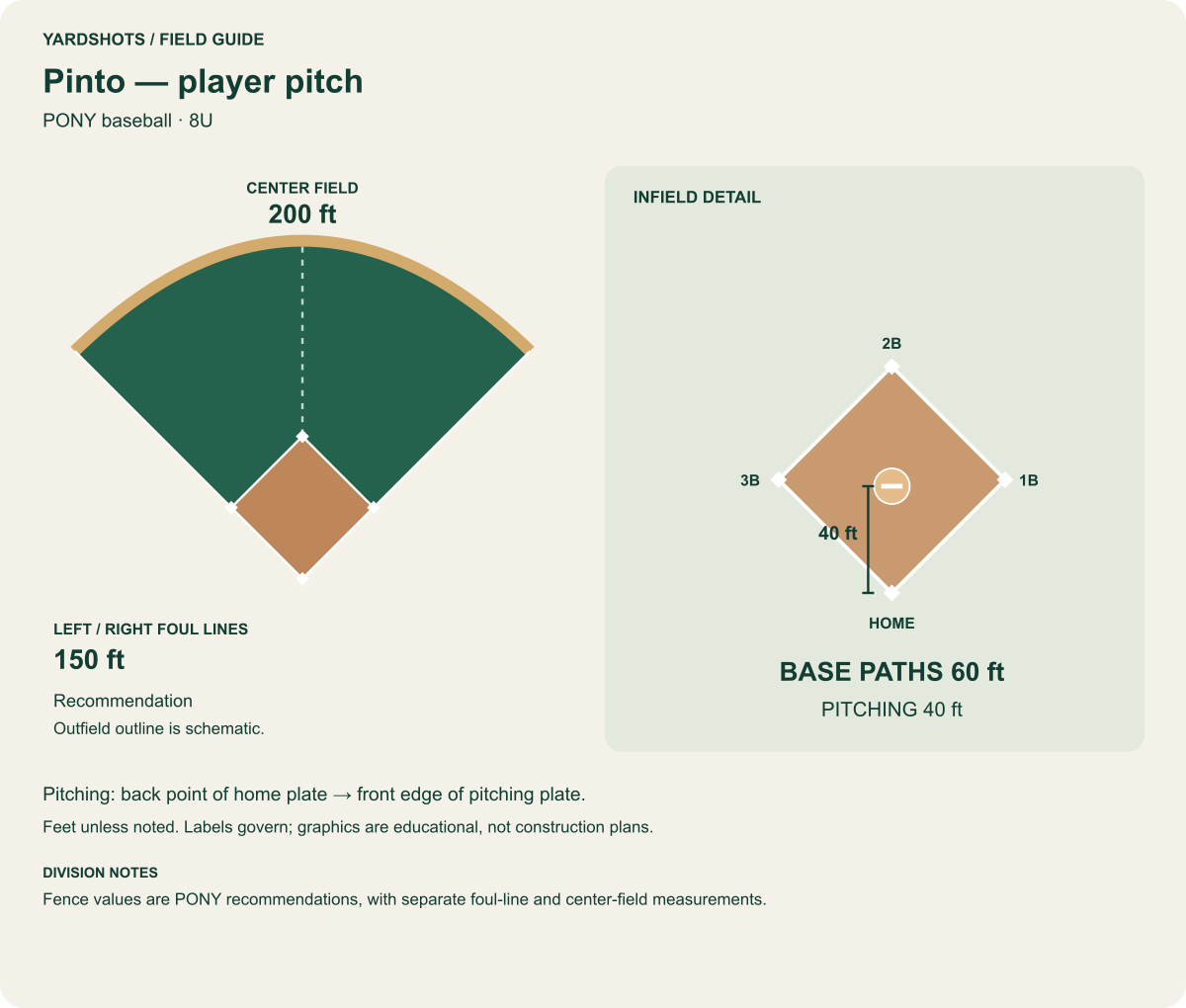
| Pinto — player pitch | 8U | 60 ft | 40 ft | 150 | 200 | Recommendation |
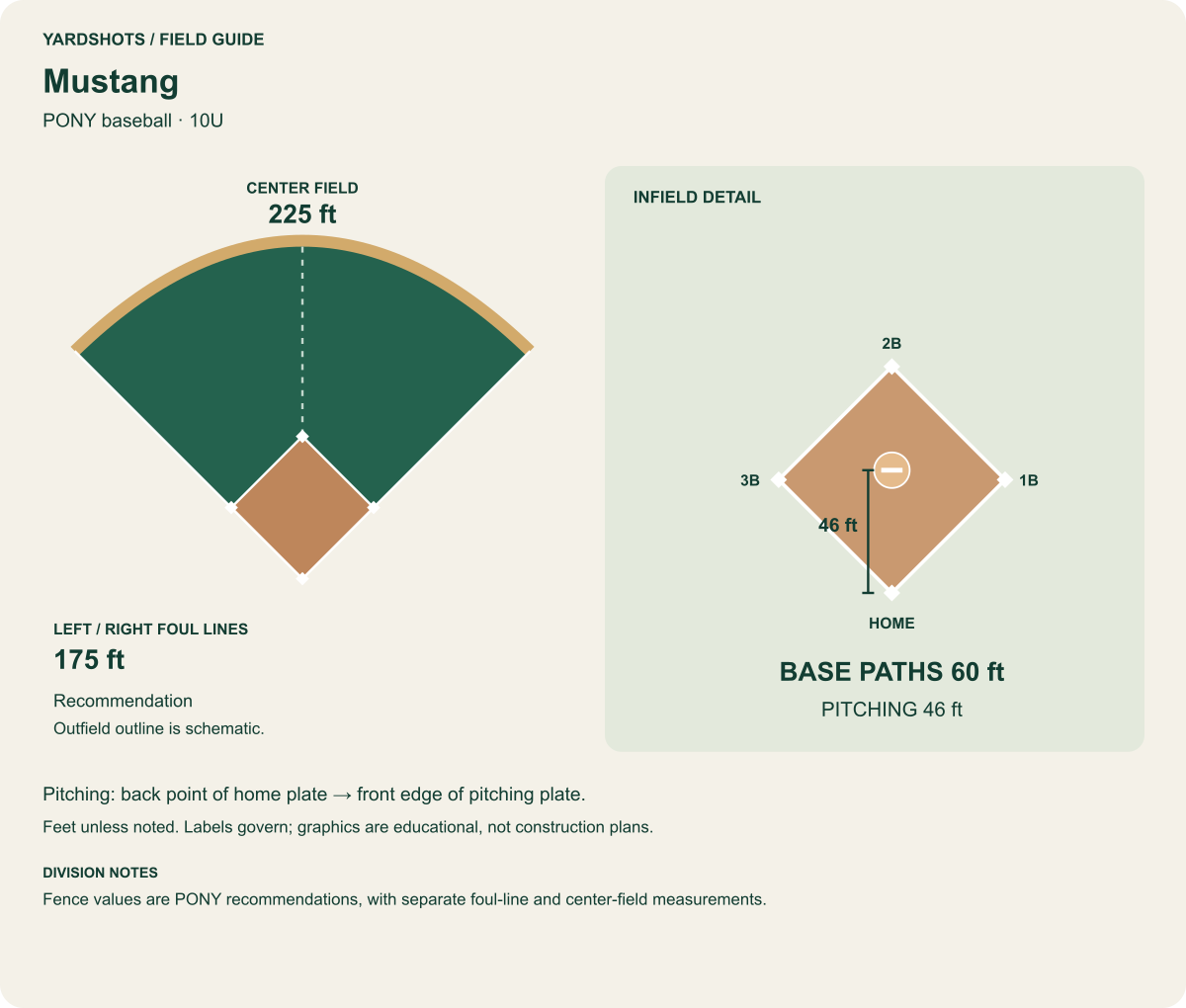
| Mustang | 10U | 60 ft | 46 ft | 175 | 225 | Recommendation |
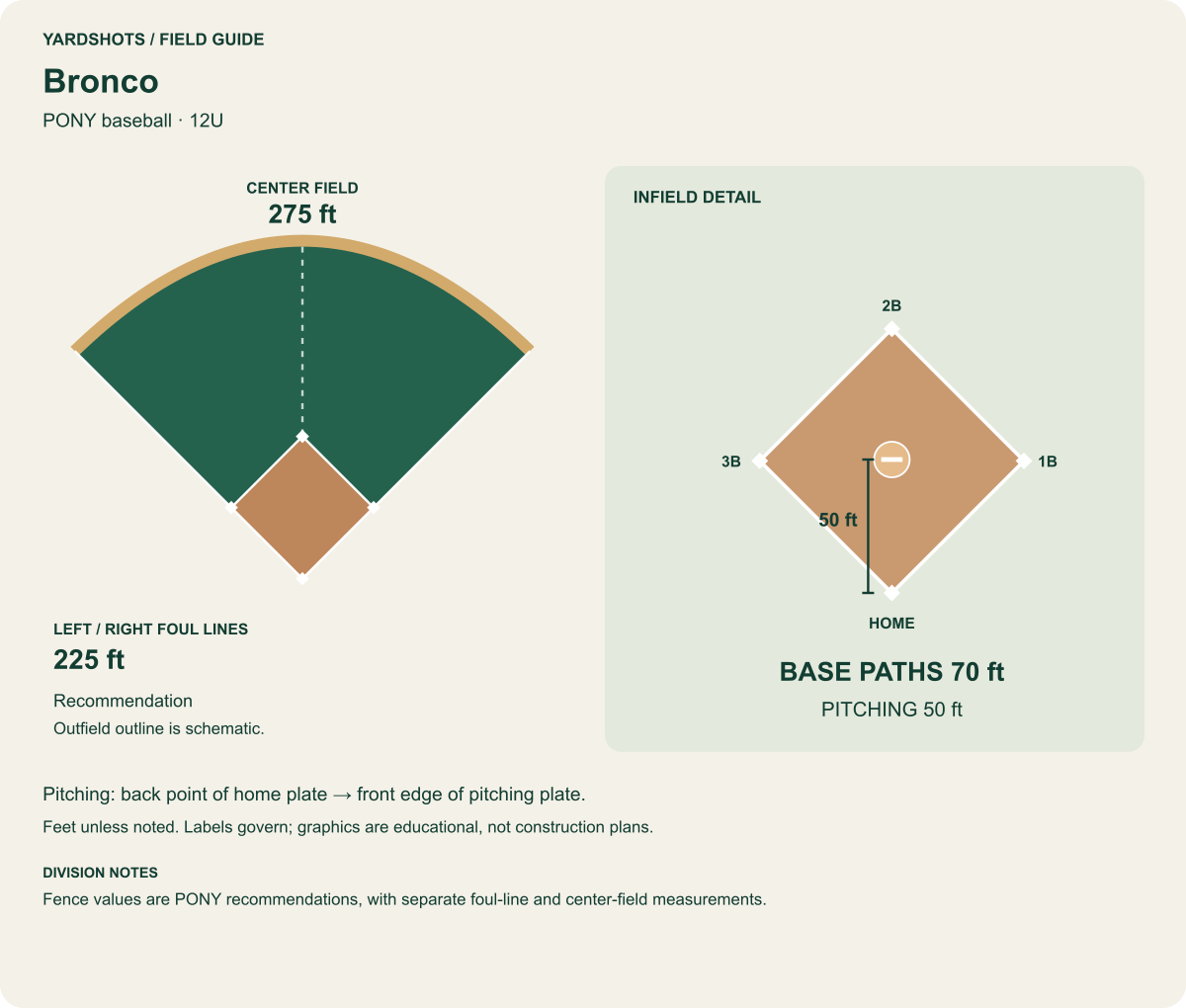
| Bronco | 12U | 70 ft | 50 ft | 225 | 275 | Recommendation |
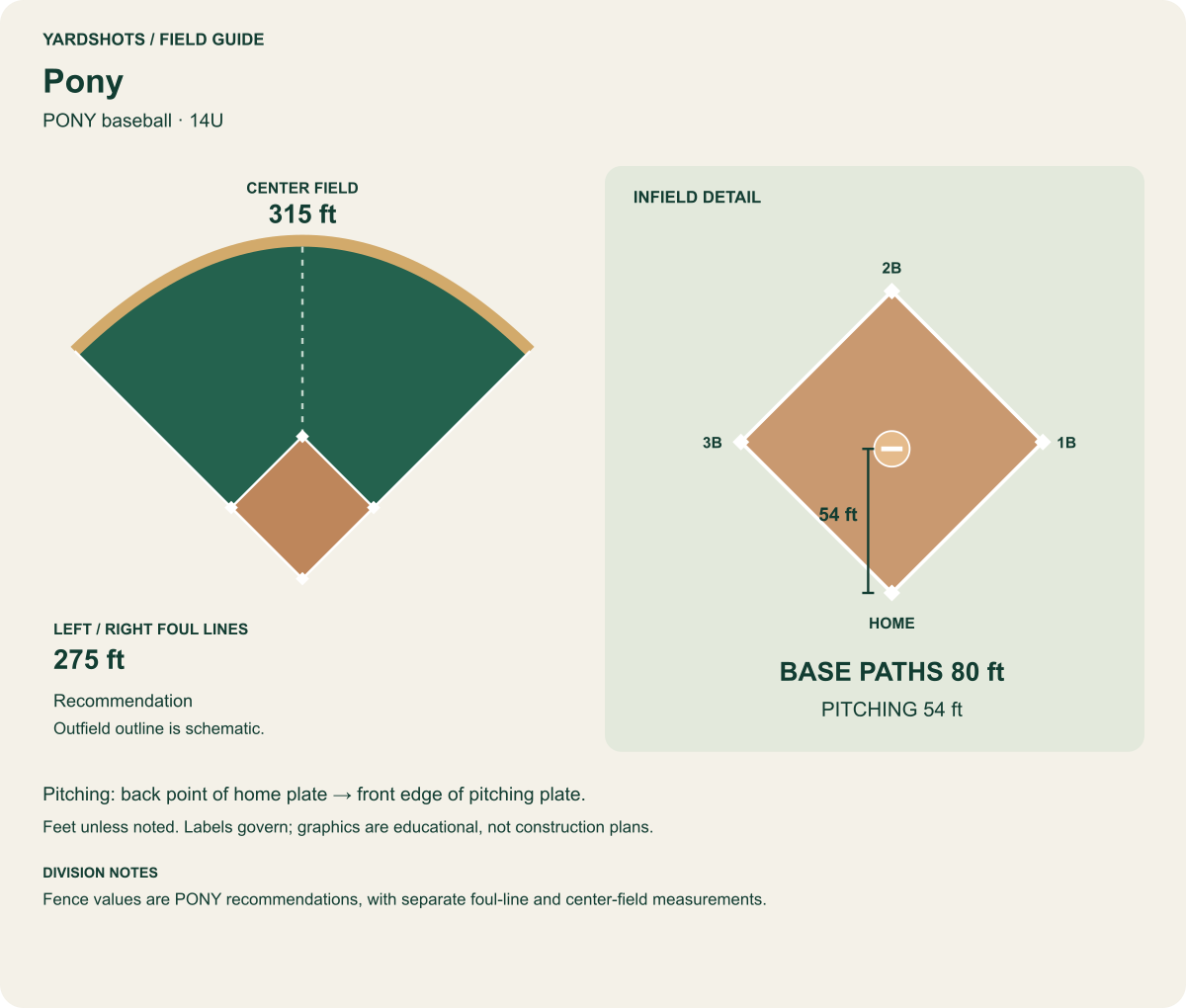
| Pony | 14U | 80 ft | 54 ft | 275 | 315 | Recommendation |
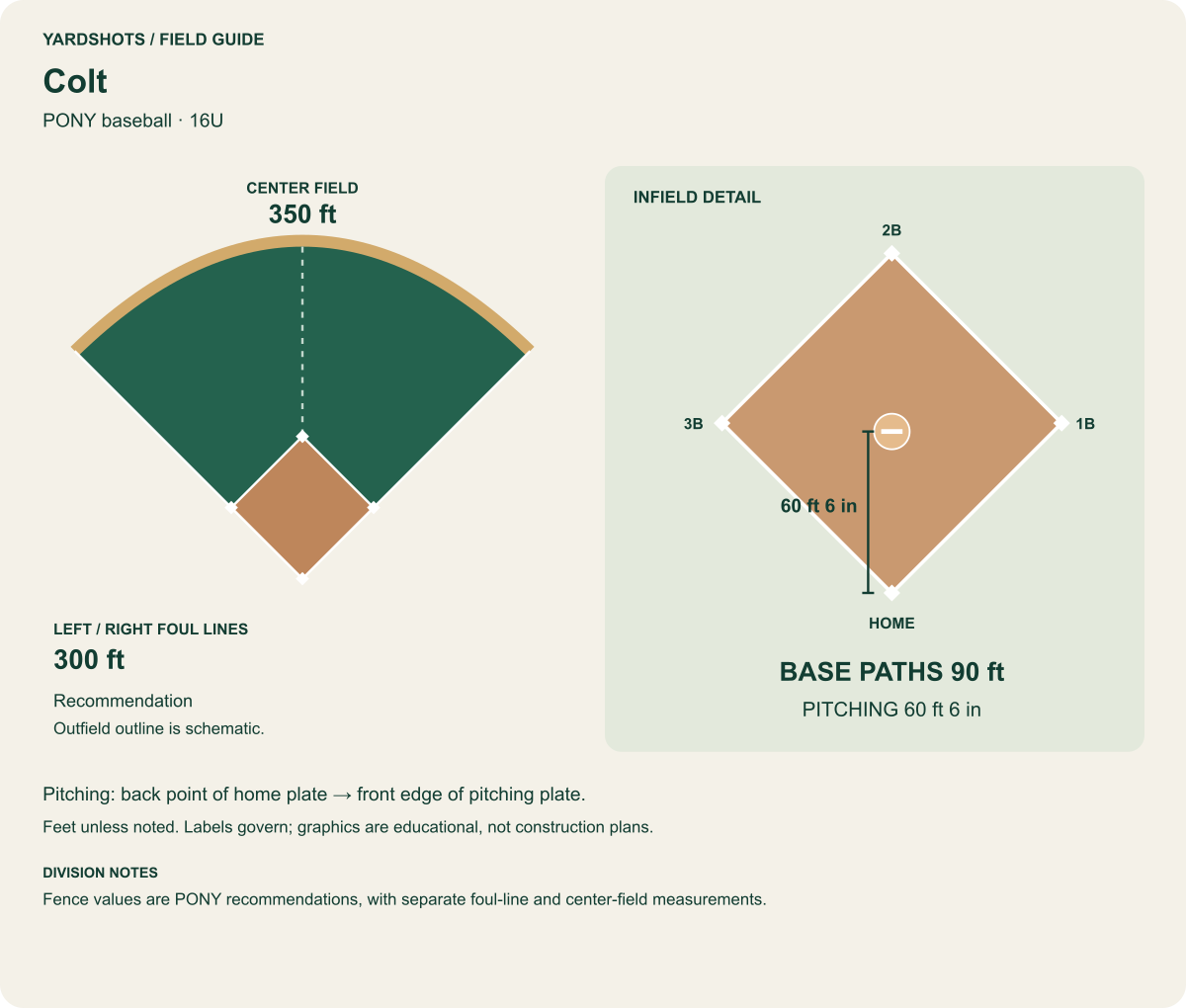
| Colt | 16U | 90 ft | 60 ft 6 in | 300 | 350 | Recommendation |
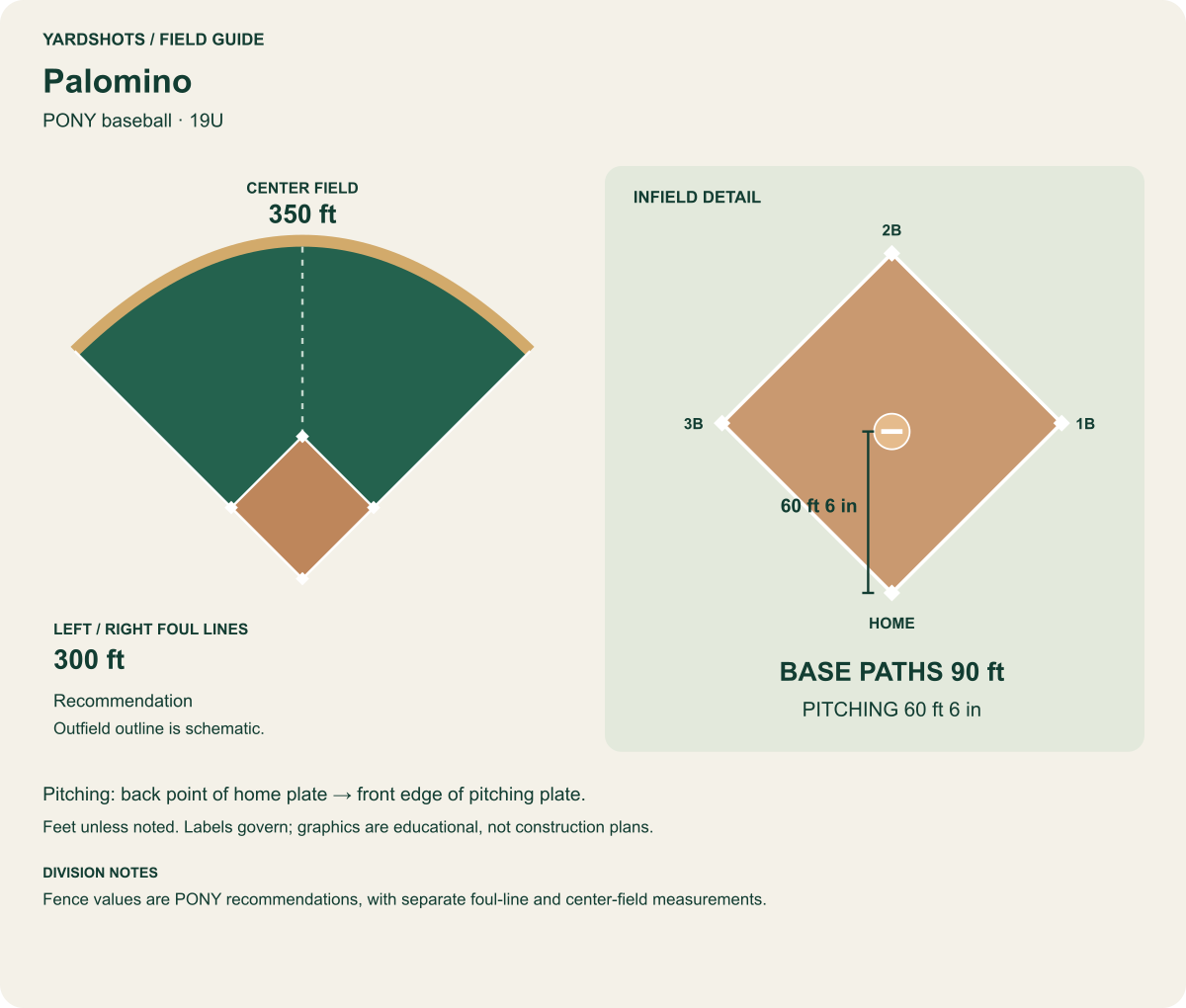
| Palomino | 19U | 90 ft | 60 ft 6 in | 300 | 350 | Recommendation |
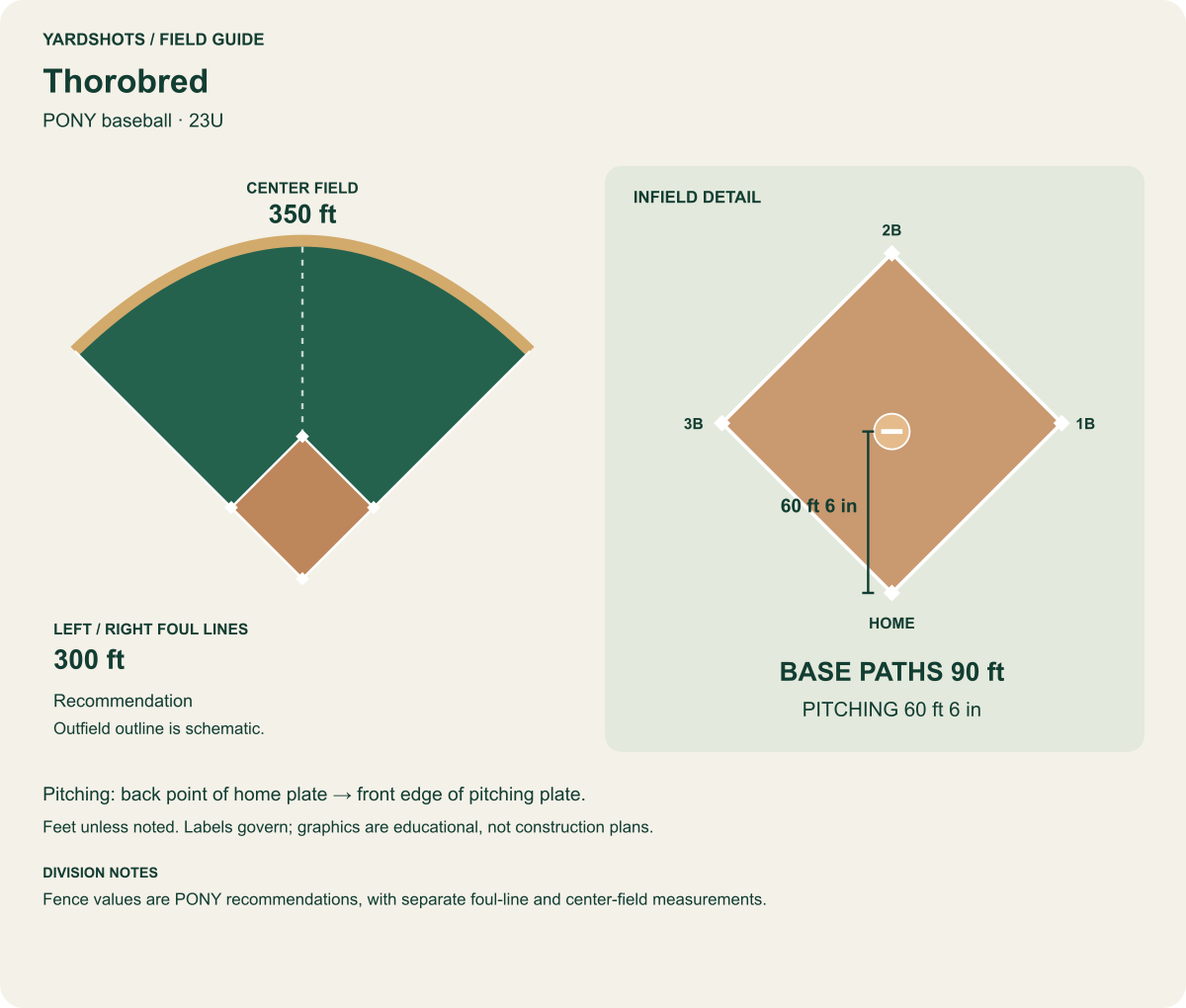
| Thorobred | 23U | 90 ft | 60 ft 6 in | 300 | 350 | Recommendation |
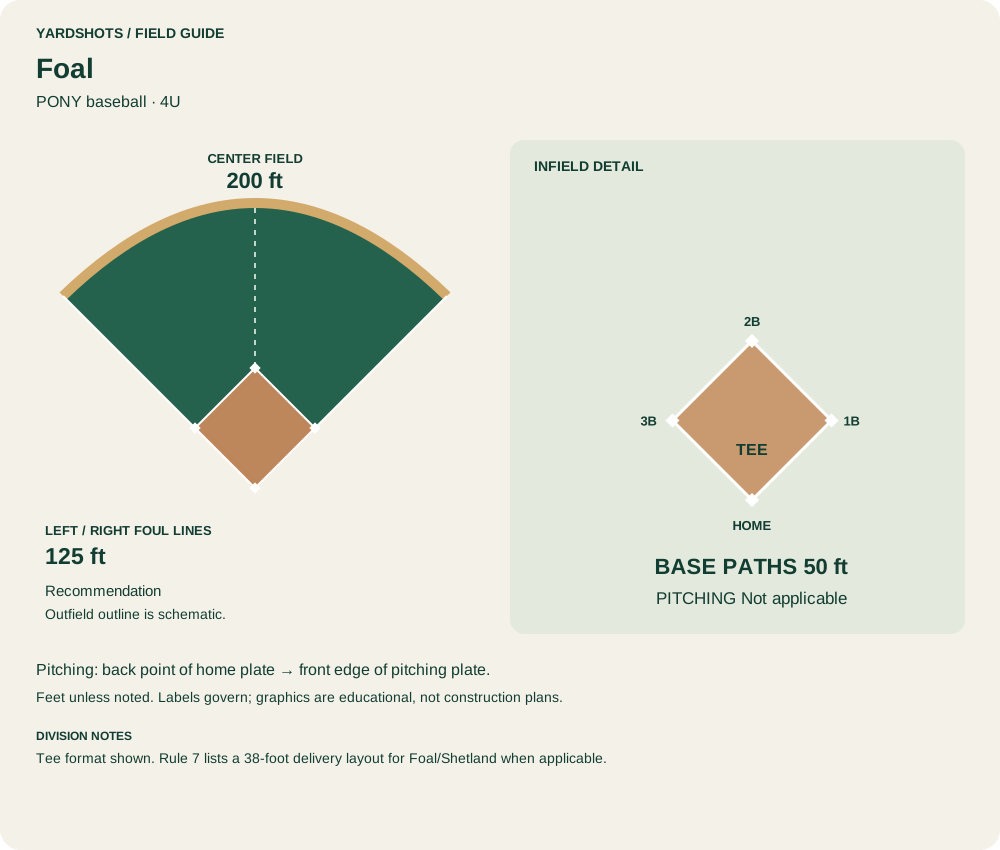
Tee format shown. Rule 7 lists a 38-foot delivery layout for Foal/Shetland when applicable.
2026 PONY Baseball Rulebook, Rule 7 (public copy) · PONY current baseball rulebook hub
Download SVG · Download PNG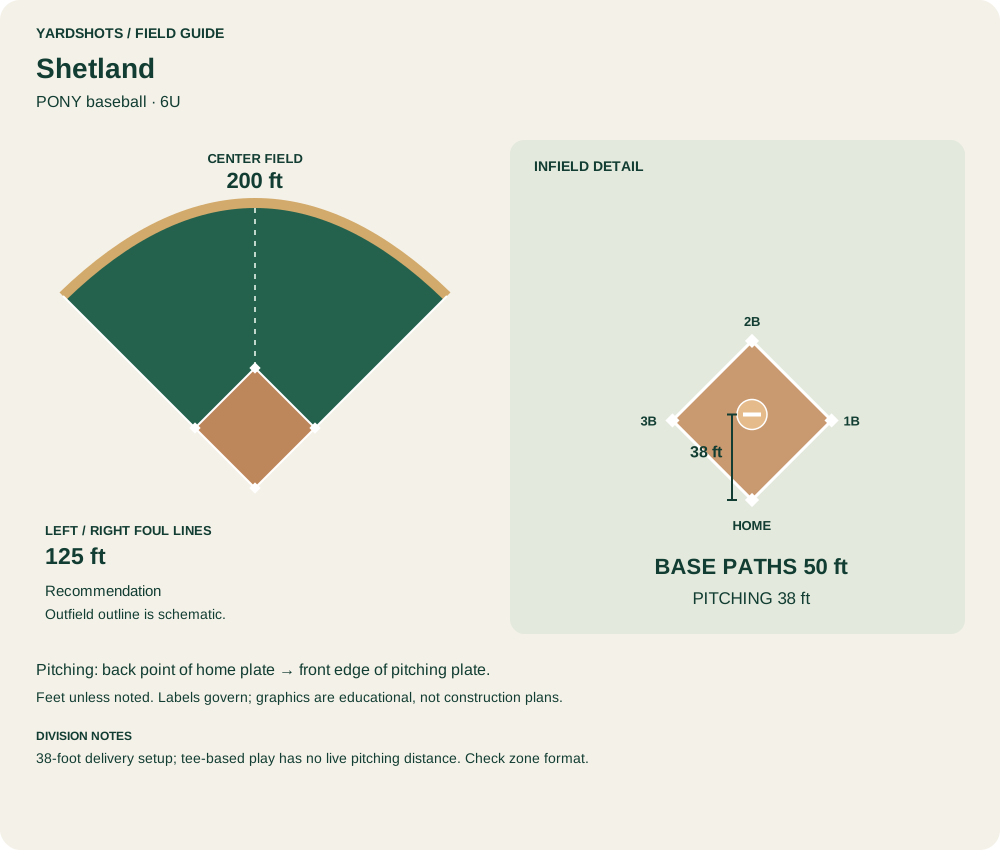
38-foot delivery setup; tee-based play has no live pitching distance. Check zone format.
2026 PONY Baseball Rulebook, Rule 7 (public copy) · PONY current baseball rulebook hub
Download SVG · Download PNG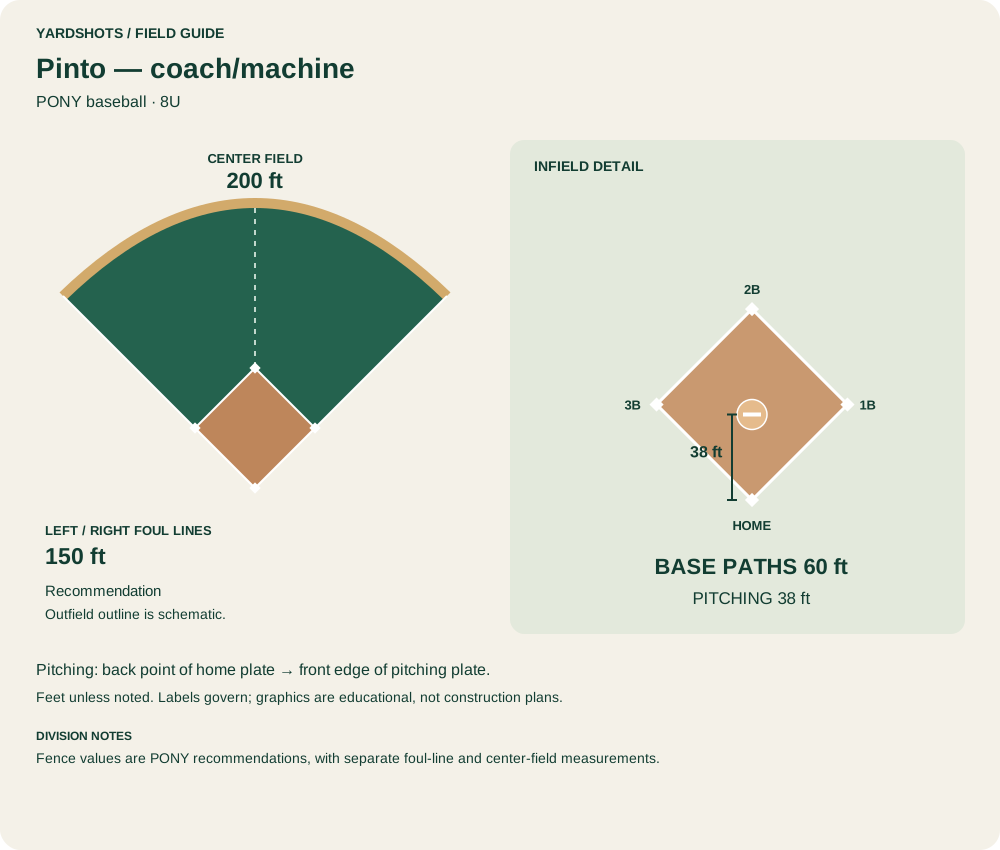
Fence values are PONY recommendations, with separate foul-line and center-field measurements.
2026 PONY Baseball Rulebook, Rule 7 (public copy) · PONY current baseball rulebook hub
Download SVG · Download PNG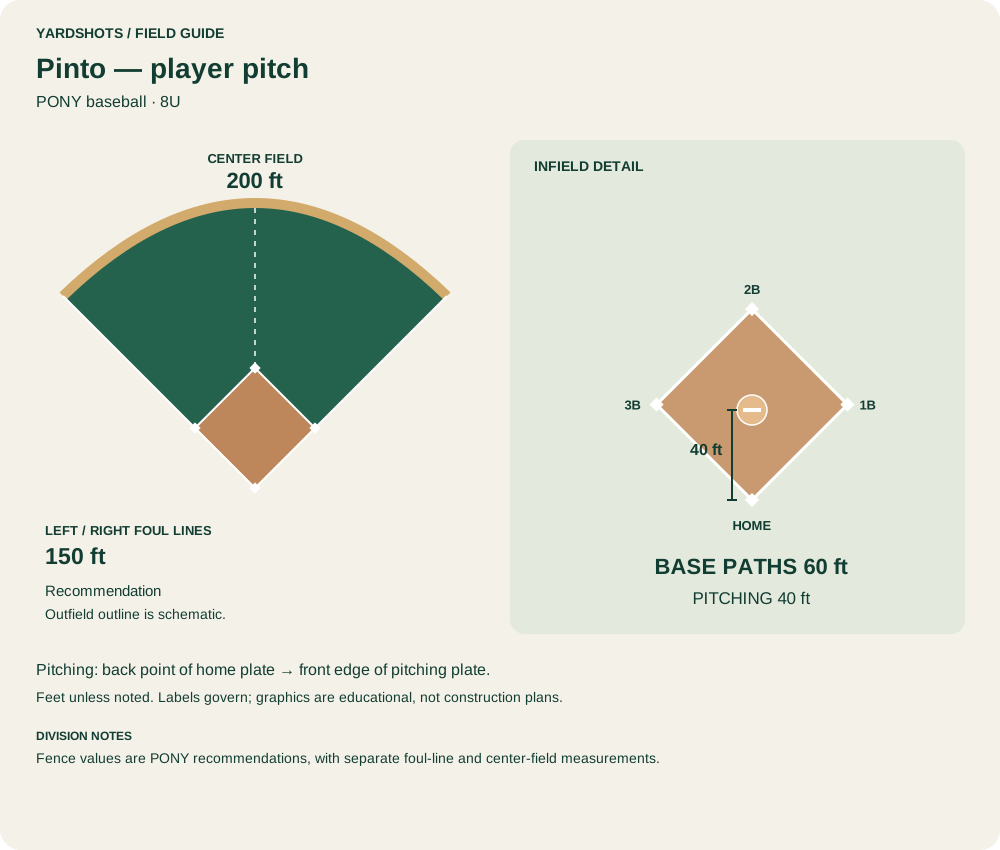
Fence values are PONY recommendations, with separate foul-line and center-field measurements.
2026 PONY Baseball Rulebook, Rule 7 (public copy) · PONY current baseball rulebook hub
Download SVG · Download PNG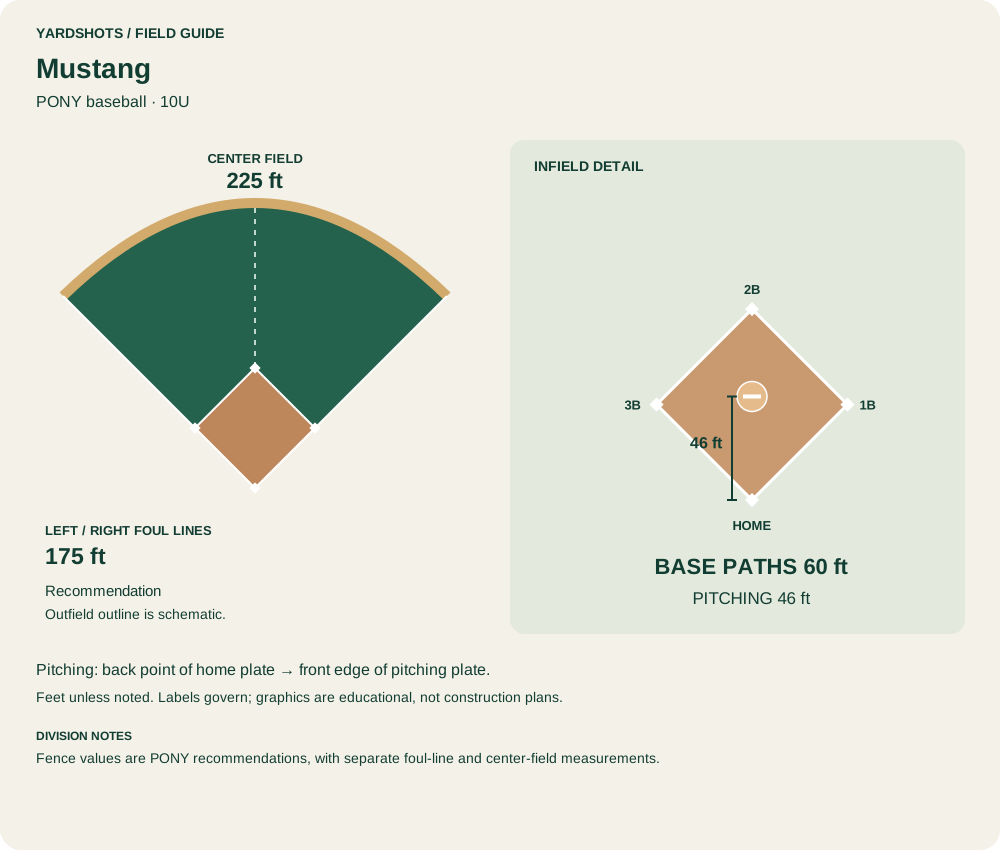
Fence values are PONY recommendations, with separate foul-line and center-field measurements.
2026 PONY Baseball Rulebook, Rule 7 (public copy) · PONY current baseball rulebook hub
Download SVG · Download PNG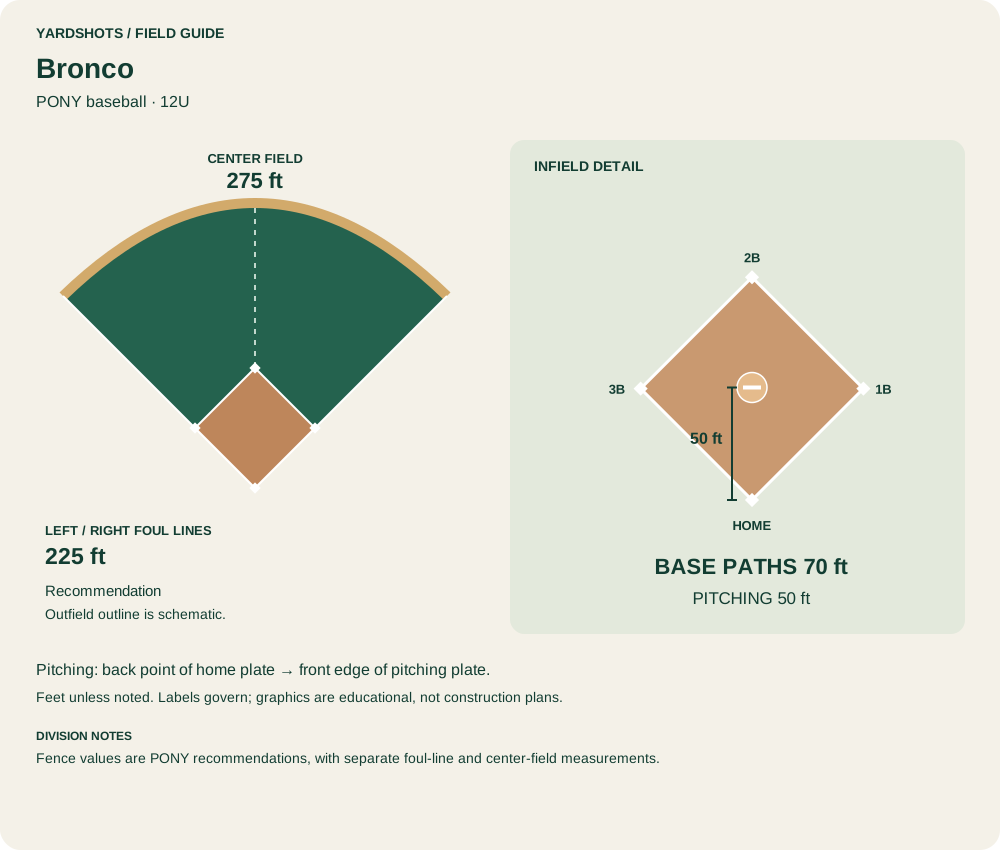
Fence values are PONY recommendations, with separate foul-line and center-field measurements.
2026 PONY Baseball Rulebook, Rule 7 (public copy) · PONY current baseball rulebook hub
Download SVG · Download PNG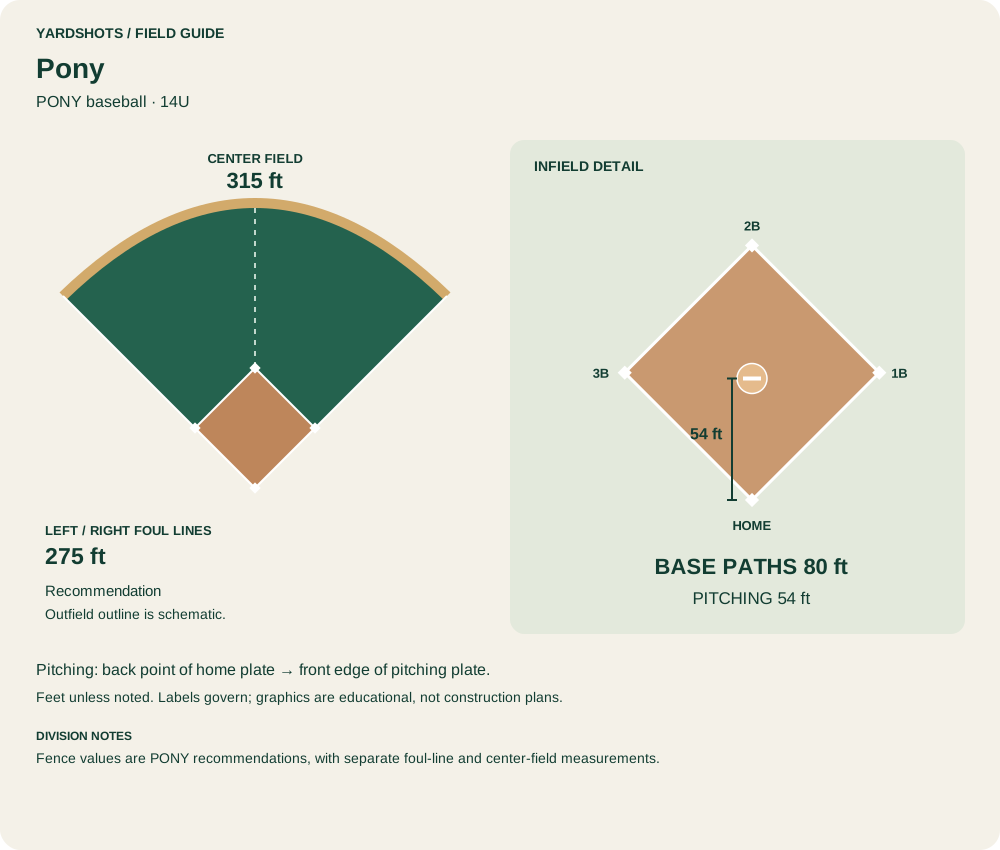
Fence values are PONY recommendations, with separate foul-line and center-field measurements.
2026 PONY Baseball Rulebook, Rule 7 (public copy) · PONY current baseball rulebook hub
Download SVG · Download PNG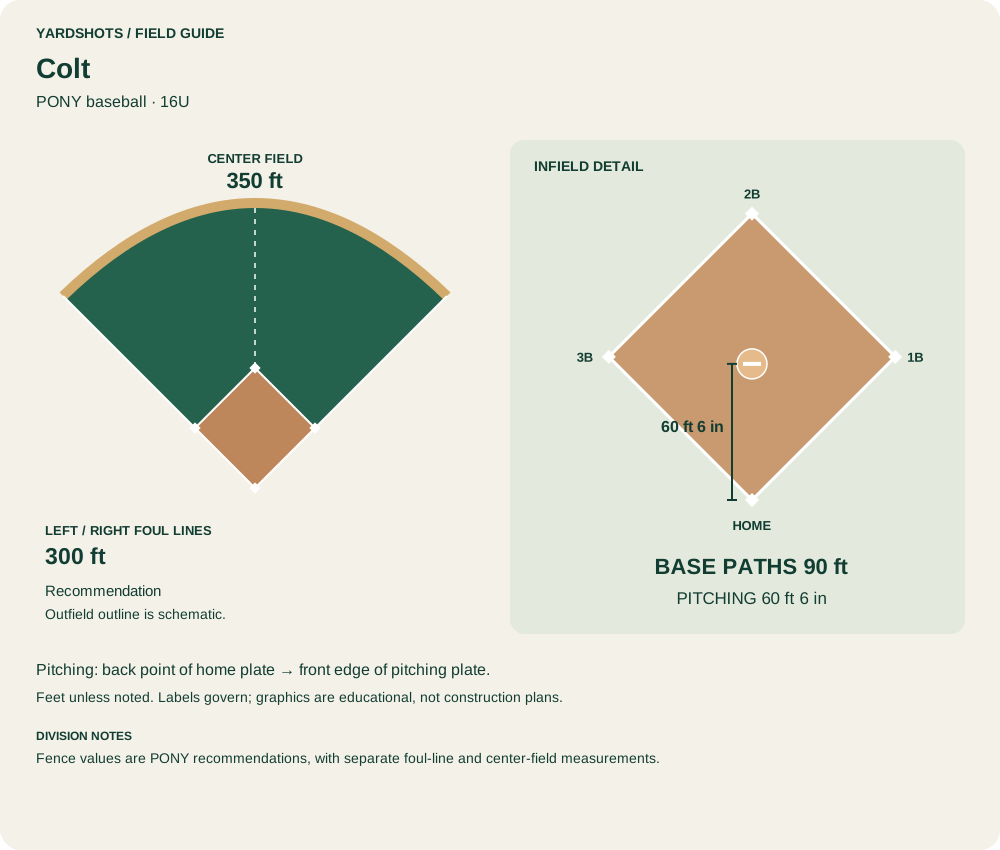
Fence values are PONY recommendations, with separate foul-line and center-field measurements.
2026 PONY Baseball Rulebook, Rule 7 (public copy) · PONY current baseball rulebook hub
Download SVG · Download PNG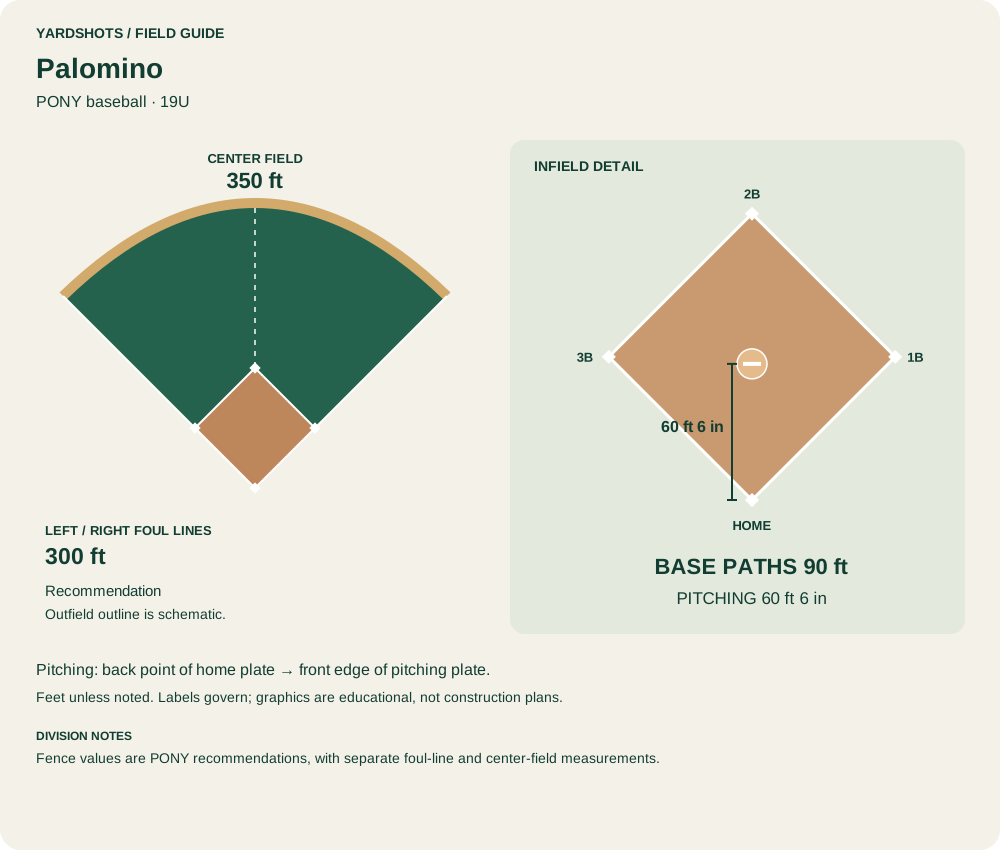
Fence values are PONY recommendations, with separate foul-line and center-field measurements.
2026 PONY Baseball Rulebook, Rule 7 (public copy) · PONY current baseball rulebook hub
Download SVG · Download PNG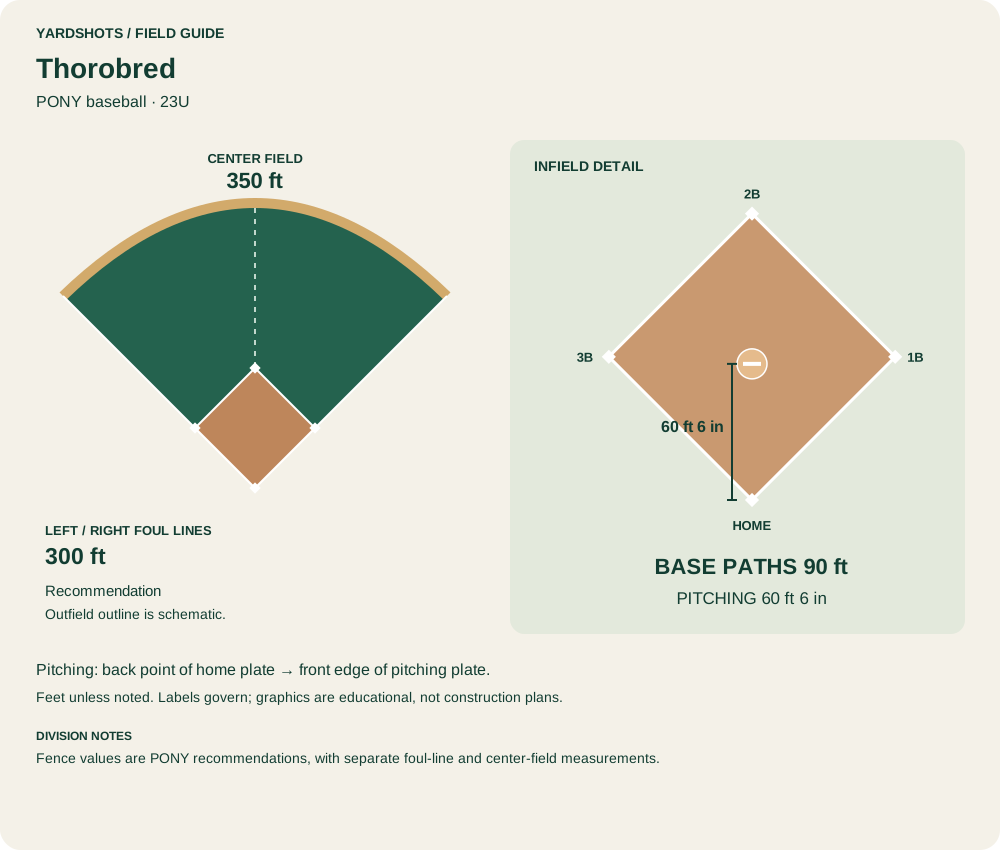
Fence values are PONY recommendations, with separate foul-line and center-field measurements.
2026 PONY Baseball Rulebook, Rule 7 (public copy) · PONY current baseball rulebook hub
Download SVG · Download PNG| Division | Age / level | Bases | Pitching | Foul lines | Center | Fence status |
|---|---|---|---|---|---|---|
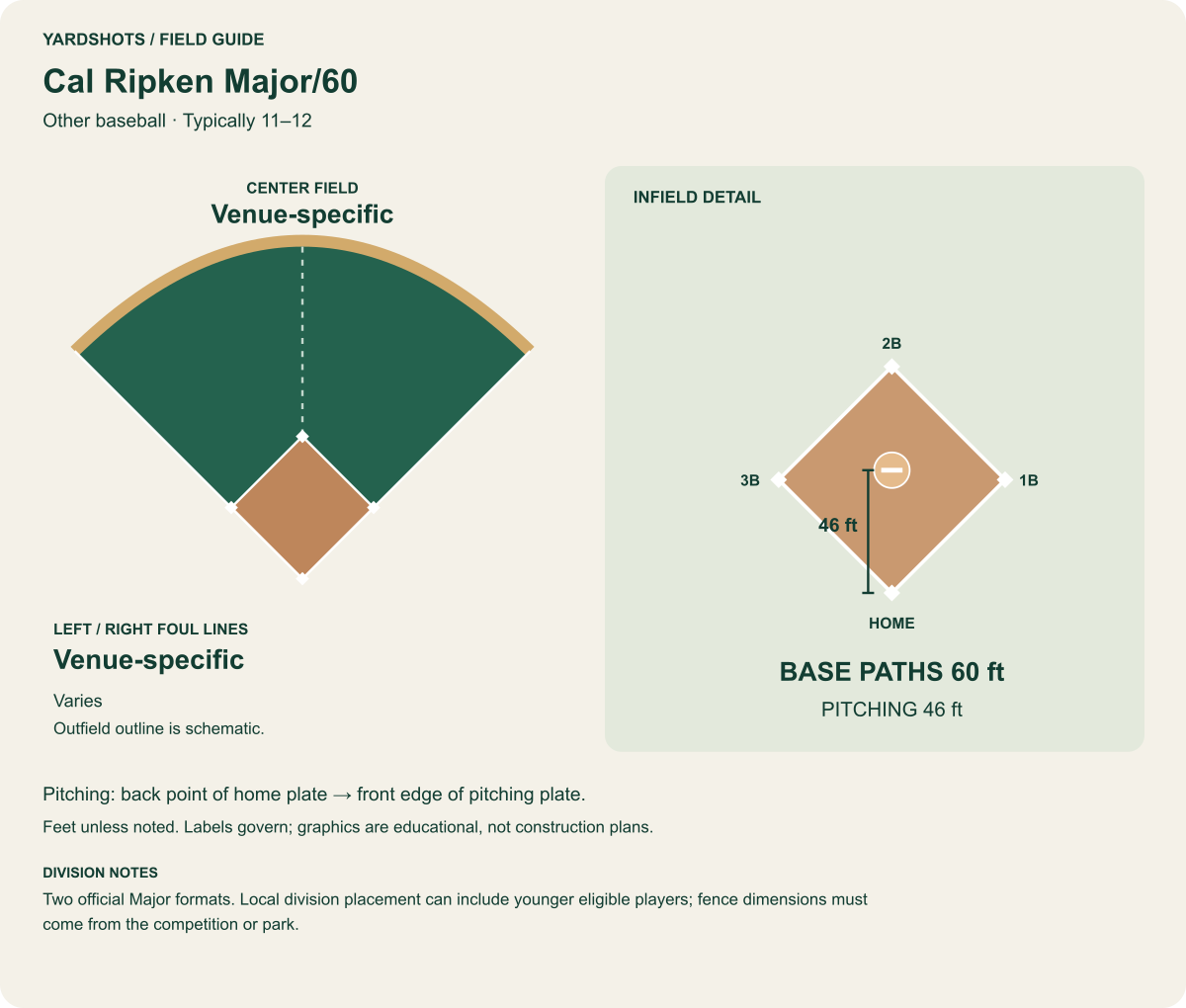
| Cal Ripken Major/60 | Typically 11–12 | 60 ft | 46 ft | Venue-specific | Venue-specific | Varies |
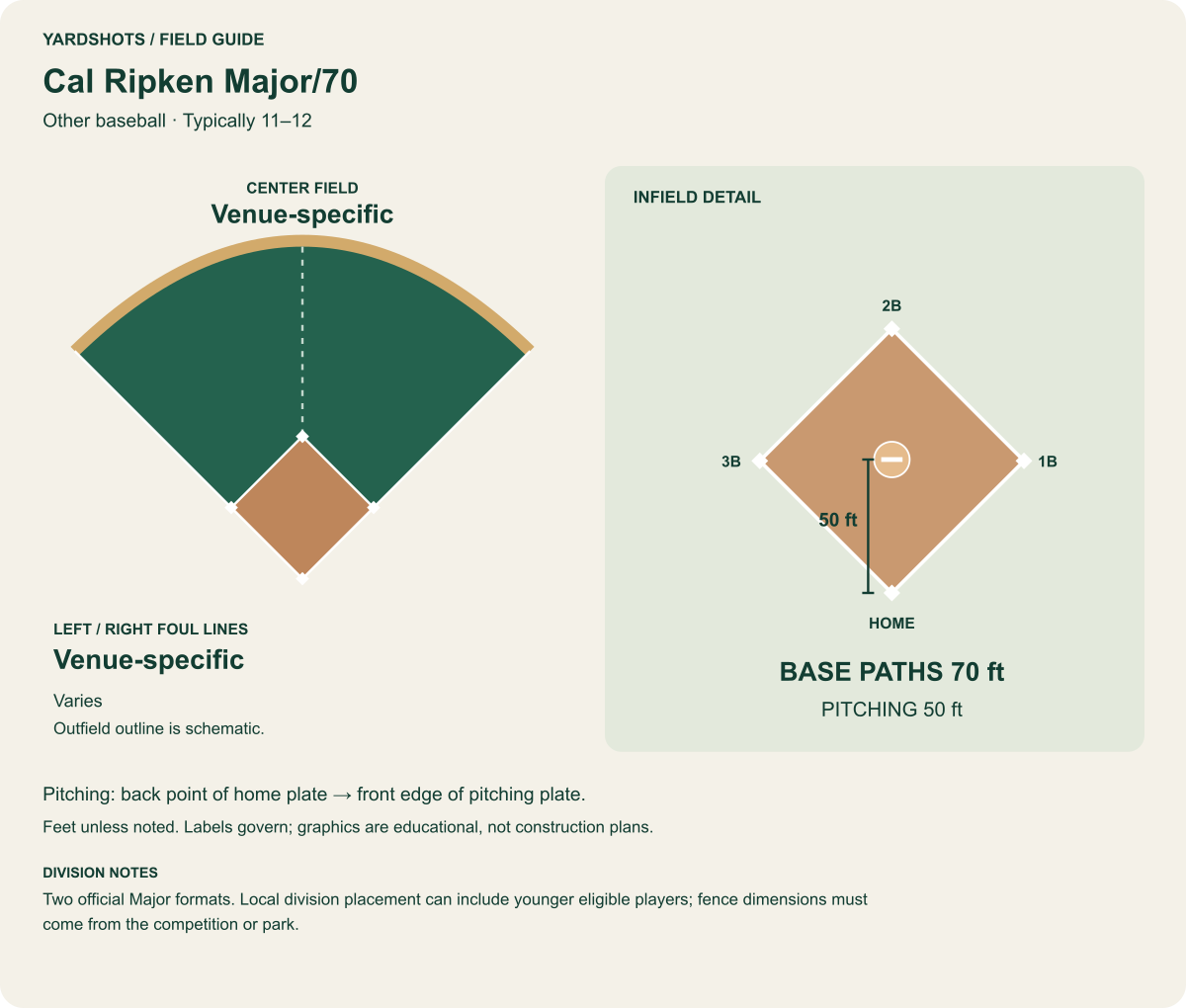
| Cal Ripken Major/70 | Typically 11–12 | 70 ft | 50 ft | Venue-specific | Venue-specific | Varies |
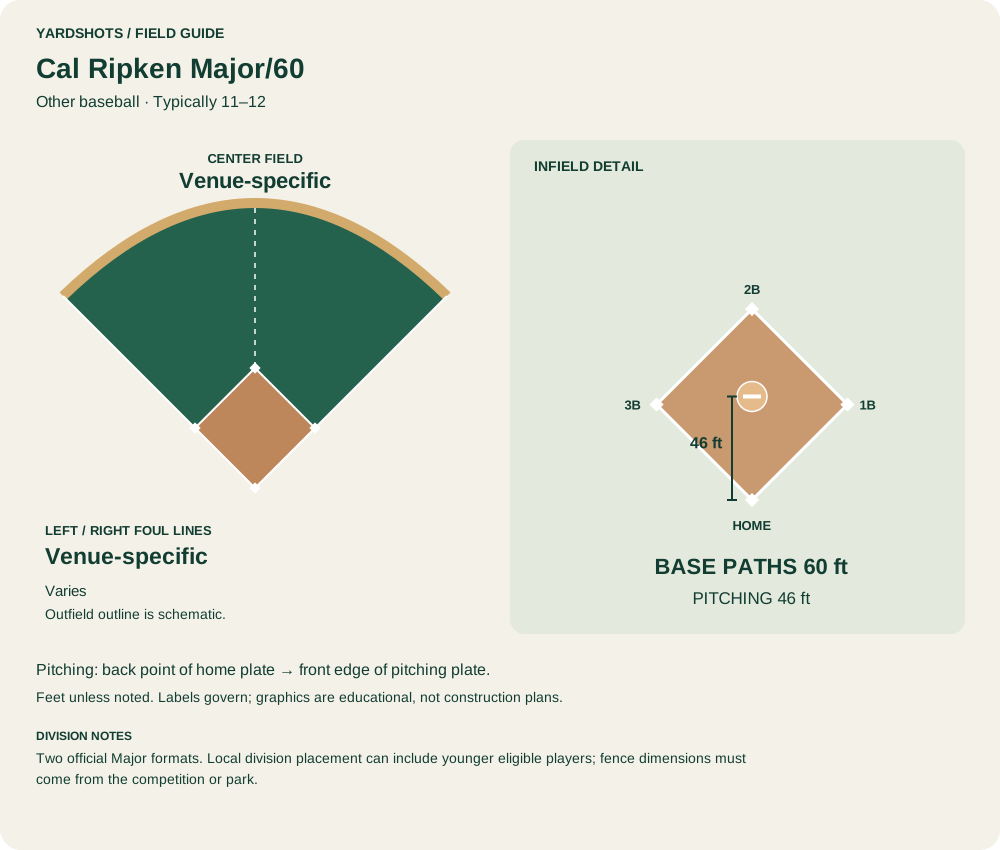
Two official Major formats. Local division placement can include younger eligible players; fence dimensions must come from the competition or park.
Download SVG · Download PNG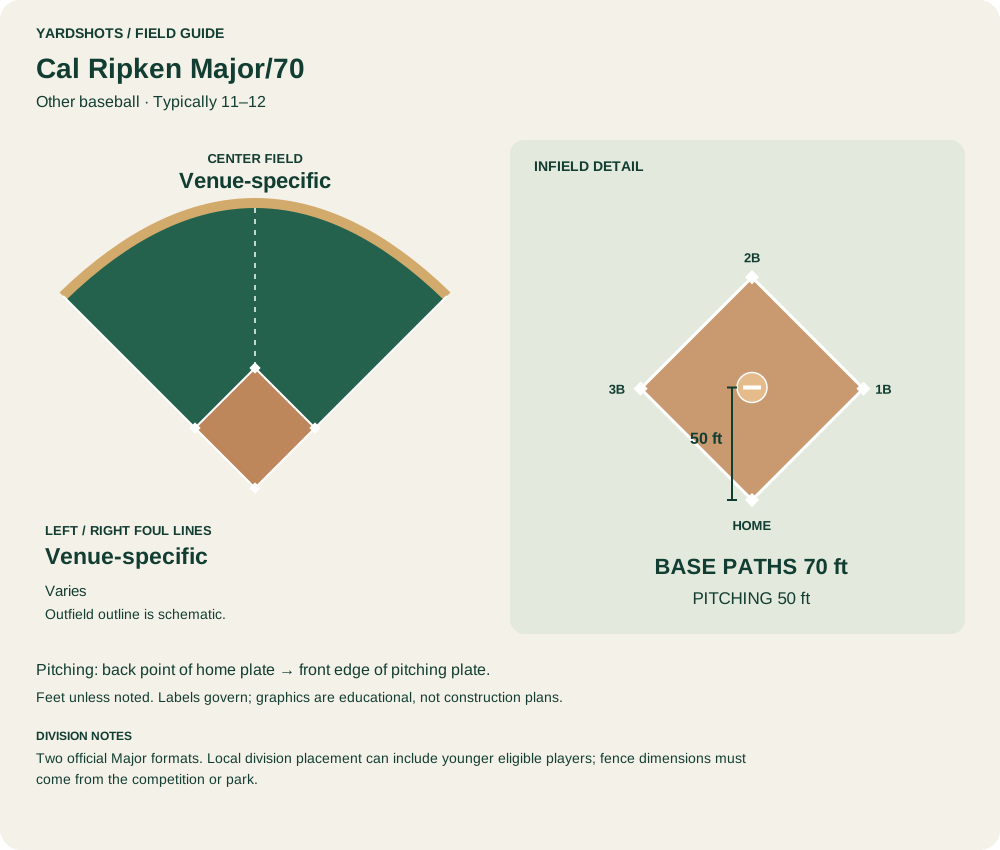
Two official Major formats. Local division placement can include younger eligible players; fence dimensions must come from the competition or park.
Download SVG · Download PNG| Division | Age / level | Bases | Pitching | Foul lines | Center | Fence status |
|---|---|---|---|---|---|---|
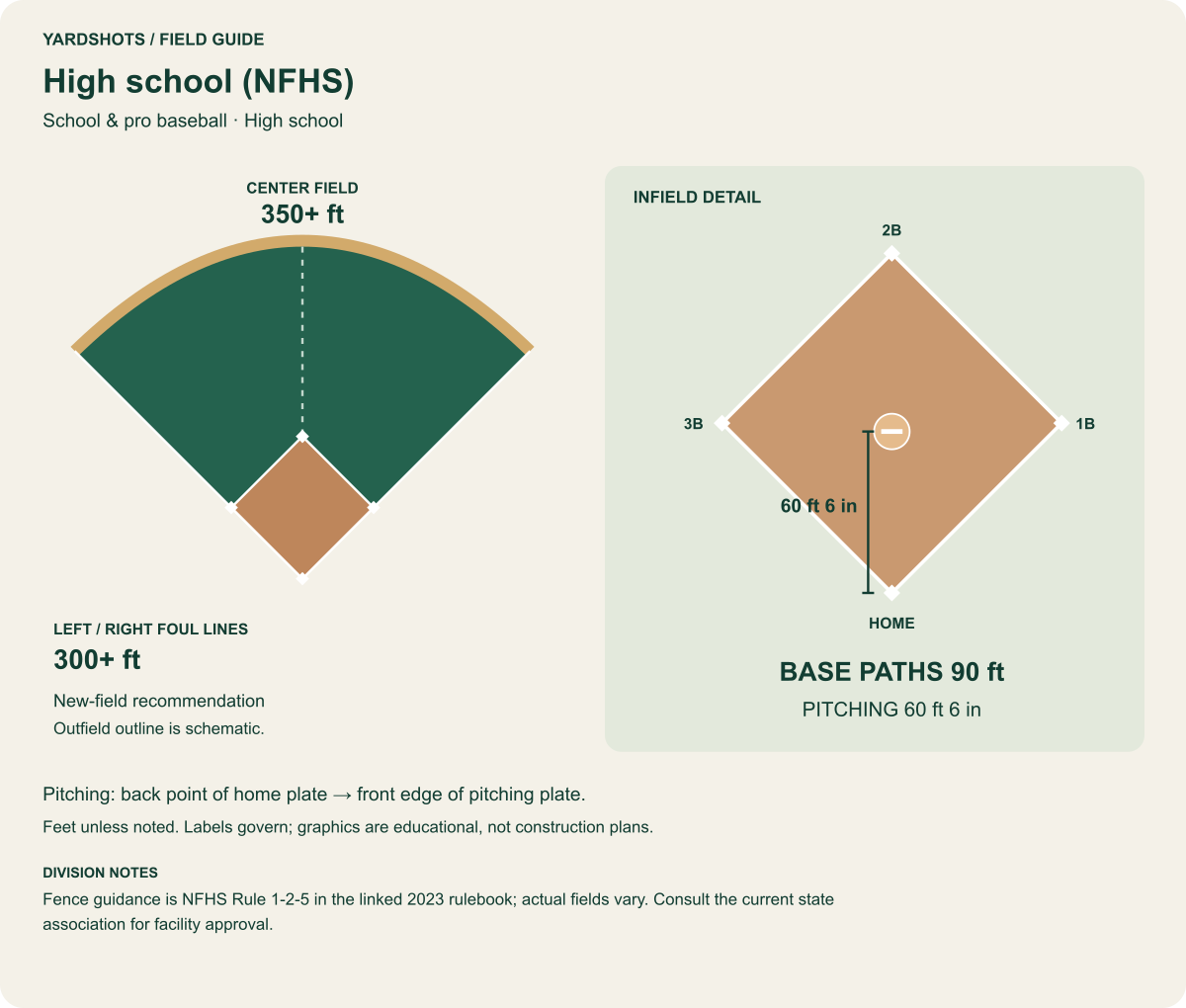
| High school (NFHS) | High school | 90 ft | 60 ft 6 in | 300+ | 350+ | New-field recommendation |
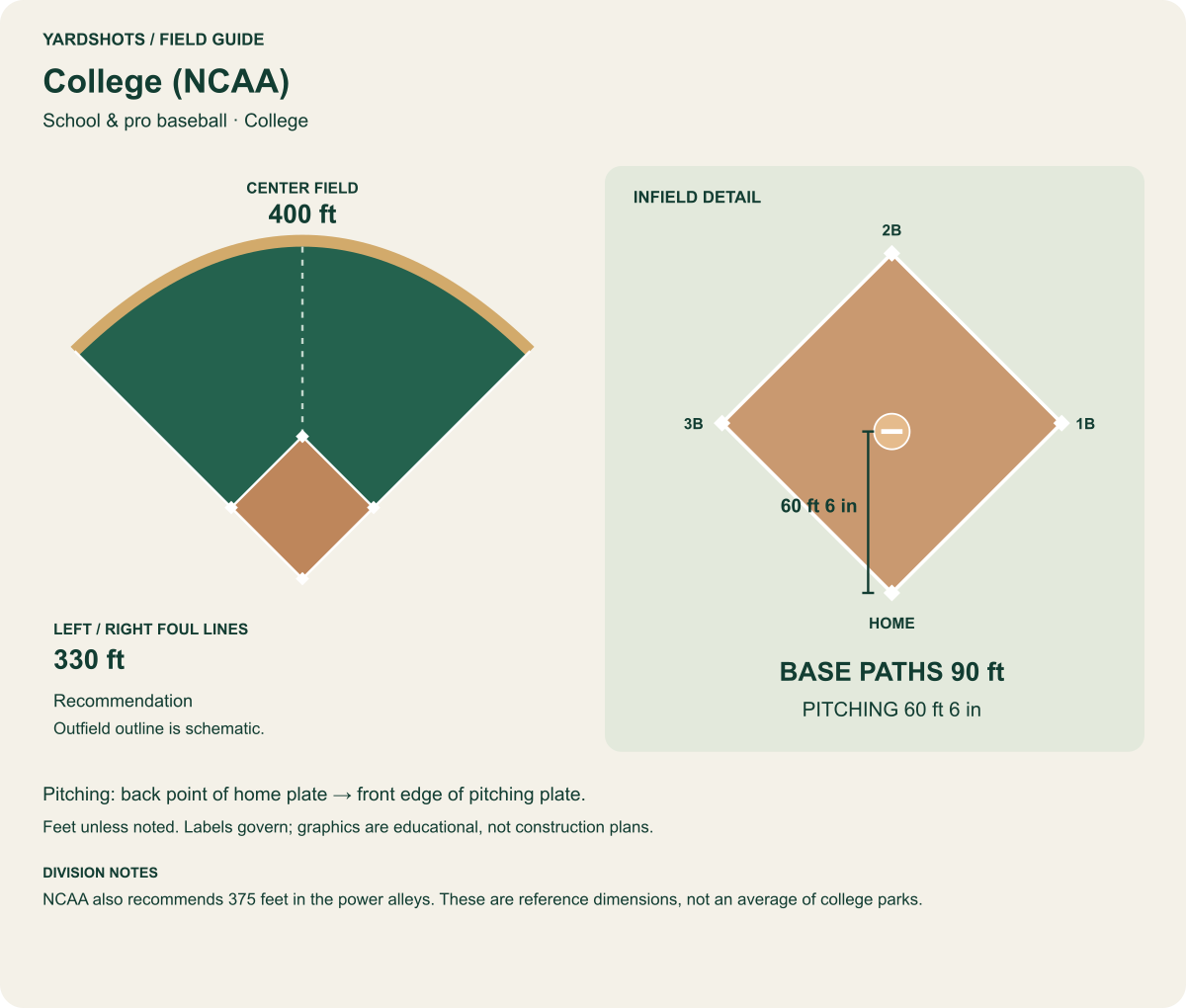
| College (NCAA) | College | 90 ft | 60 ft 6 in | 330 | 400 | Recommendation |
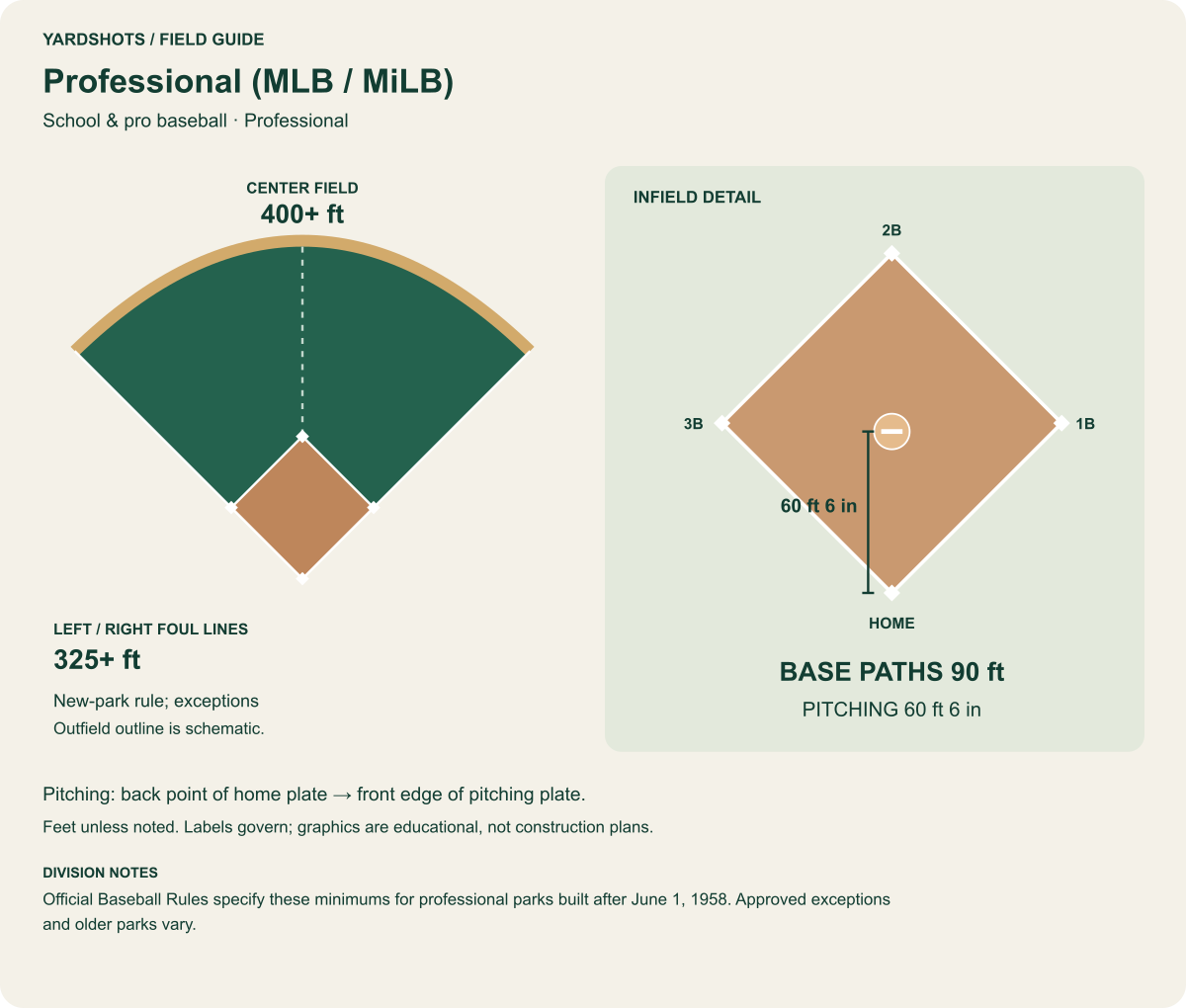
| Professional (MLB / MiLB) | Professional | 90 ft | 60 ft 6 in | 325+ | 400+ | New-park rule; exceptions |
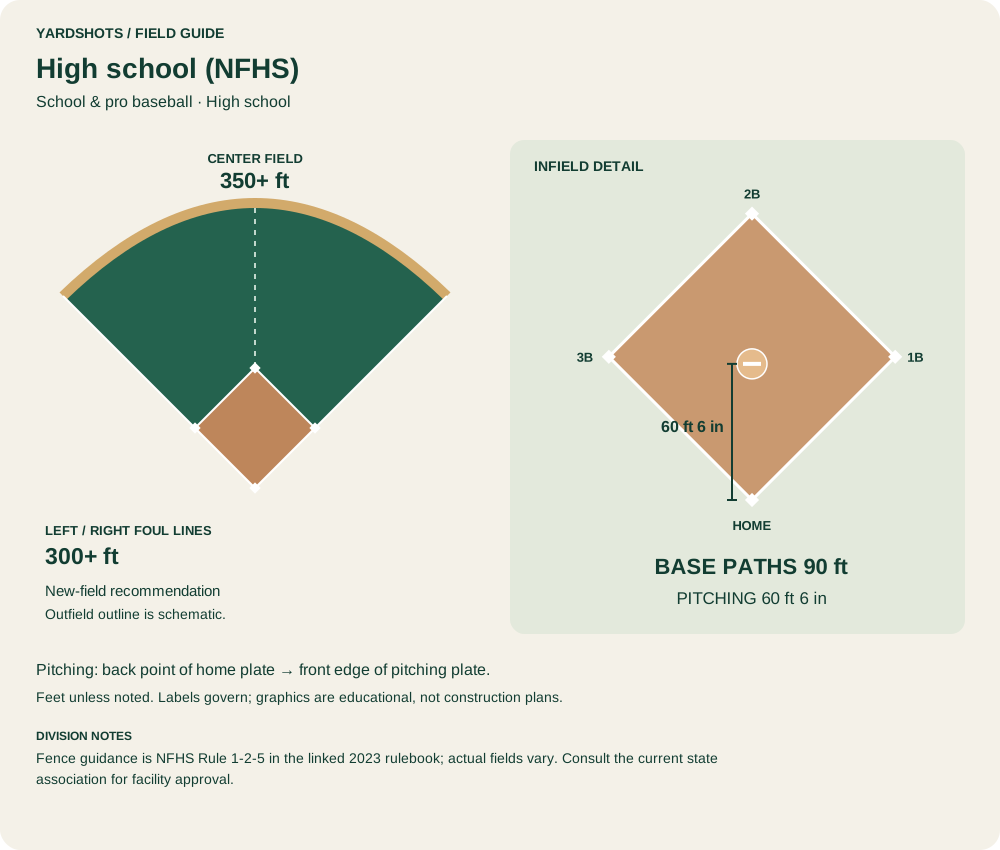
Fence guidance is NFHS Rule 1-2-5 in the linked 2023 rulebook; actual fields vary. Consult the current state association for facility approval.
NFHS baseball field diagram · NFHS baseball Rule 1-2-5, 2023 public copy
Download SVG · Download PNG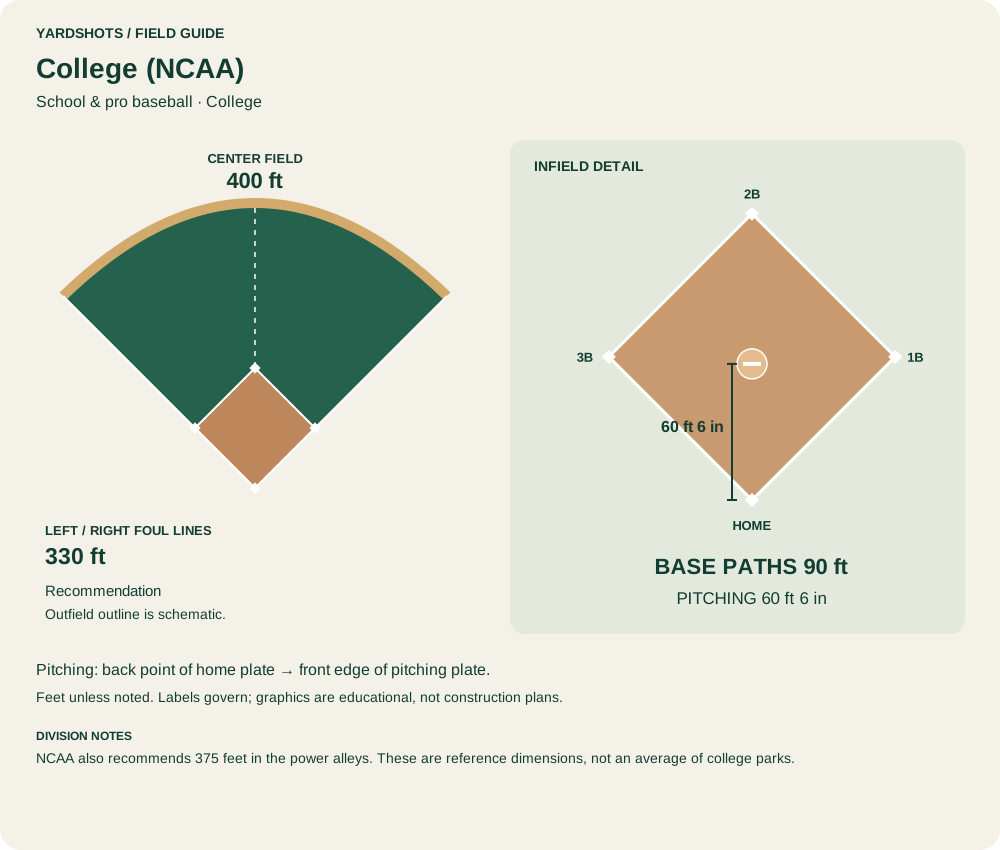
NCAA also recommends 375 feet in the power alleys. These are reference dimensions, not an average of college parks.
NCAA baseball rules, 2025–26, Rule 1
Download SVG · Download PNG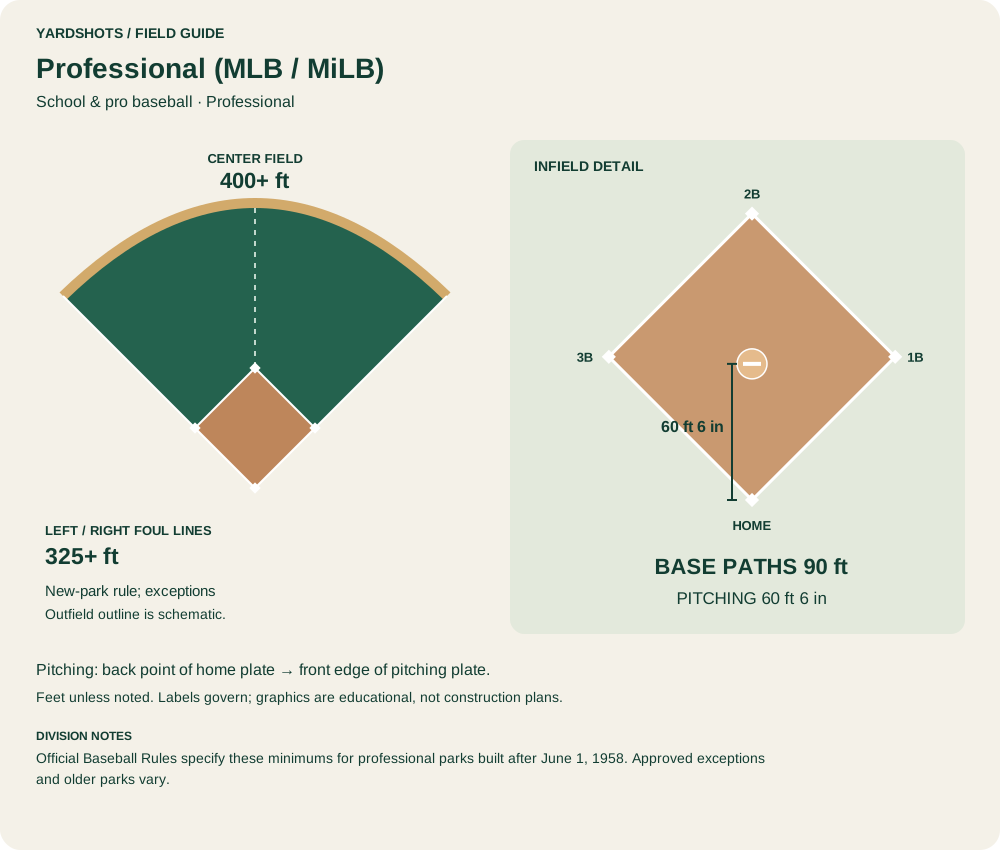
Official Baseball Rules specify these minimums for professional parks built after June 1, 1958. Approved exceptions and older parks vary.
Official Baseball Rules, 2026, Rule 2.01
Download SVG · Download PNG| Division | Age / level | Bases | Pitching | Foul lines | Center | Fence status |
|---|---|---|---|---|---|---|
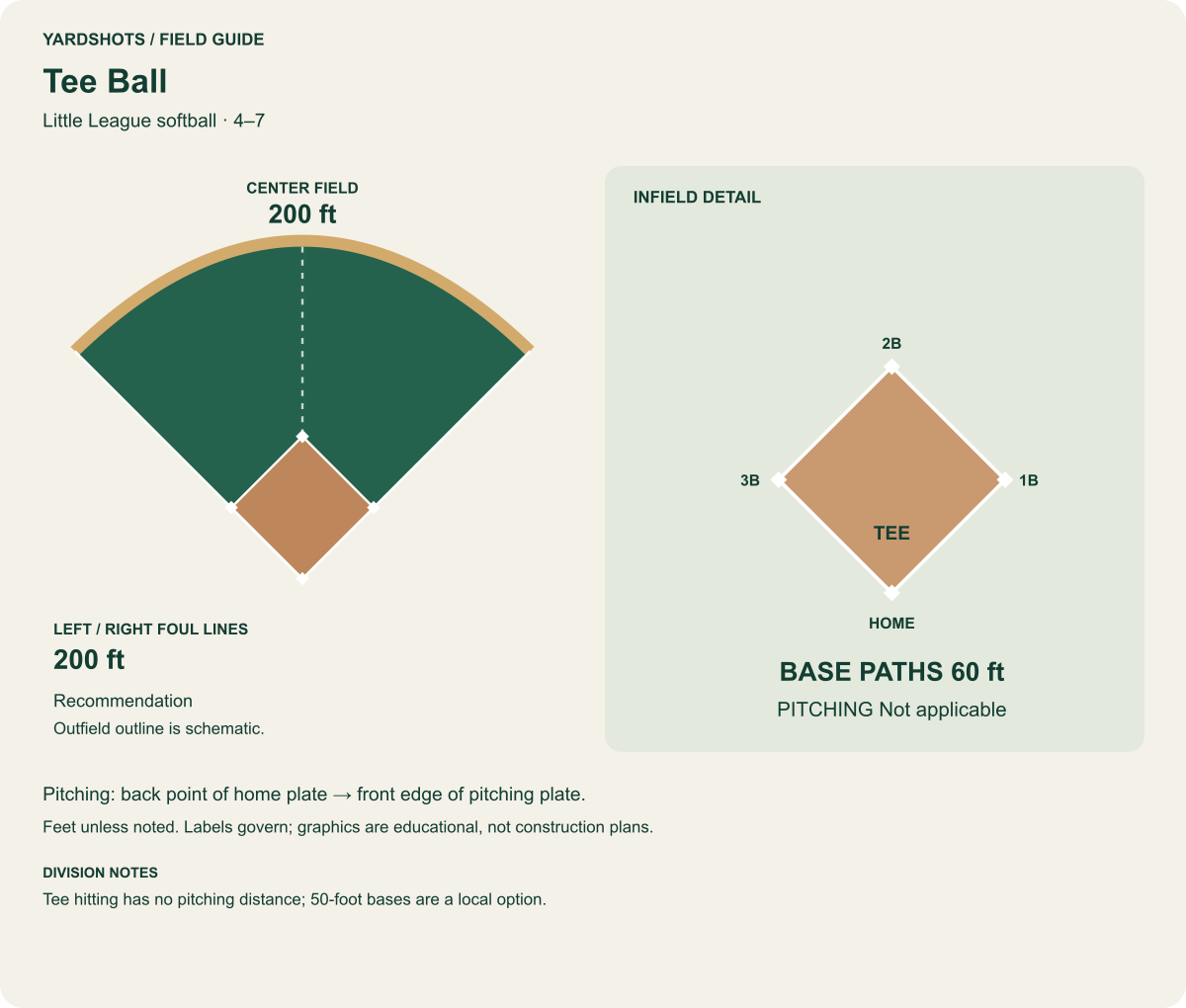
| Tee Ball | 4–7 | 60 ft | Not applicable | 200 | 200 | Recommendation |
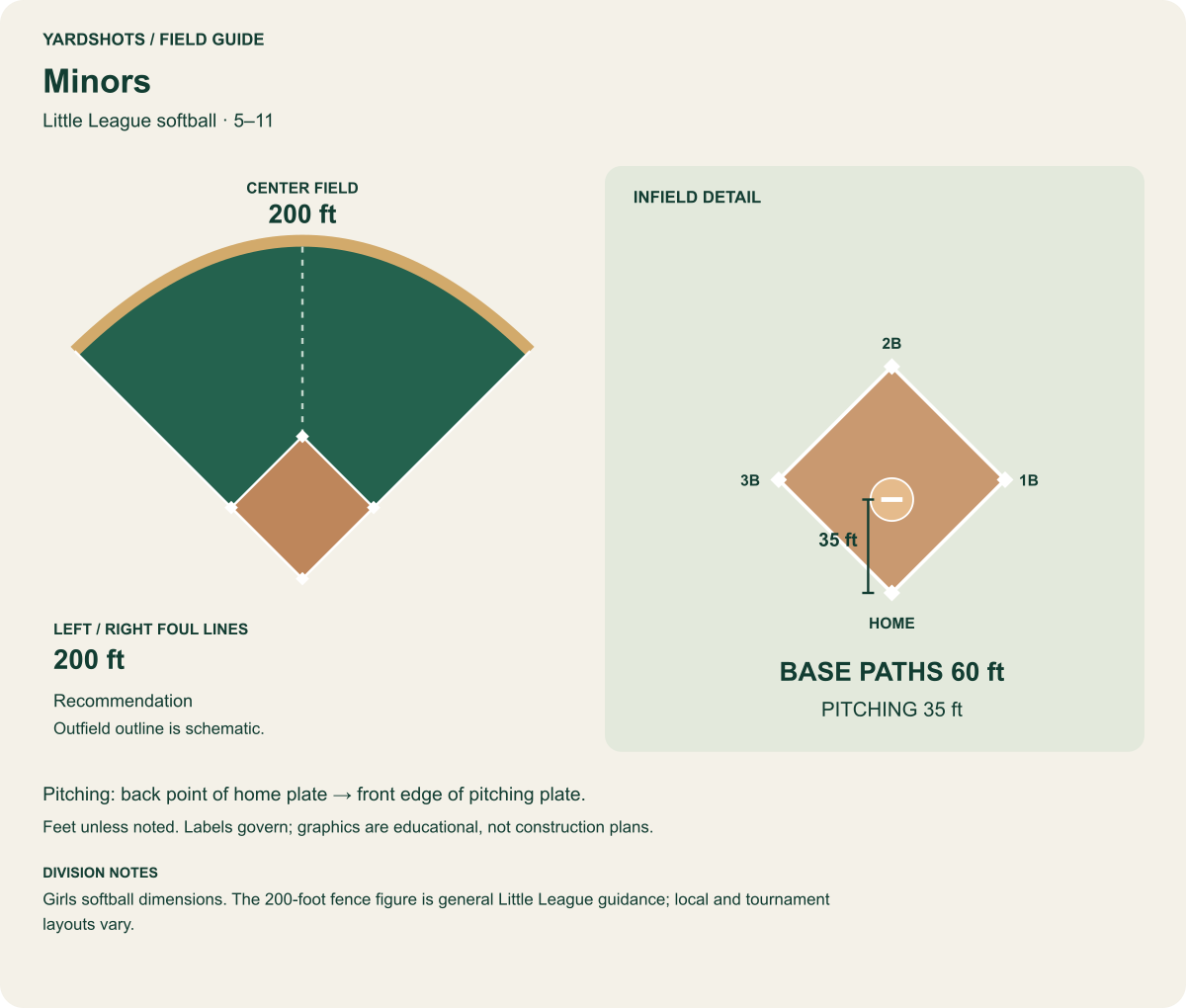
| Minors | 5–11 | 60 ft | 35 ft | 200 | 200 | Recommendation |
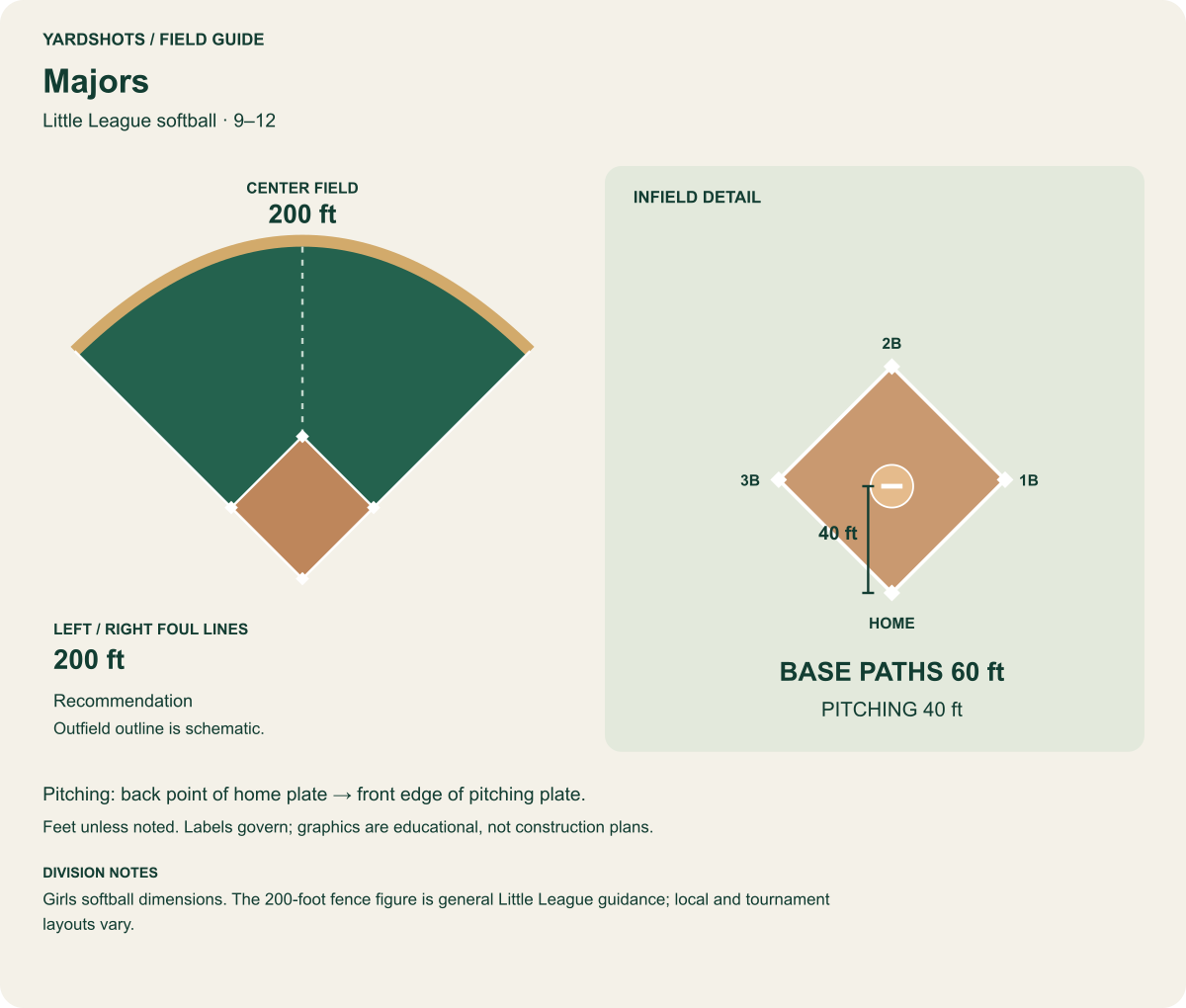
| Majors | 9–12 | 60 ft | 40 ft | 200 | 200 | Recommendation |
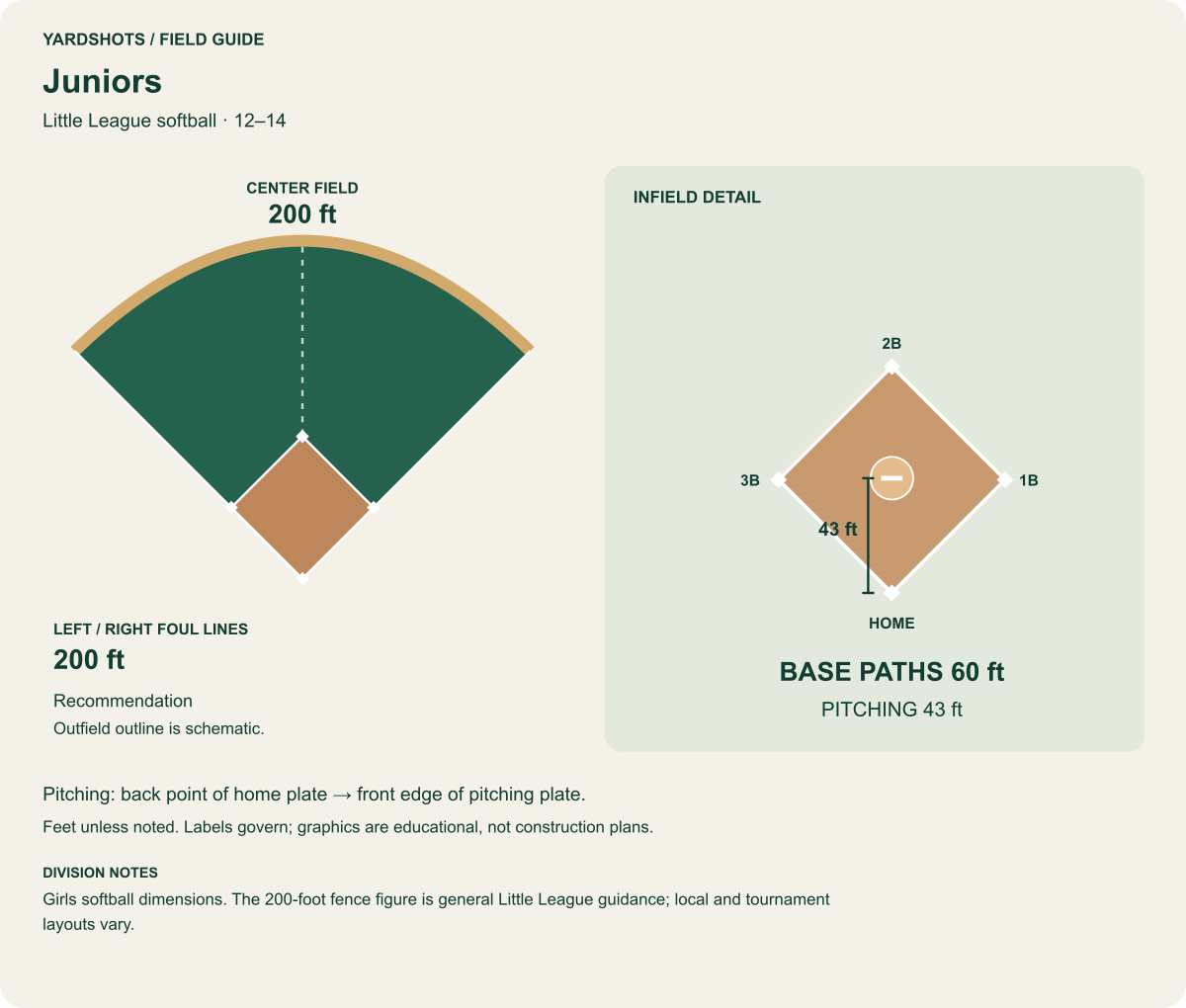
| Juniors | 12–14 | 60 ft | 43 ft | 200 | 200 | Recommendation |
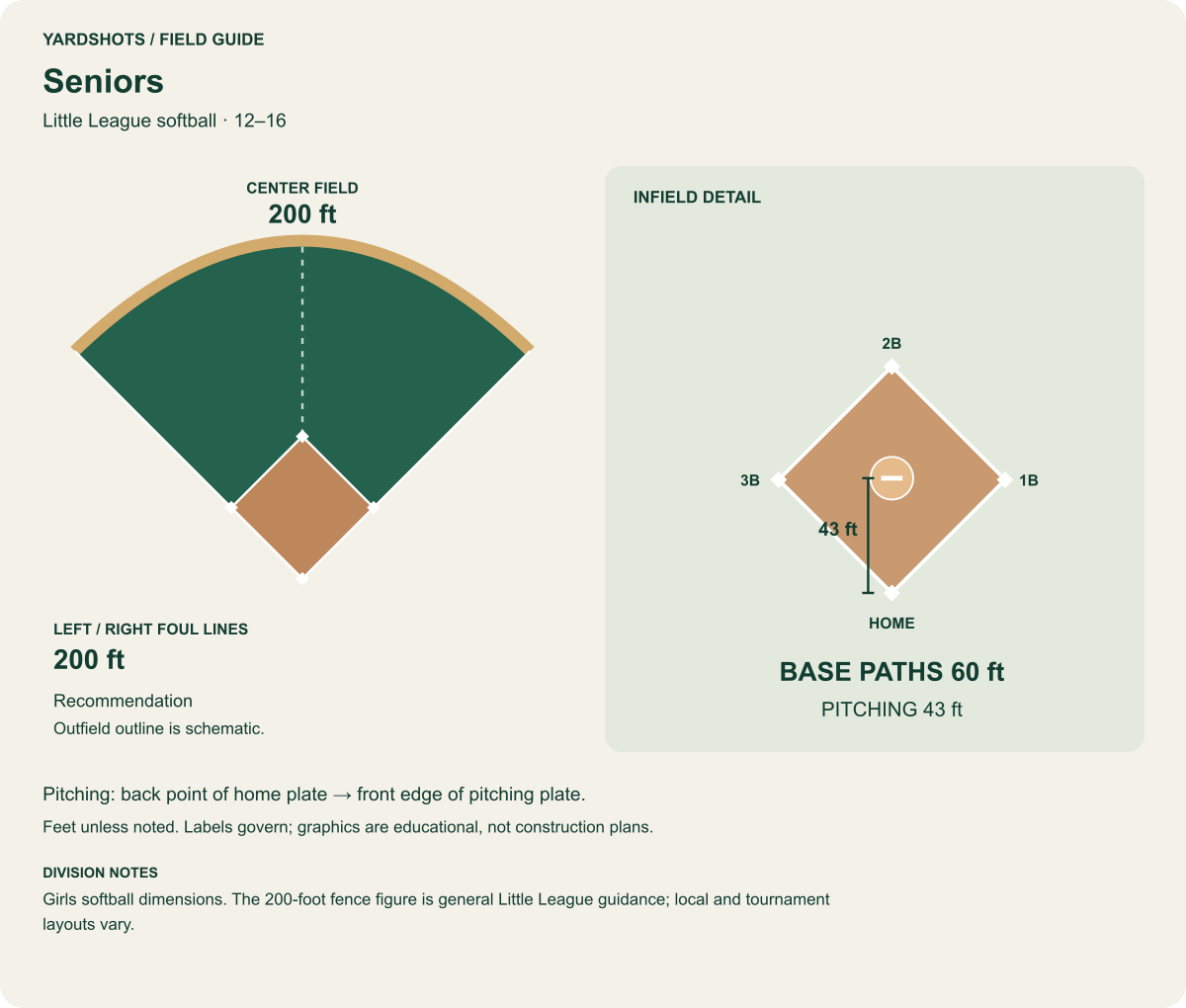
| Seniors | 12–16 | 60 ft | 43 ft | 200 | 200 | Recommendation |
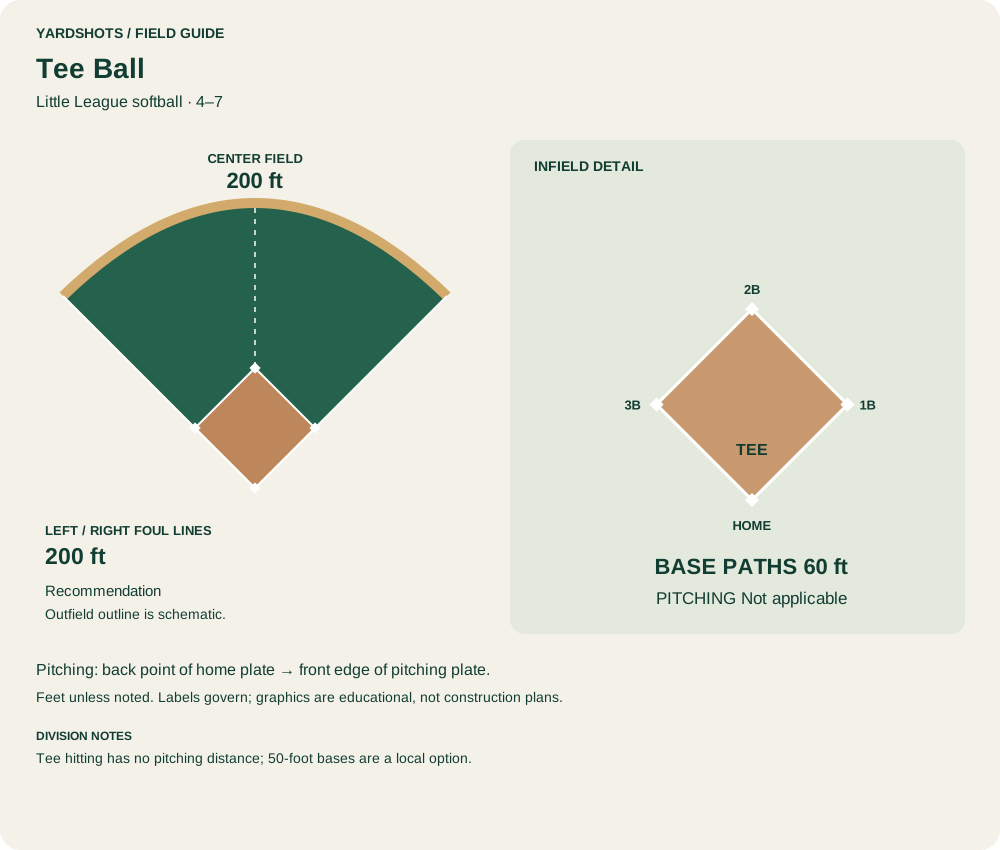
Tee hitting has no pitching distance; 50-foot bases are a local option.
Little League softball divisions · Little League field specifications
Download SVG · Download PNG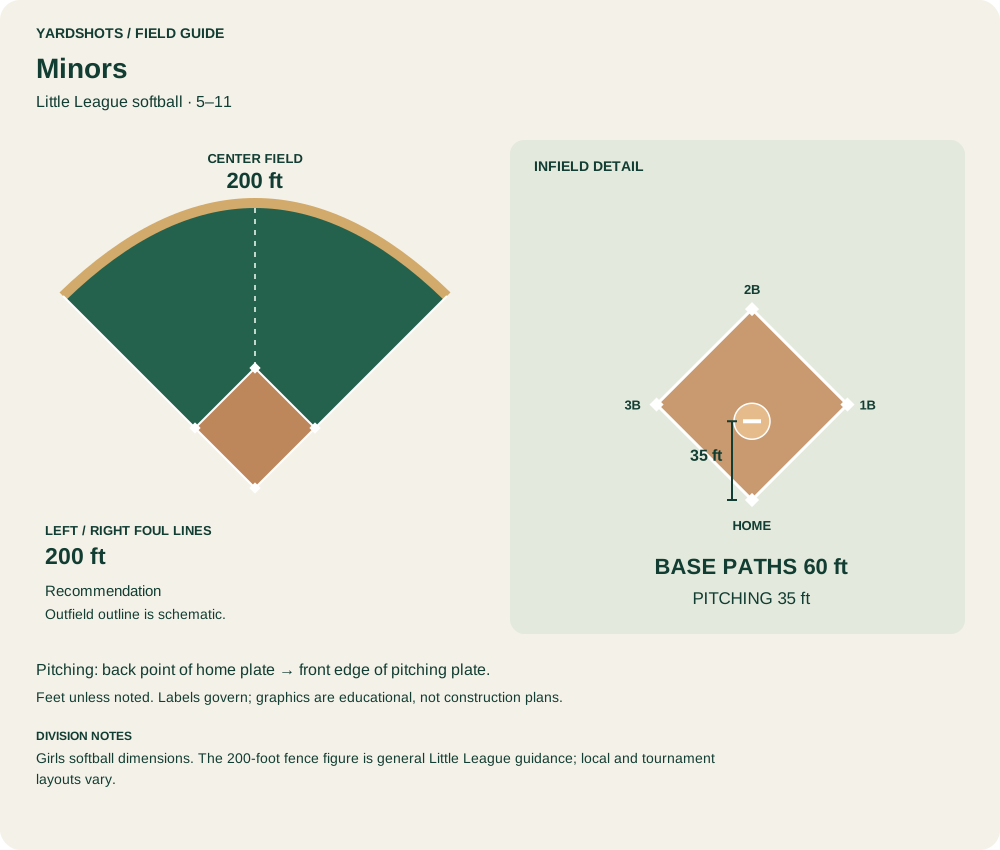
Girls softball dimensions. The 200-foot fence figure is general Little League guidance; local and tournament layouts vary.
Little League softball divisions · Little League field specifications
Download SVG · Download PNG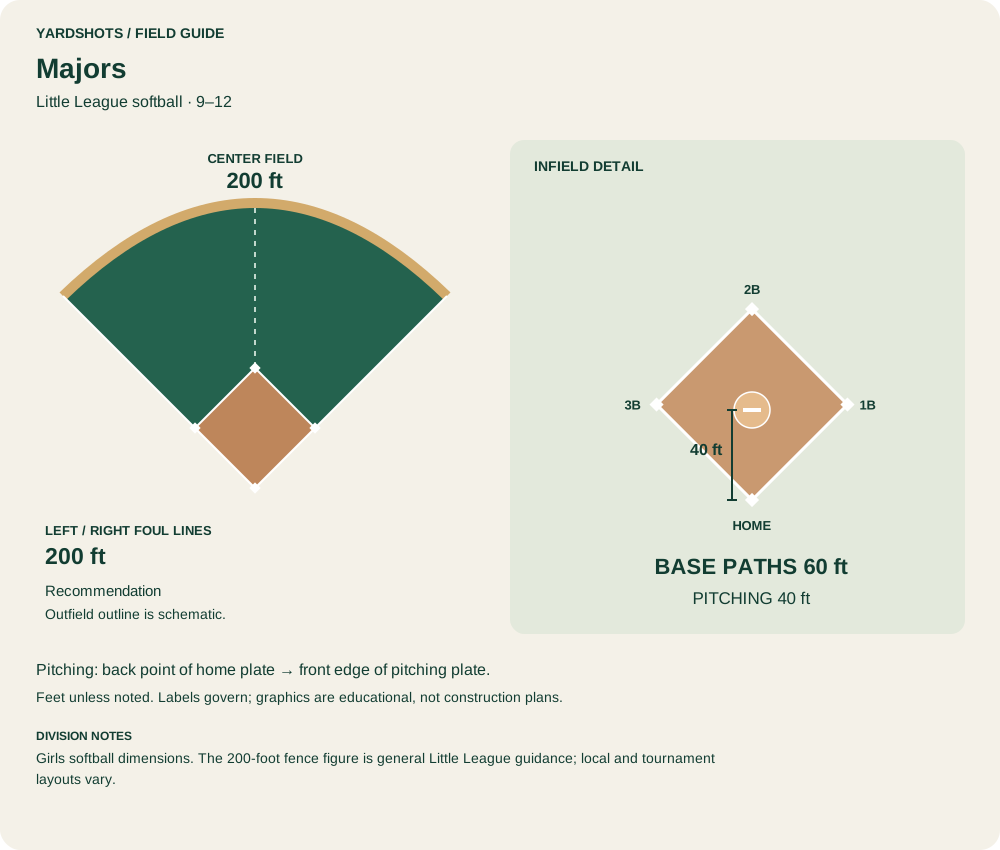
Girls softball dimensions. The 200-foot fence figure is general Little League guidance; local and tournament layouts vary.
Little League softball divisions · Little League field specifications
Download SVG · Download PNG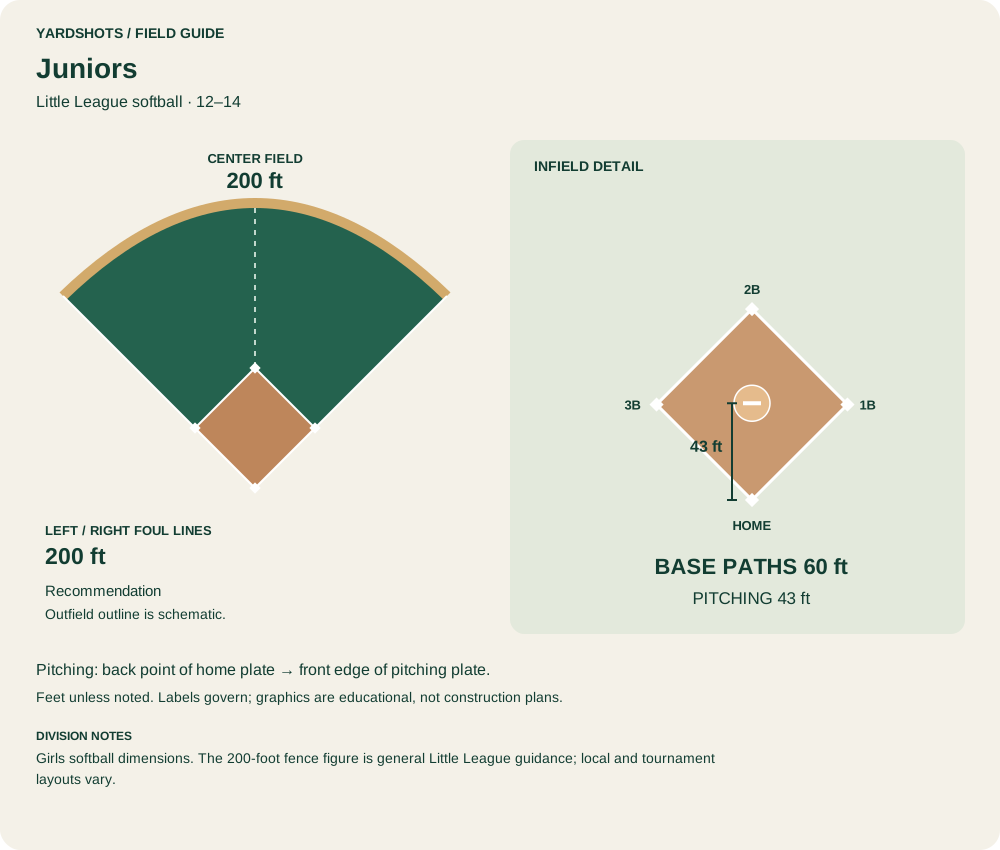
Girls softball dimensions. The 200-foot fence figure is general Little League guidance; local and tournament layouts vary.
Little League softball divisions · Little League field specifications
Download SVG · Download PNG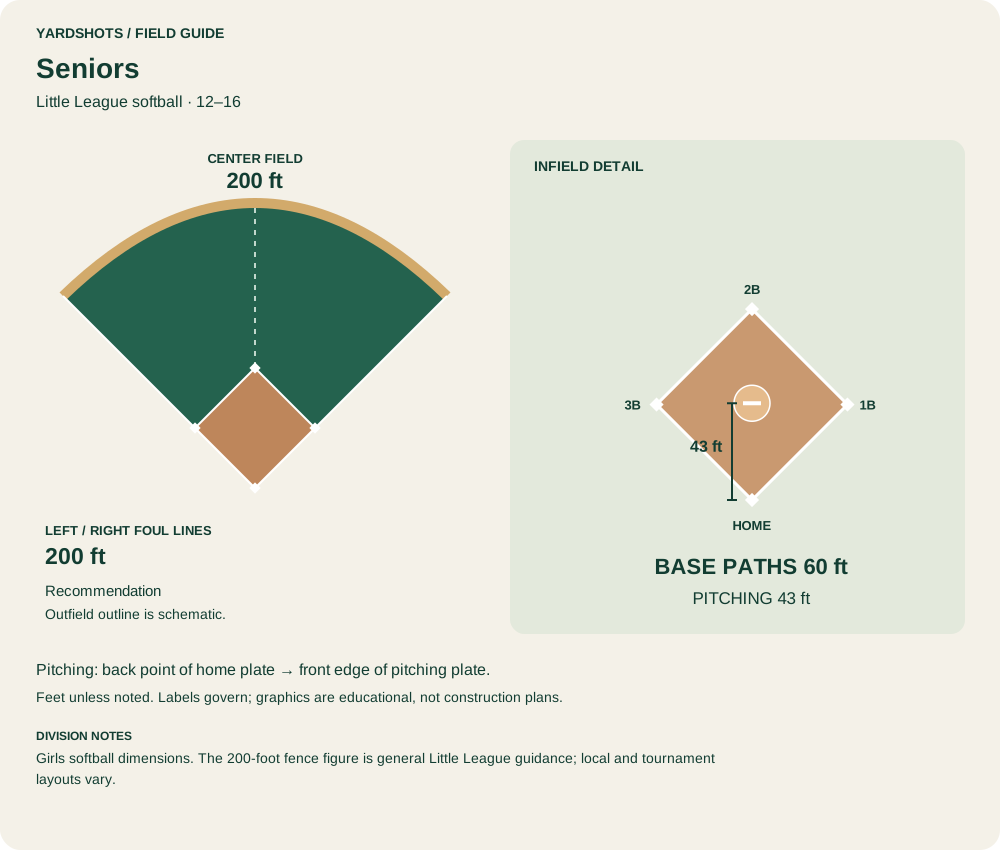
Girls softball dimensions. The 200-foot fence figure is general Little League guidance; local and tournament layouts vary.
Little League softball divisions · Little League field specifications
Download SVG · Download PNG| Division | Age / level | Bases | Pitching | Foul lines | Center | Fence status |
|---|---|---|---|---|---|---|
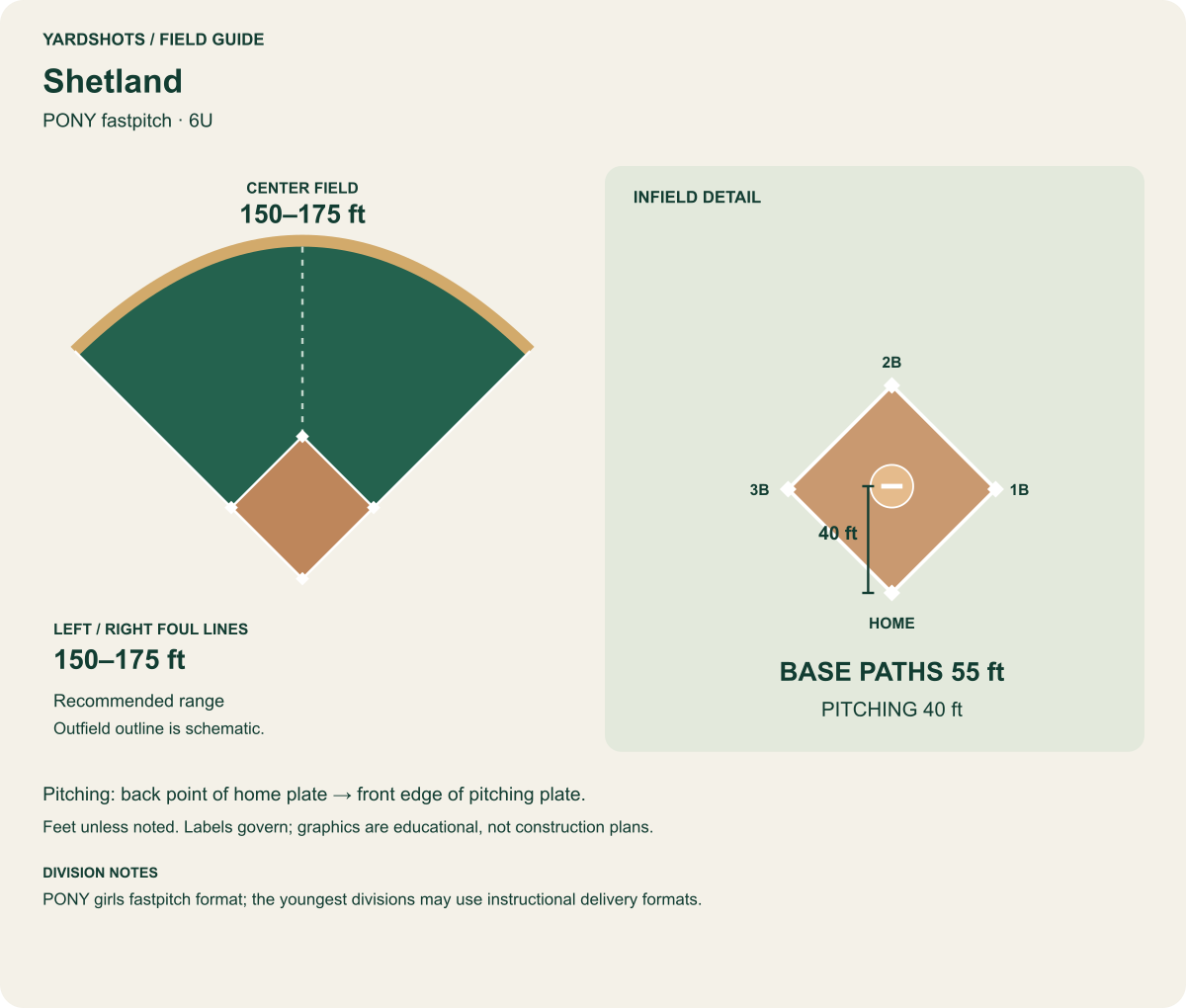
| Shetland | 6U | 55 ft | 40 ft | 150–175 | 150–175 | Recommended range |
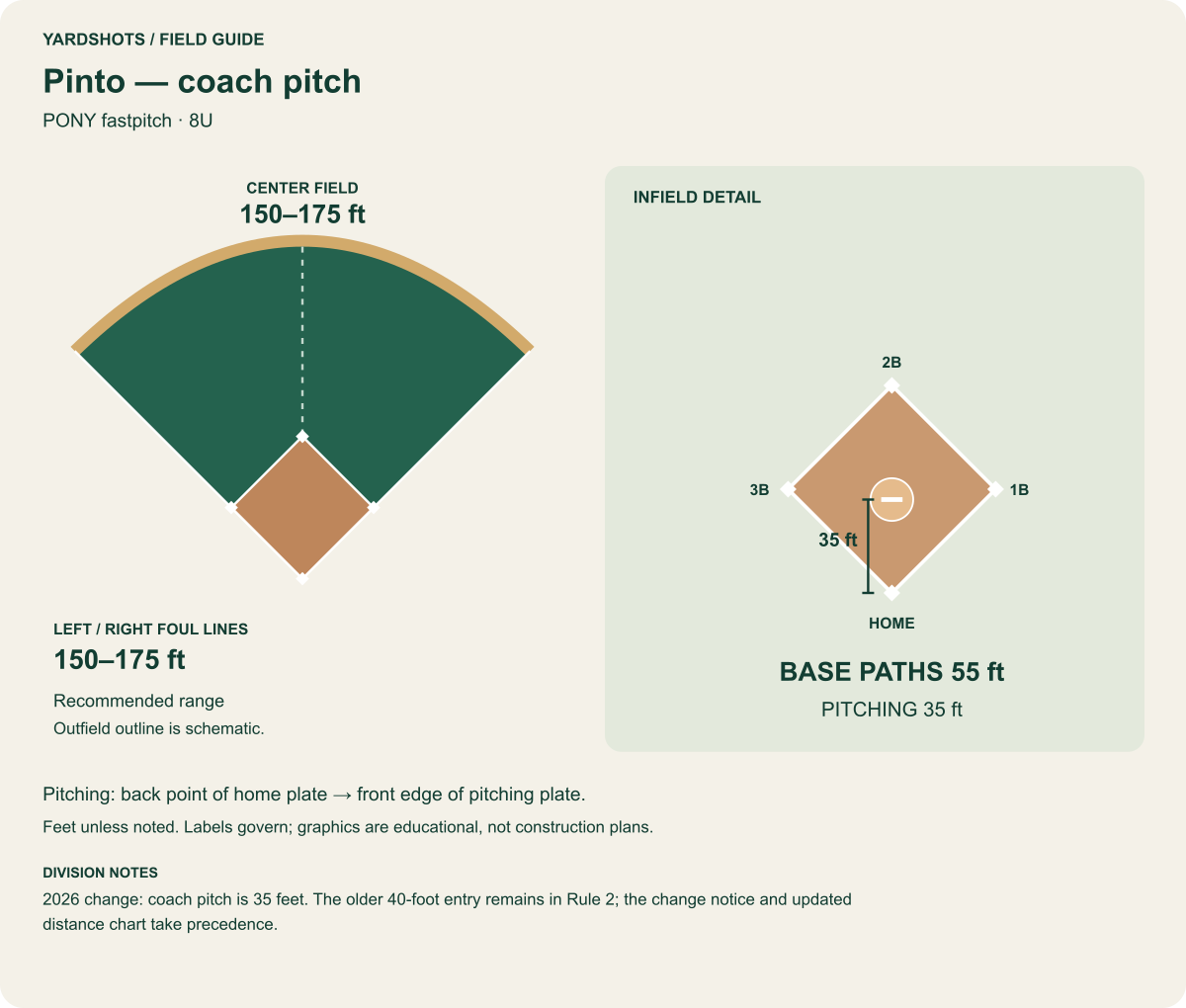
| Pinto — coach pitch | 8U | 55 ft | 35 ft | 150–175 | 150–175 | Recommended range |
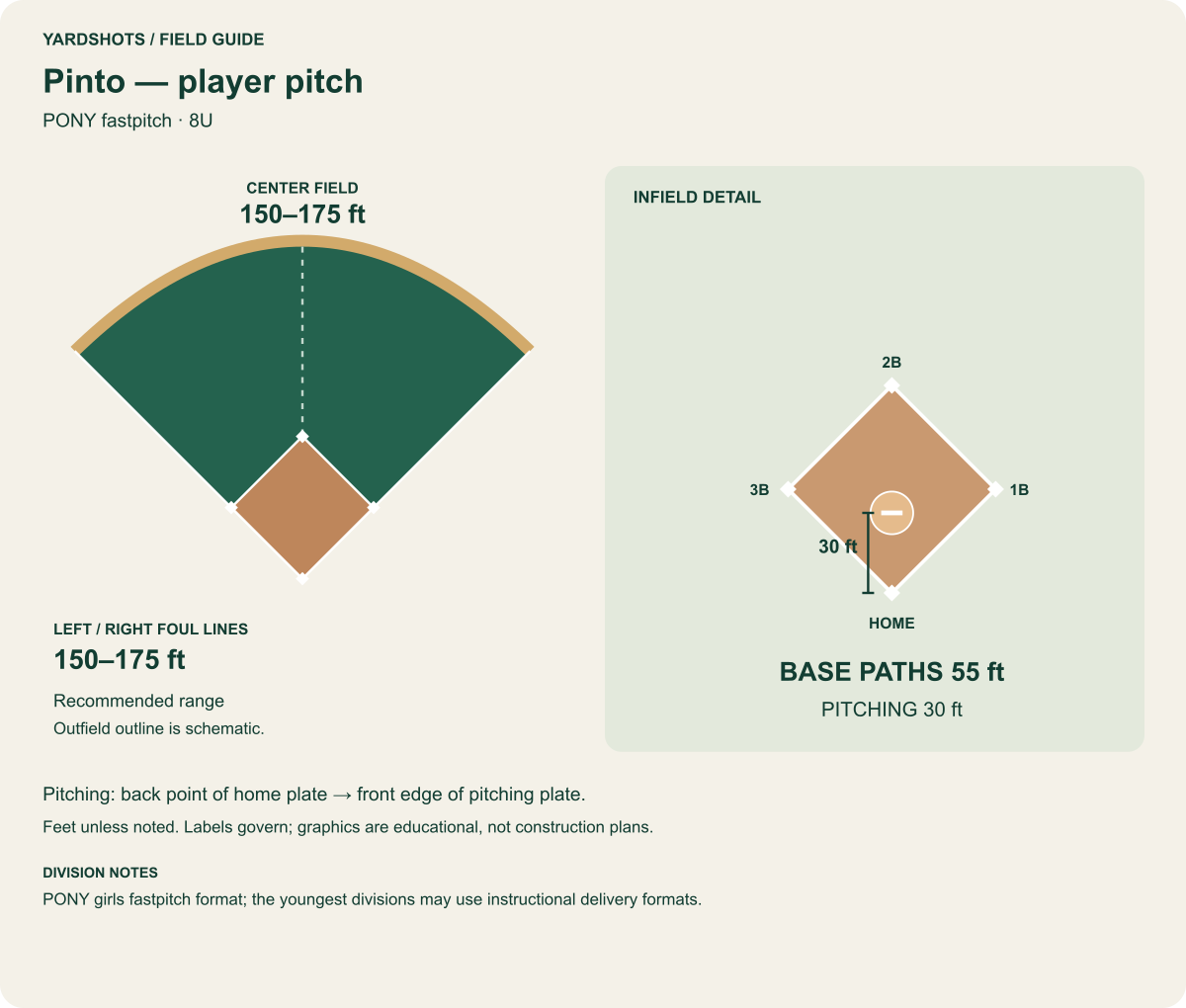
| Pinto — player pitch | 8U | 55 ft | 30 ft | 150–175 | 150–175 | Recommended range |
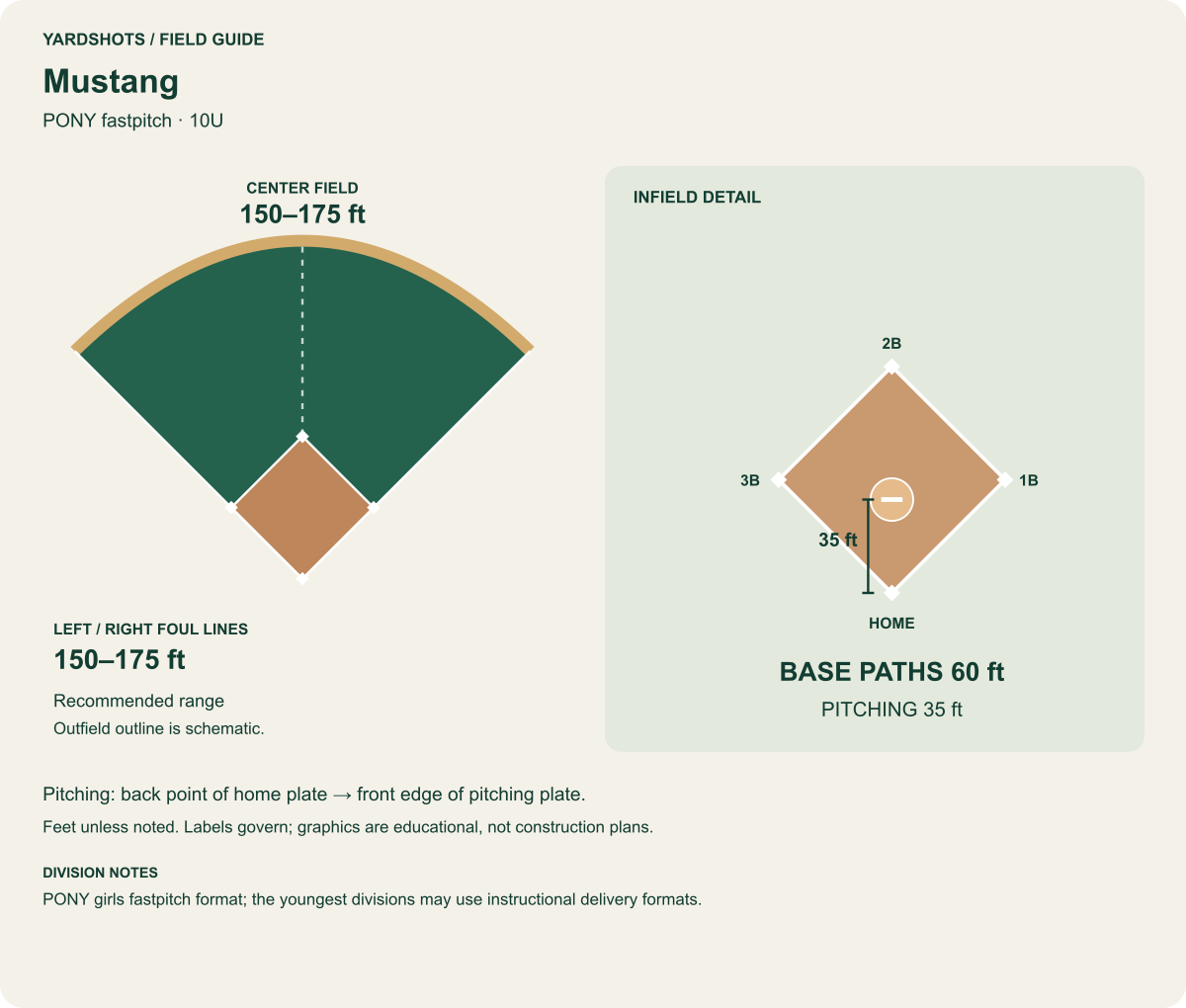
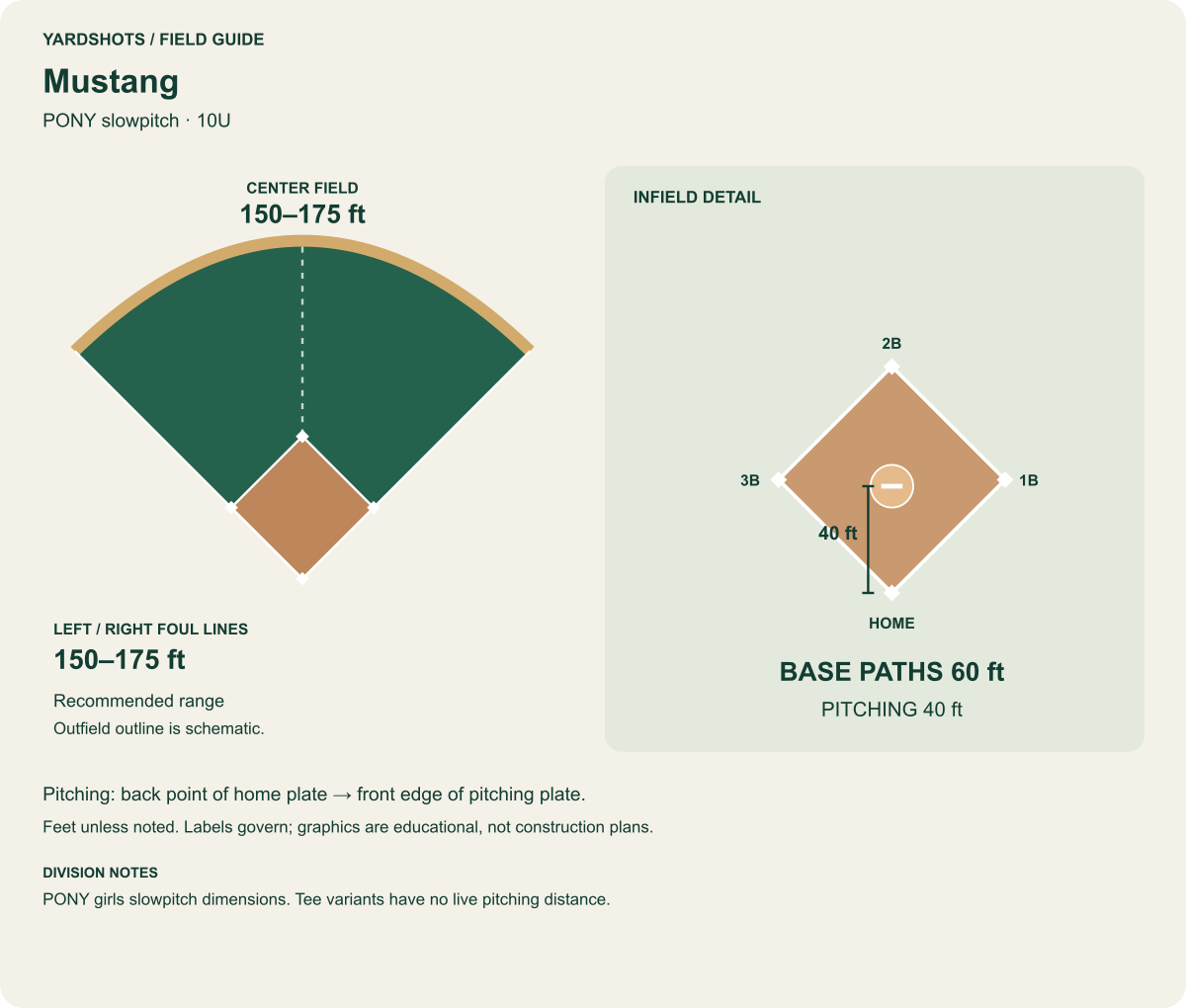
| Mustang | 10U | 60 ft | 35 ft | 150–175 | 150–175 | Recommended range |
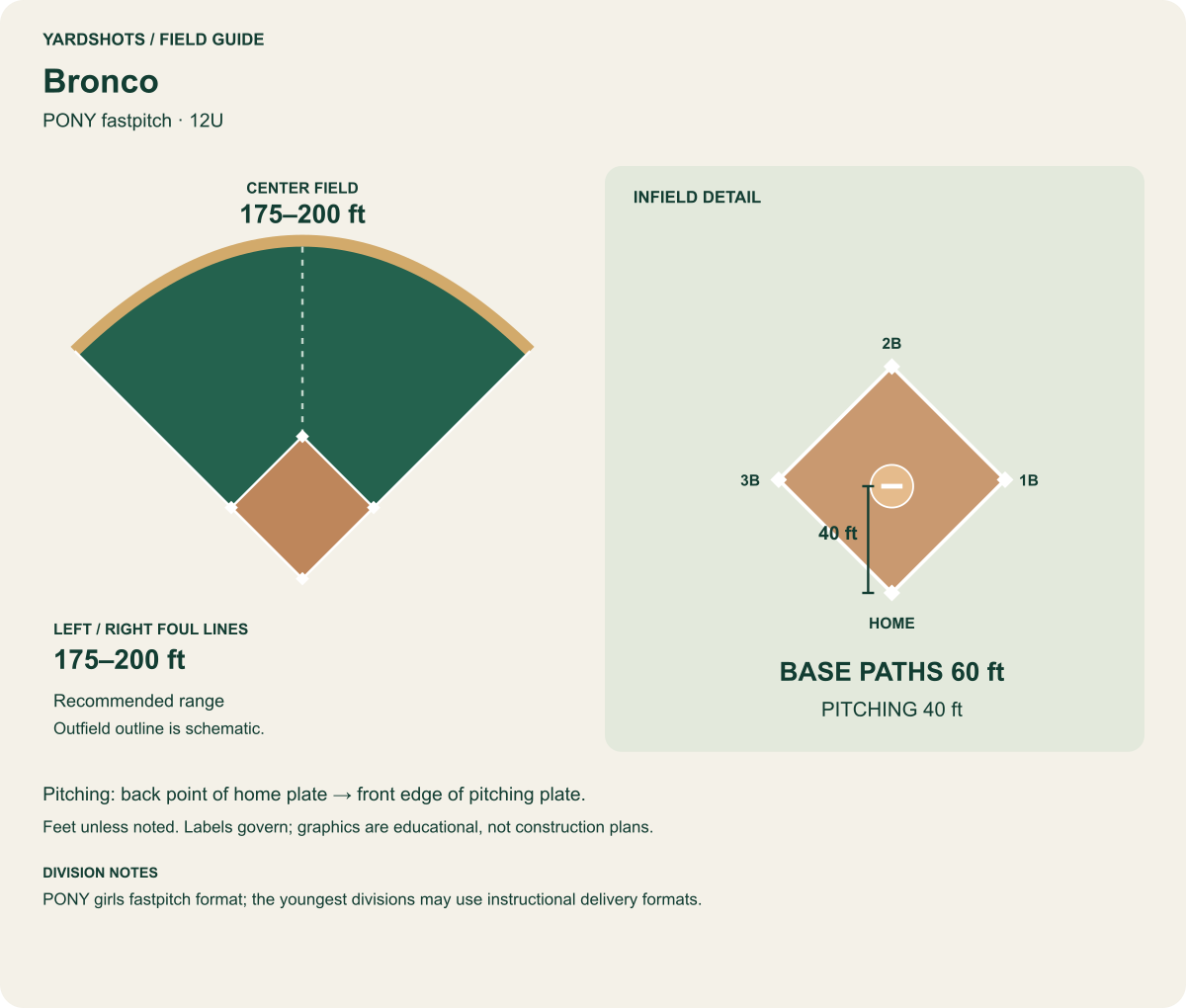
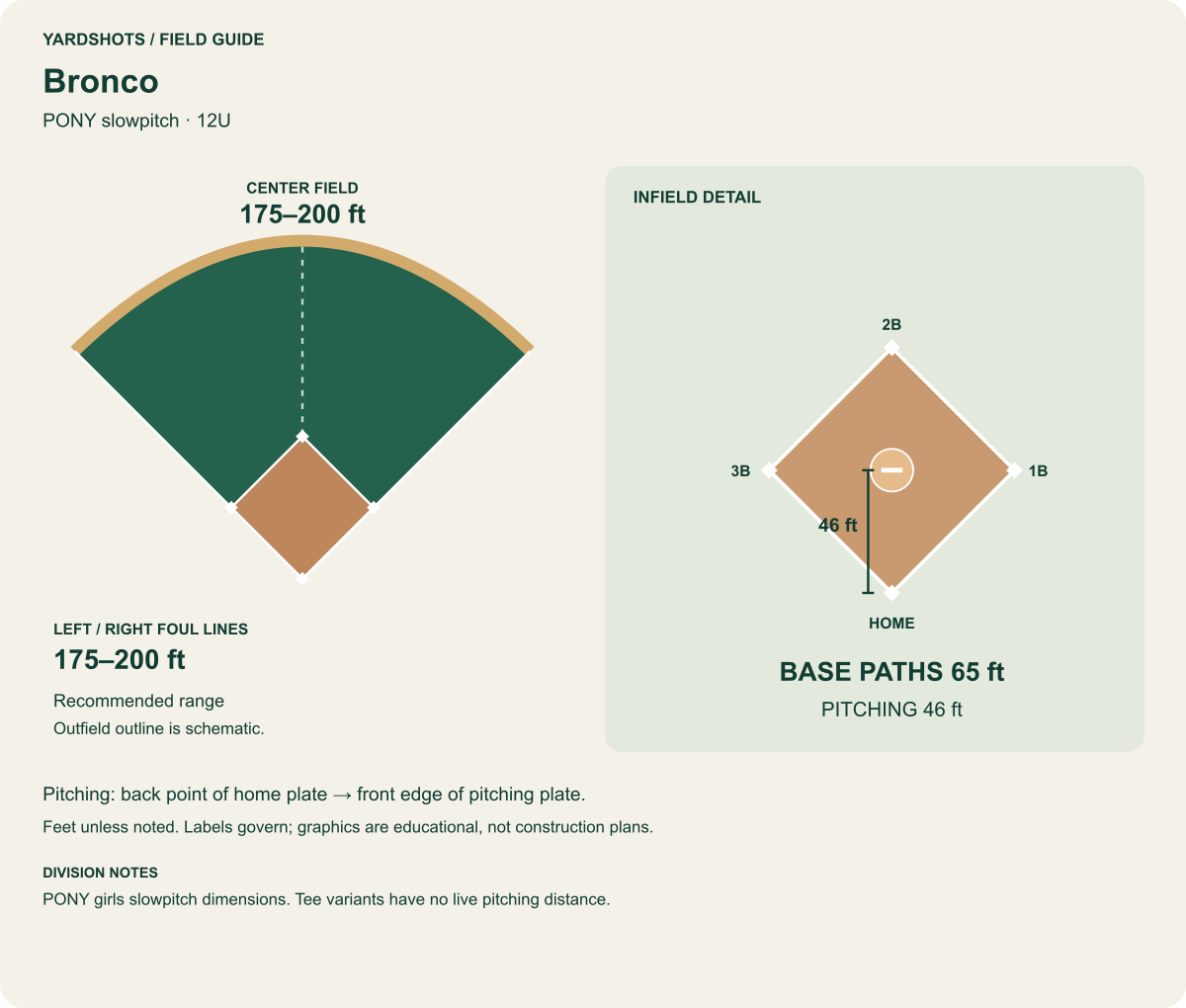
| Bronco | 12U | 60 ft | 40 ft | 175–200 | 175–200 | Recommended range |
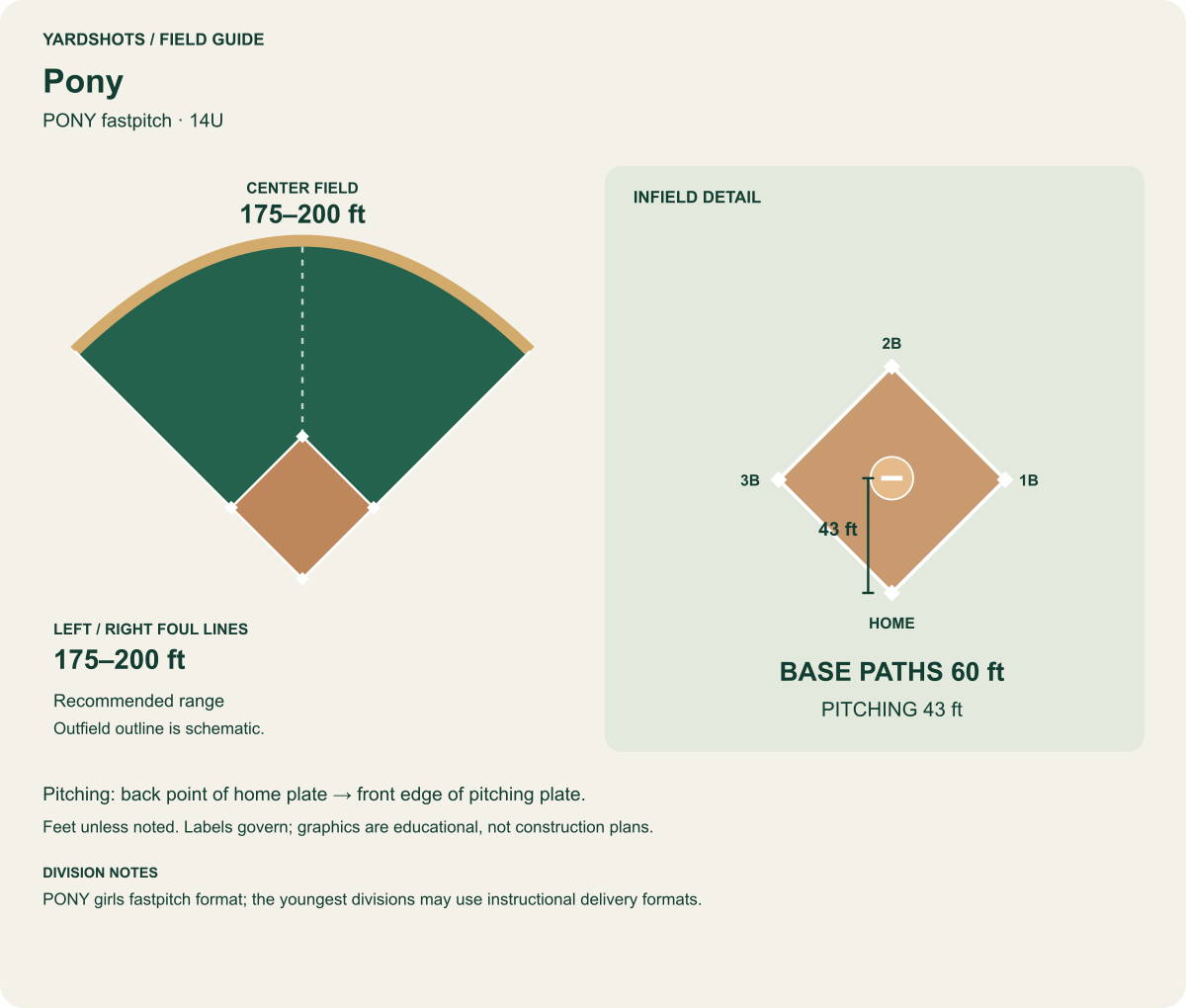
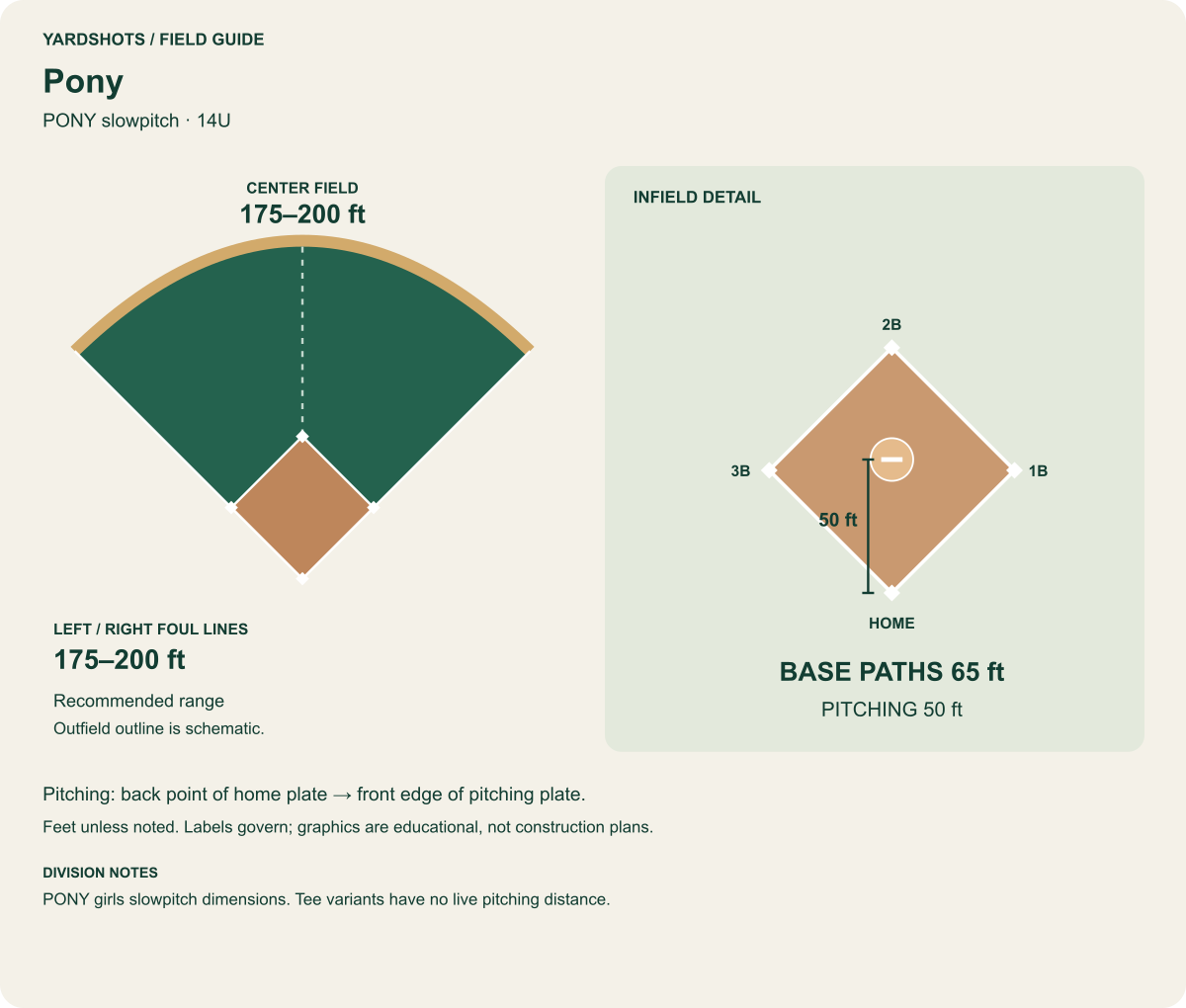
| Pony | 14U | 60 ft | 43 ft | 175–200 | 175–200 | Recommended range |
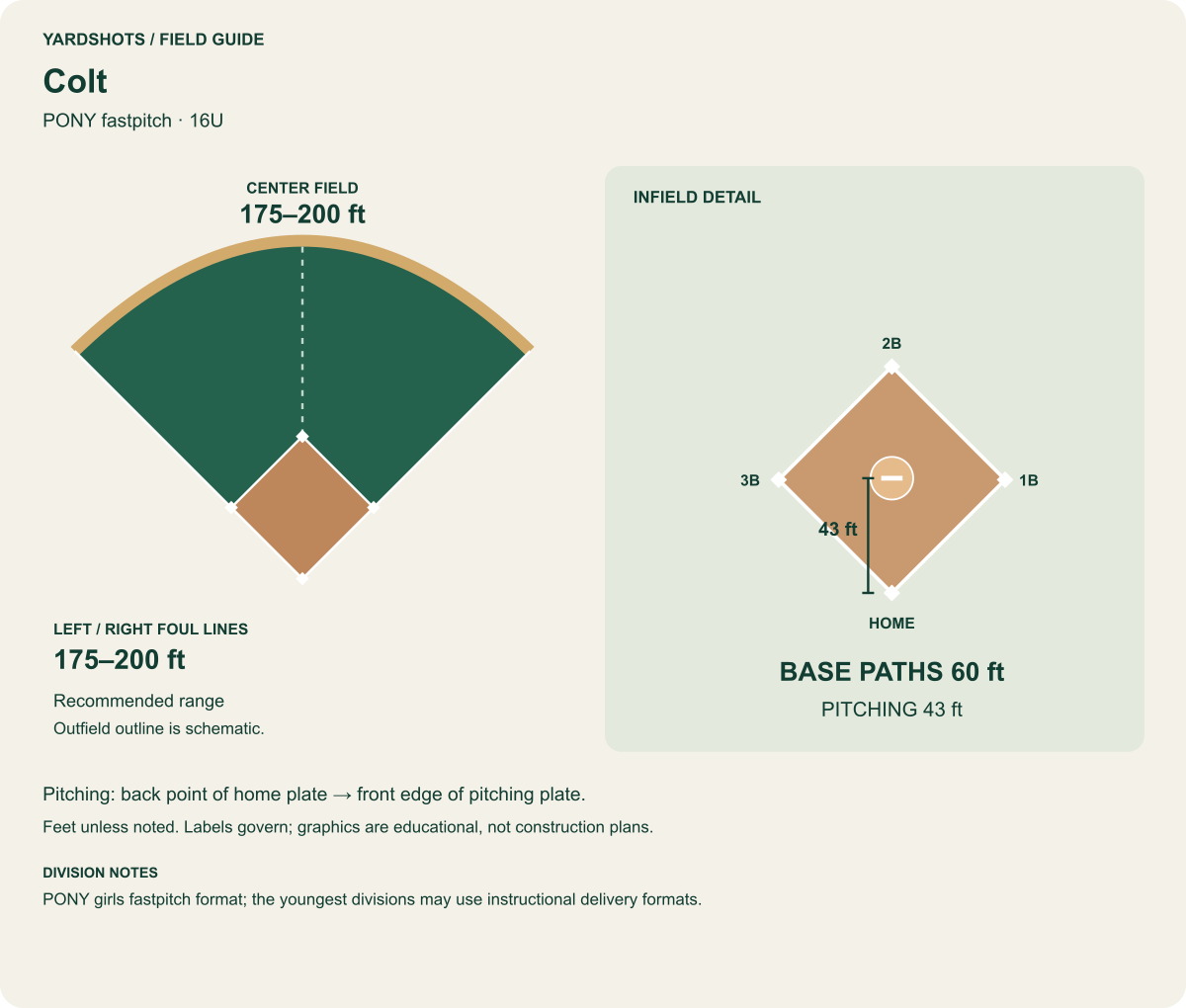
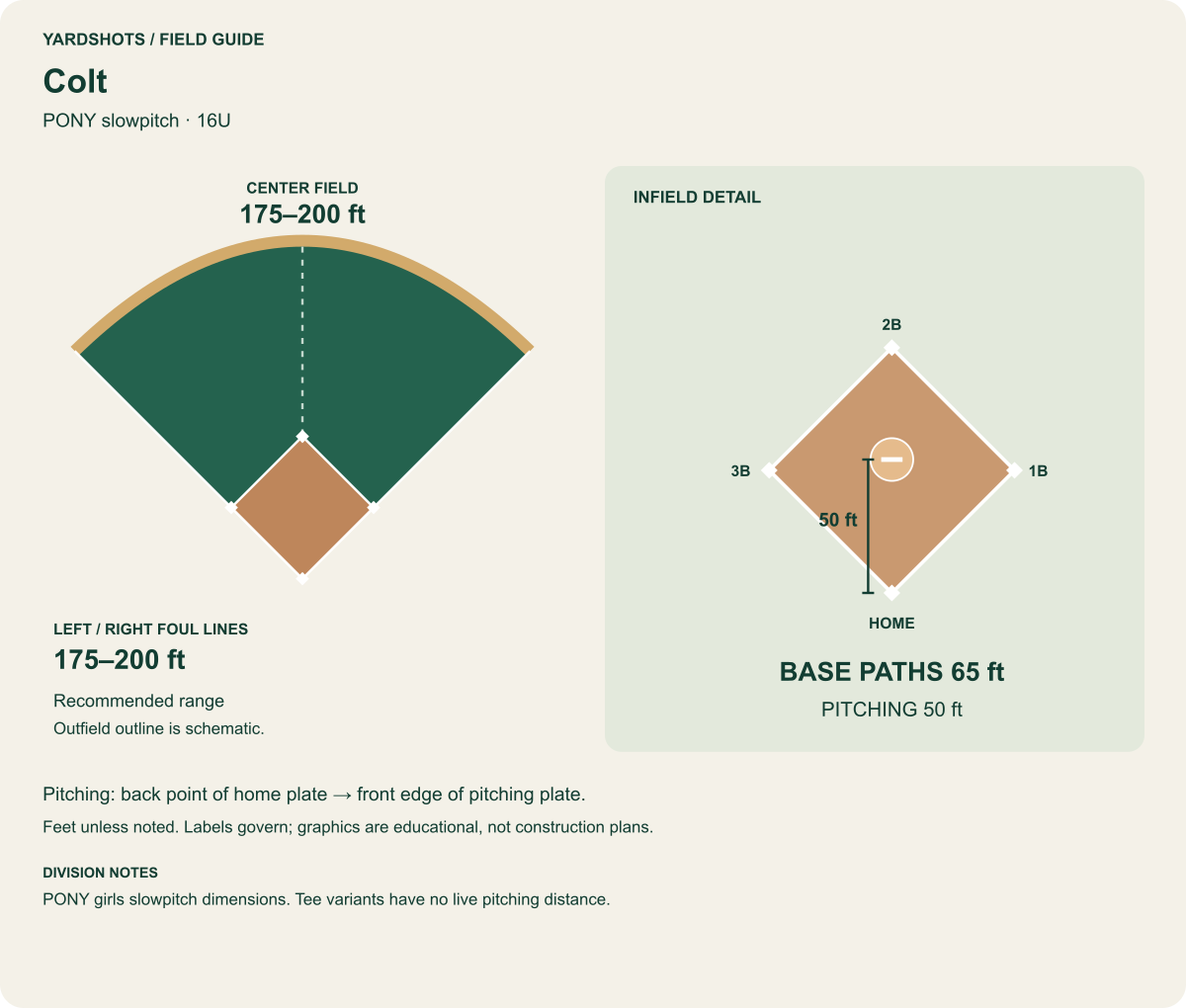
| Colt | 16U | 60 ft | 43 ft | 175–200 | 175–200 | Recommended range |
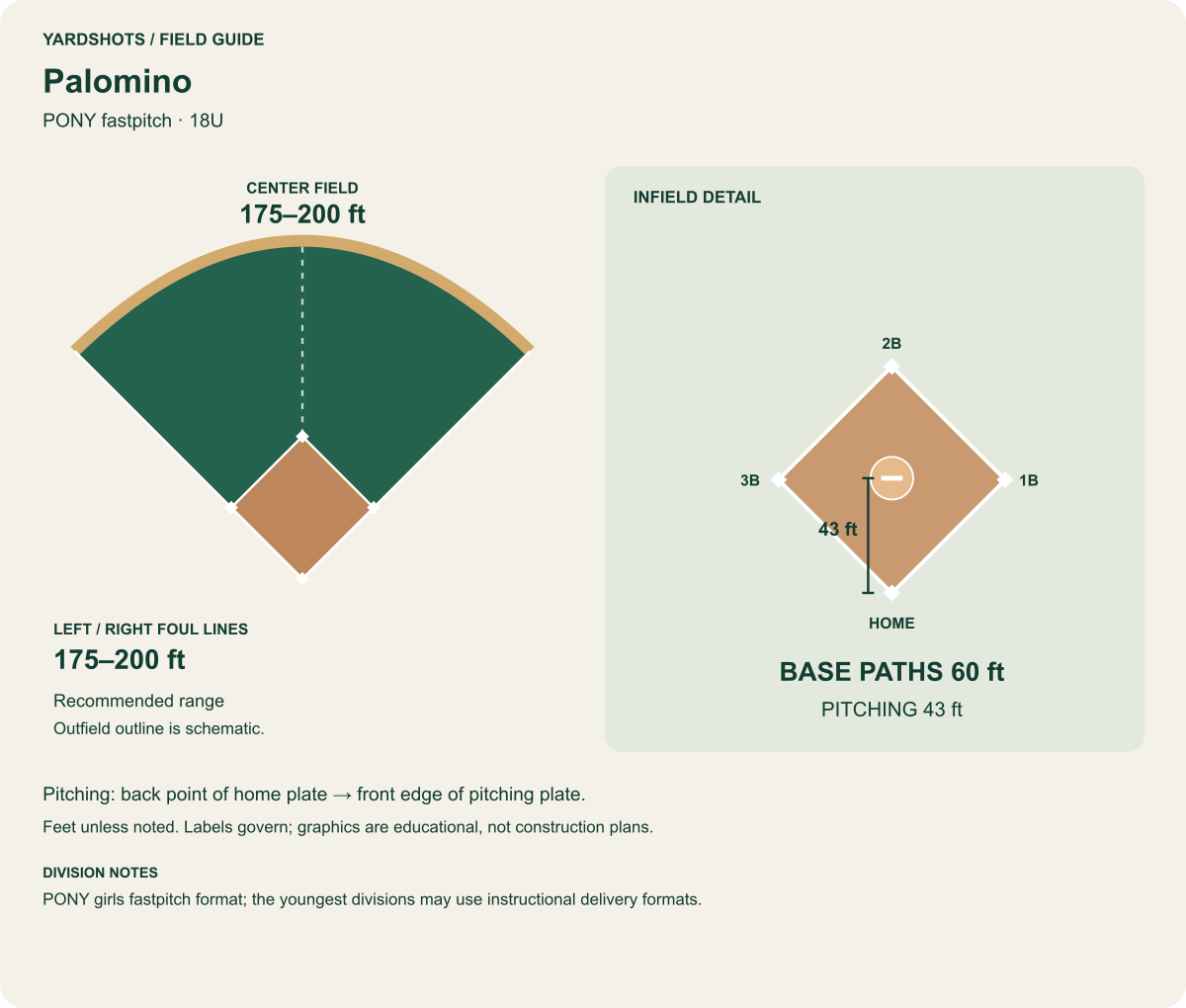
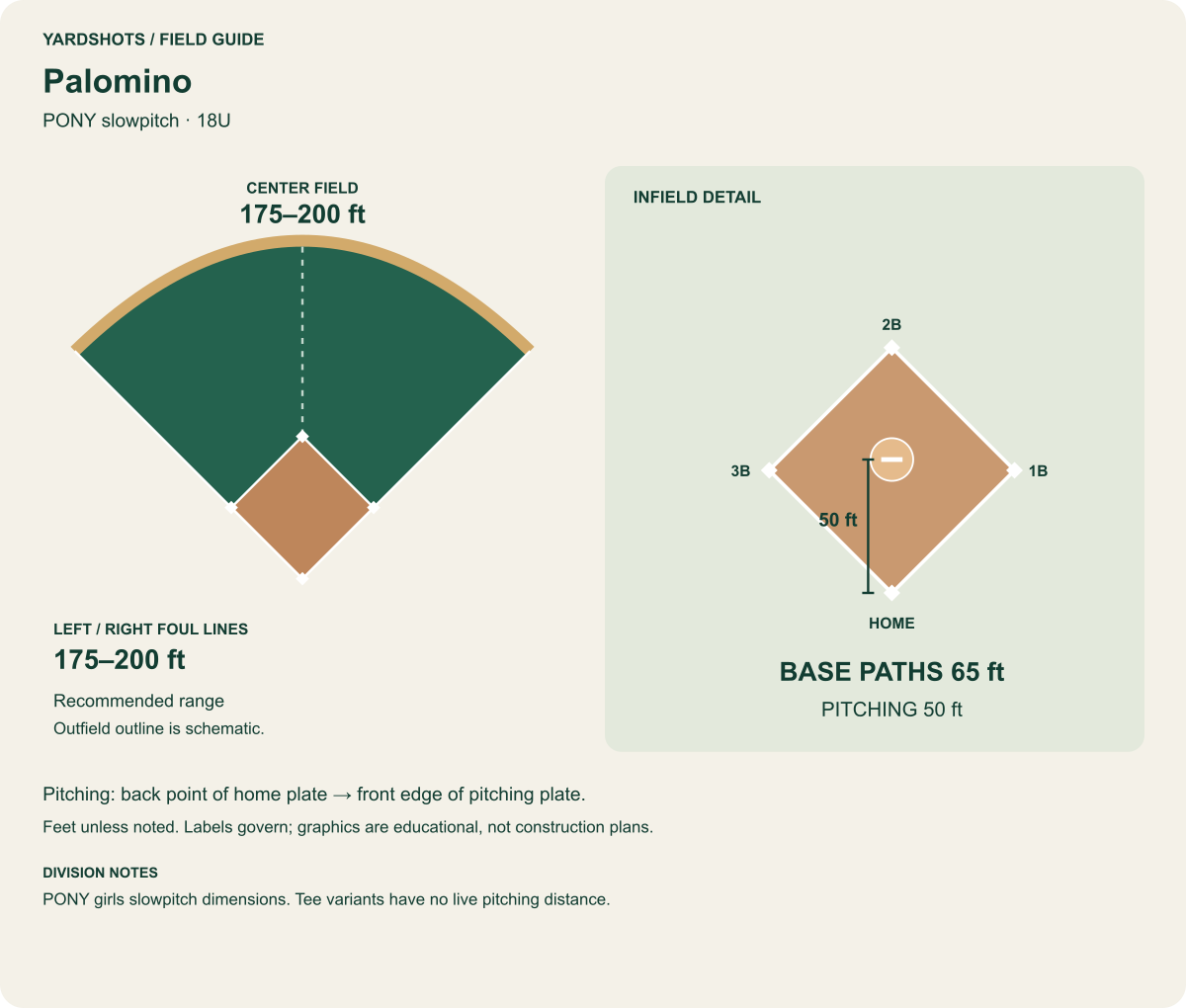
| Palomino | 18U | 60 ft | 43 ft | 175–200 | 175–200 | Recommended range |
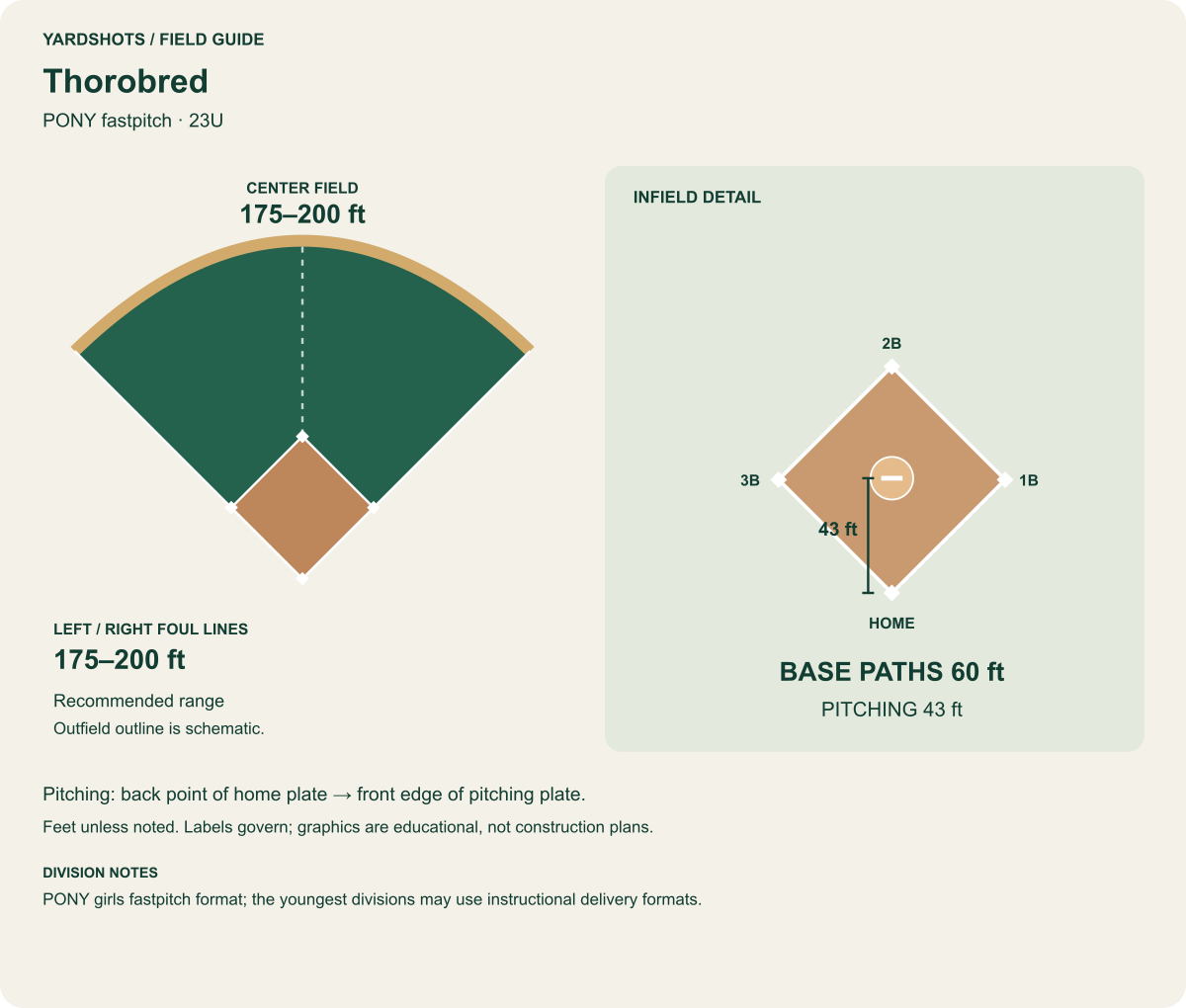
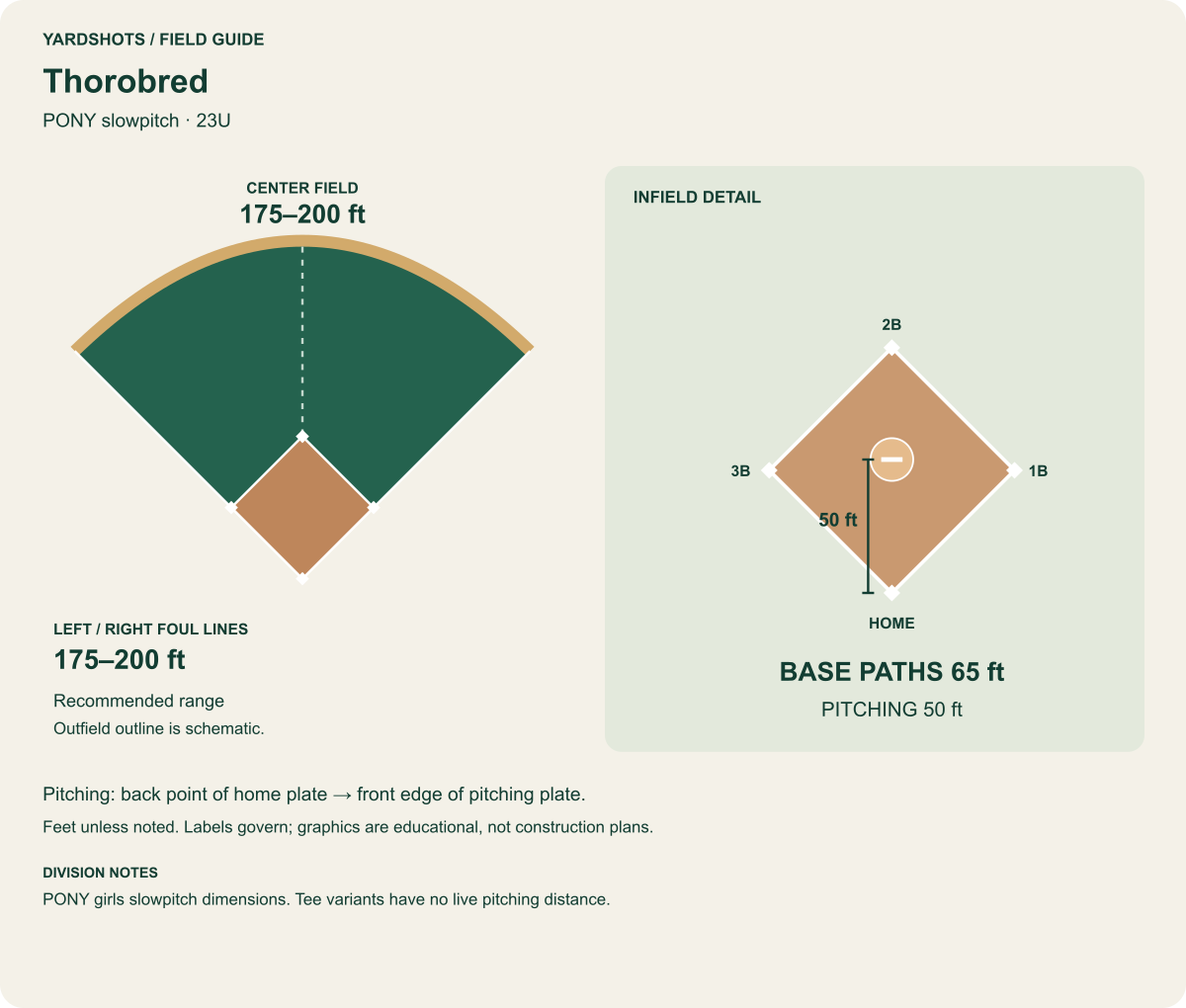
| Thorobred | 23U | 60 ft | 43 ft | 175–200 | 175–200 | Recommended range |
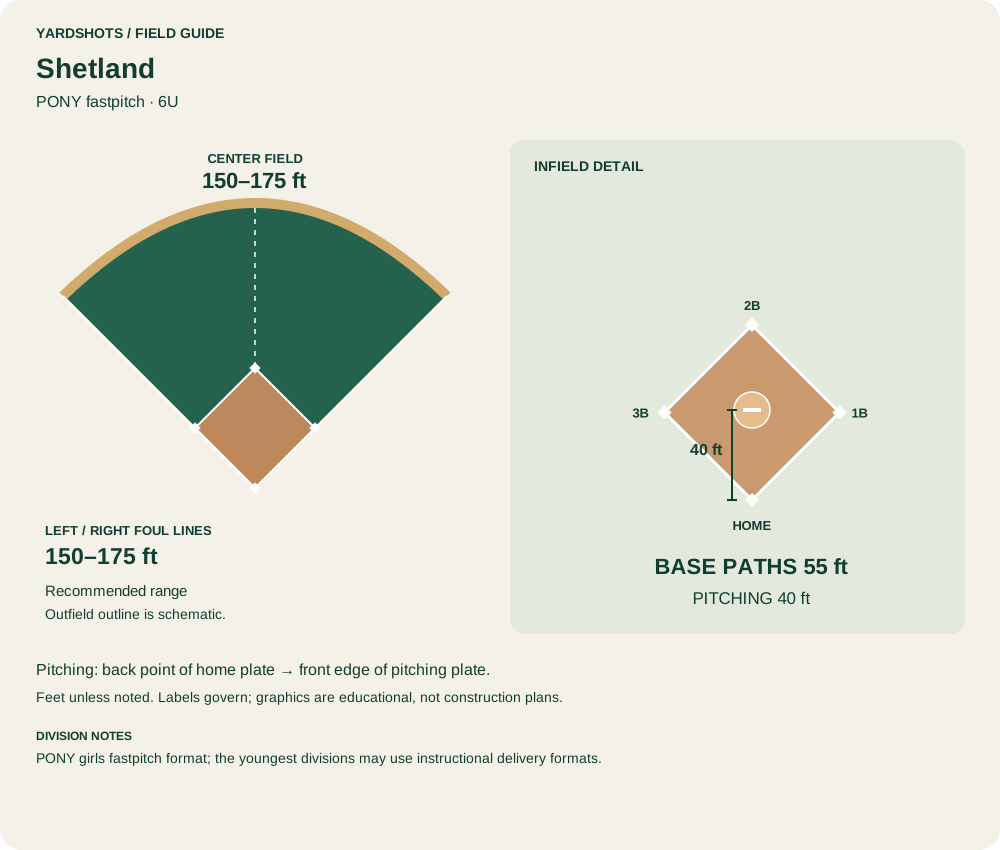
PONY girls fastpitch format; the youngest divisions may use instructional delivery formats.
2026 PONY Girls Softball Rulebook, distance chart and Rule 2 (public copy) · PONY current softball rulebook hub
Download SVG · Download PNG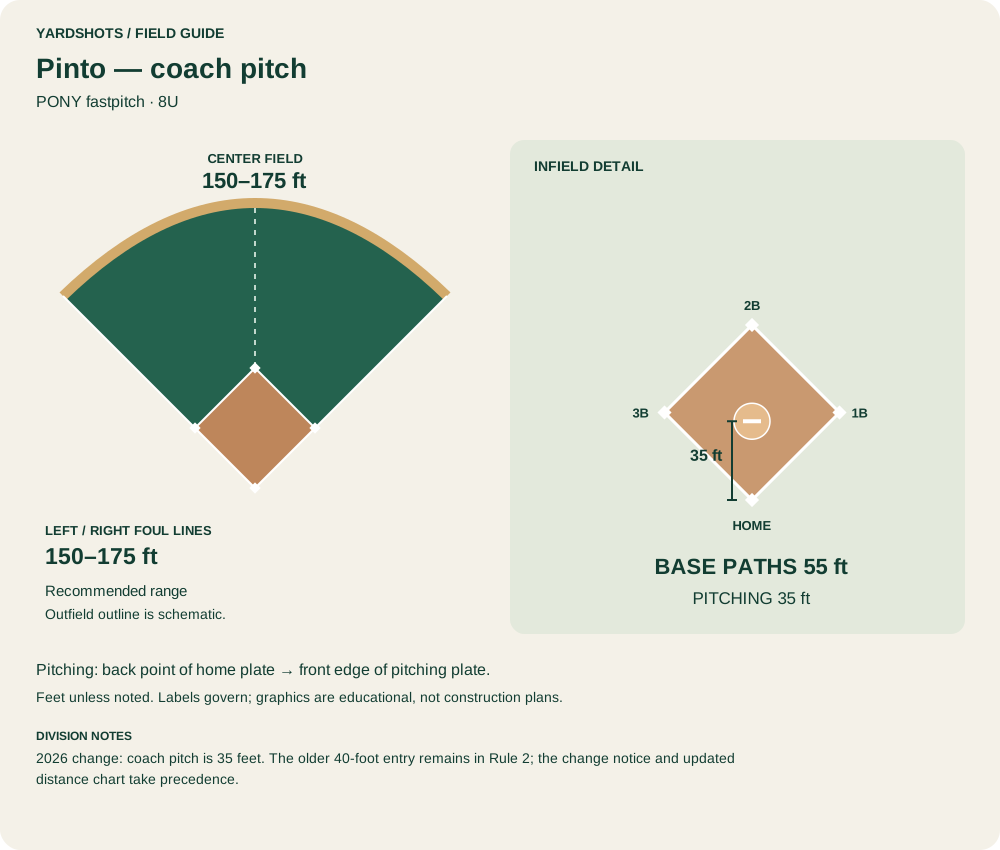
2026 change: coach pitch is 35 feet. The older 40-foot entry remains in Rule 2; the change notice and updated distance chart take precedence.
2026 PONY Girls Softball Rulebook, distance chart and Rule 2 (public copy) · PONY current softball rulebook hub
Download SVG · Download PNG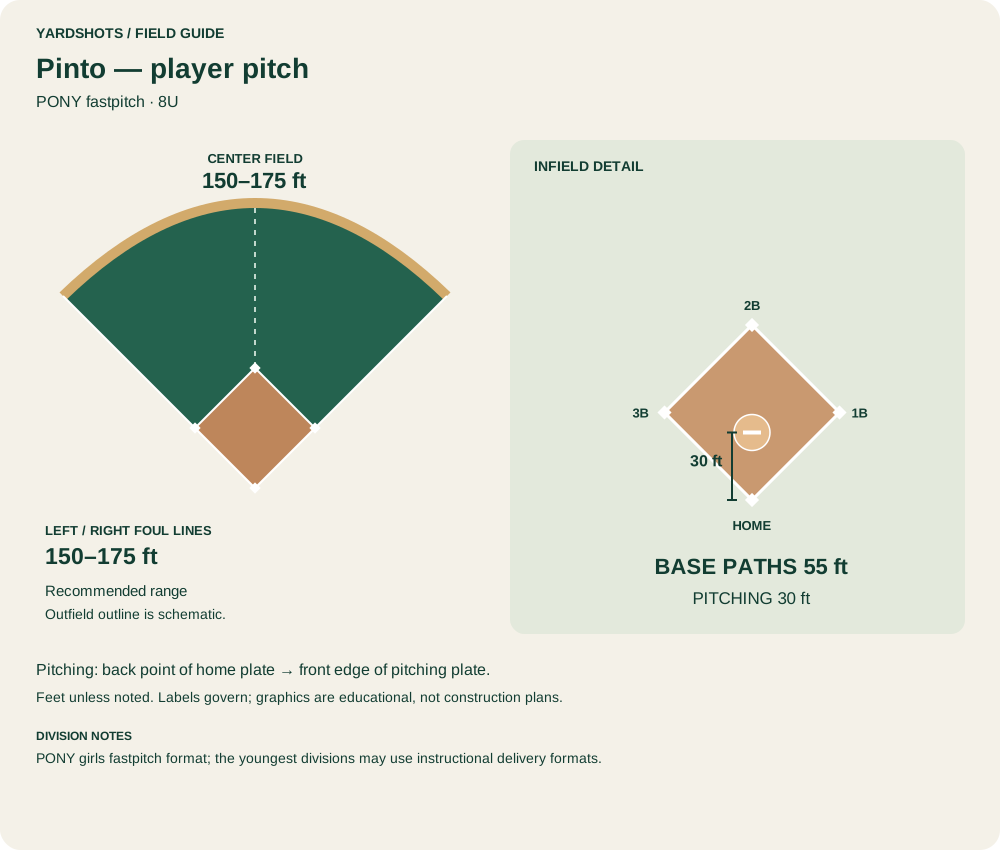
PONY girls fastpitch format; the youngest divisions may use instructional delivery formats.
2026 PONY Girls Softball Rulebook, distance chart and Rule 2 (public copy) · PONY current softball rulebook hub
Download SVG · Download PNG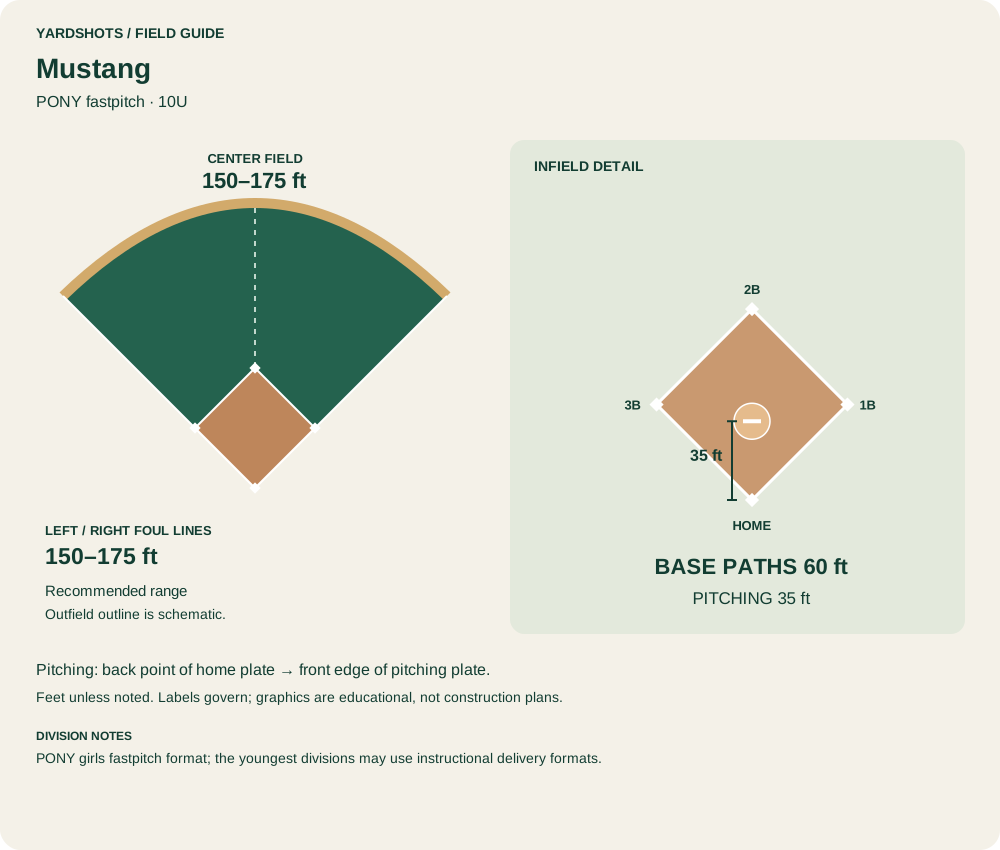
PONY girls fastpitch format; the youngest divisions may use instructional delivery formats.
2026 PONY Girls Softball Rulebook, distance chart and Rule 2 (public copy) · PONY current softball rulebook hub
Download SVG · Download PNG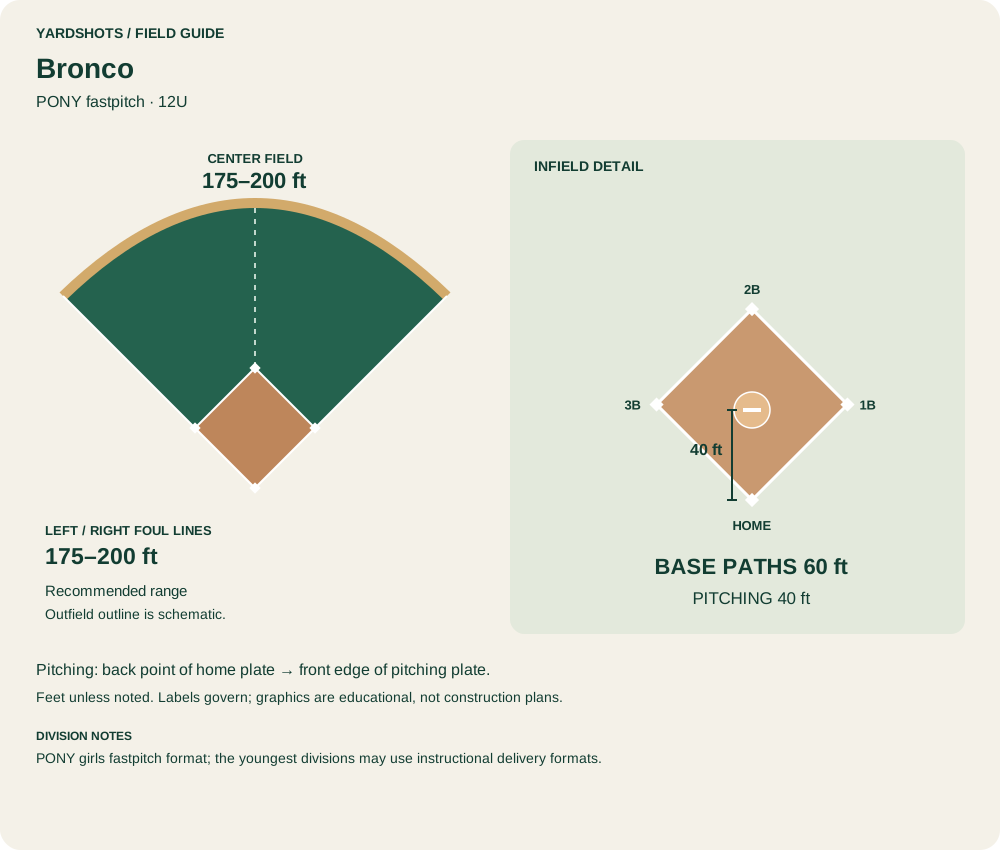
PONY girls fastpitch format; the youngest divisions may use instructional delivery formats.
2026 PONY Girls Softball Rulebook, distance chart and Rule 2 (public copy) · PONY current softball rulebook hub
Download SVG · Download PNG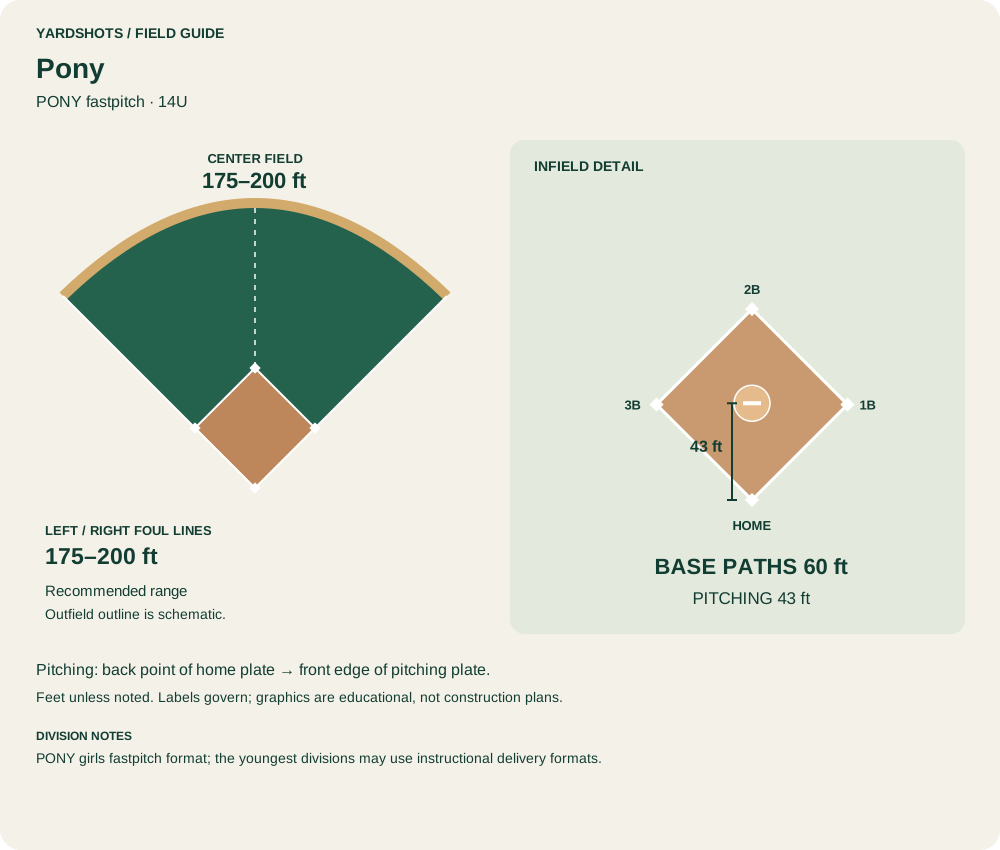
PONY girls fastpitch format; the youngest divisions may use instructional delivery formats.
2026 PONY Girls Softball Rulebook, distance chart and Rule 2 (public copy) · PONY current softball rulebook hub
Download SVG · Download PNG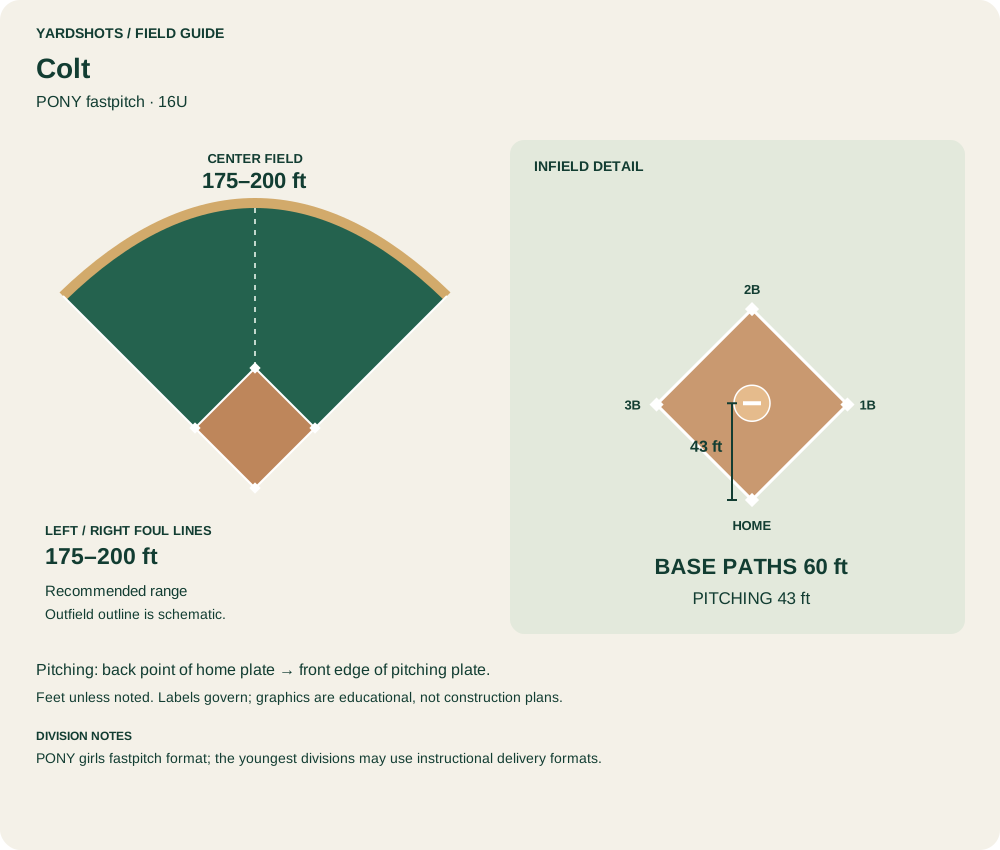
PONY girls fastpitch format; the youngest divisions may use instructional delivery formats.
2026 PONY Girls Softball Rulebook, distance chart and Rule 2 (public copy) · PONY current softball rulebook hub
Download SVG · Download PNG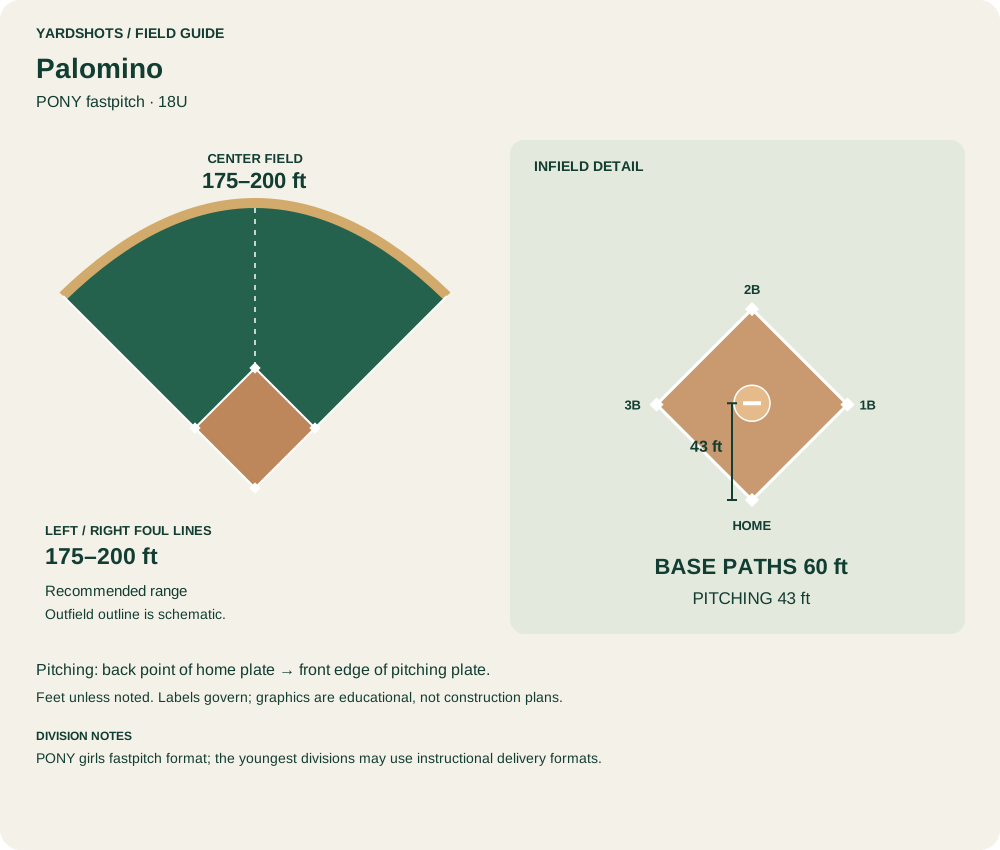
PONY girls fastpitch format; the youngest divisions may use instructional delivery formats.
2026 PONY Girls Softball Rulebook, distance chart and Rule 2 (public copy) · PONY current softball rulebook hub
Download SVG · Download PNG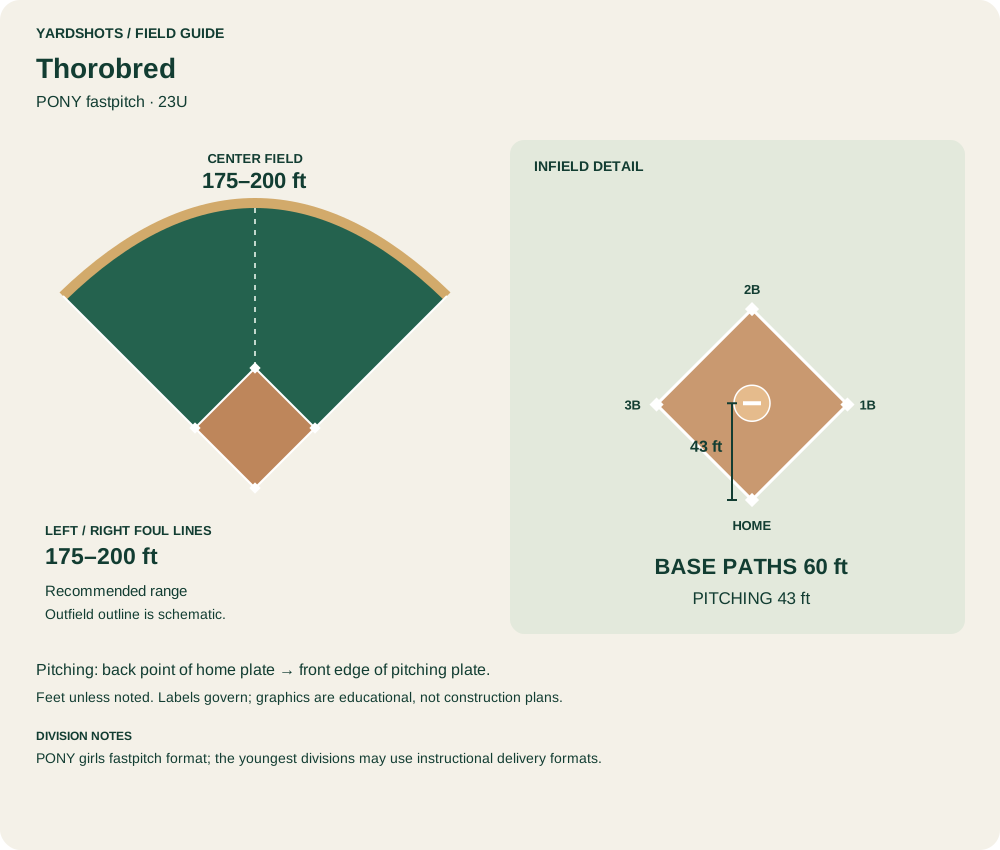
PONY girls fastpitch format; the youngest divisions may use instructional delivery formats.
2026 PONY Girls Softball Rulebook, distance chart and Rule 2 (public copy) · PONY current softball rulebook hub
Download SVG · Download PNG| Division | Age / level | Bases | Pitching | Foul lines | Center | Fence status |
|---|---|---|---|---|---|---|
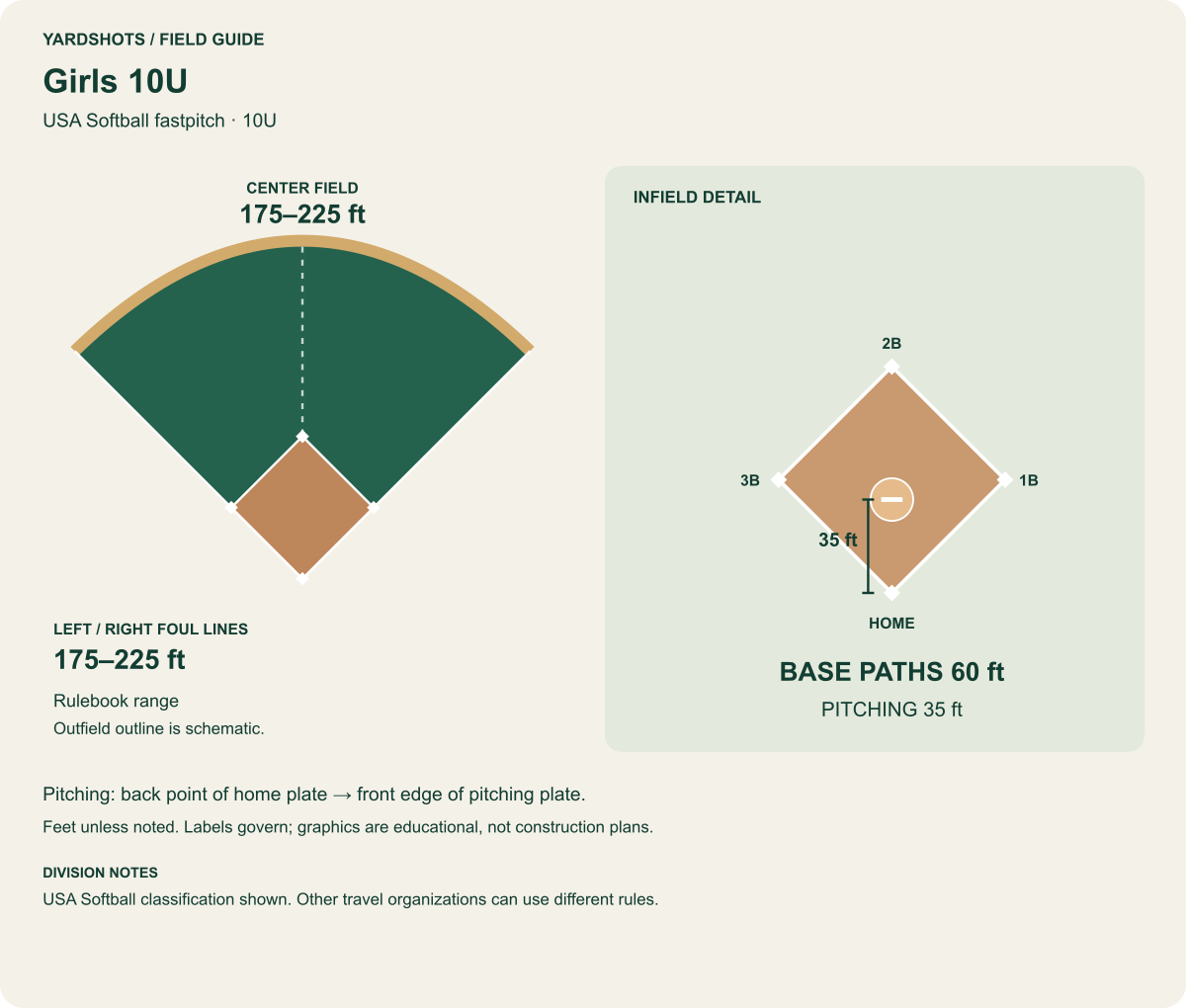
| Girls 10U | 10U | 60 ft | 35 ft | 175–225 | 175–225 | Rulebook range |
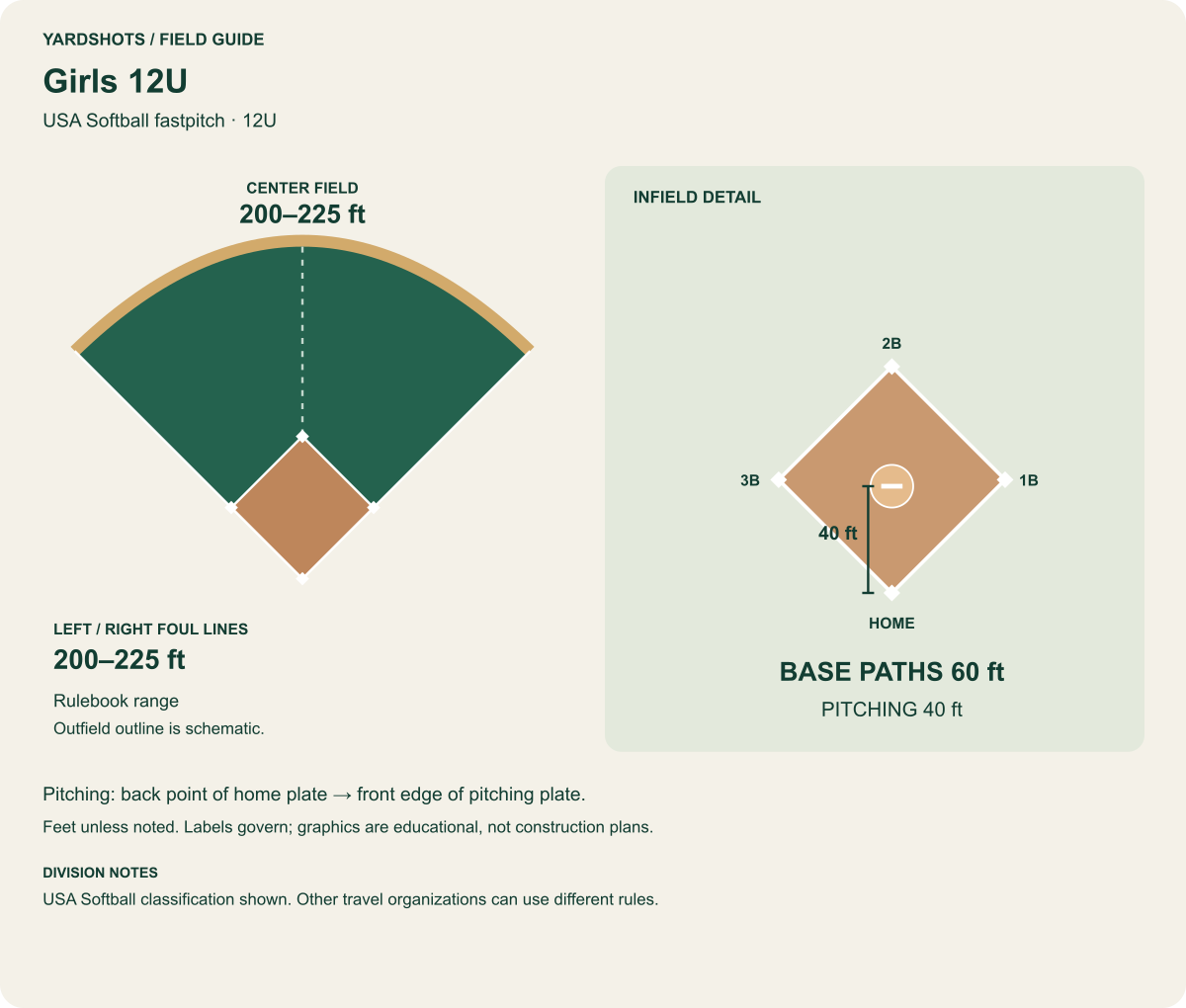
| Girls 12U | 12U | 60 ft | 40 ft | 200–225 | 200–225 | Rulebook range |
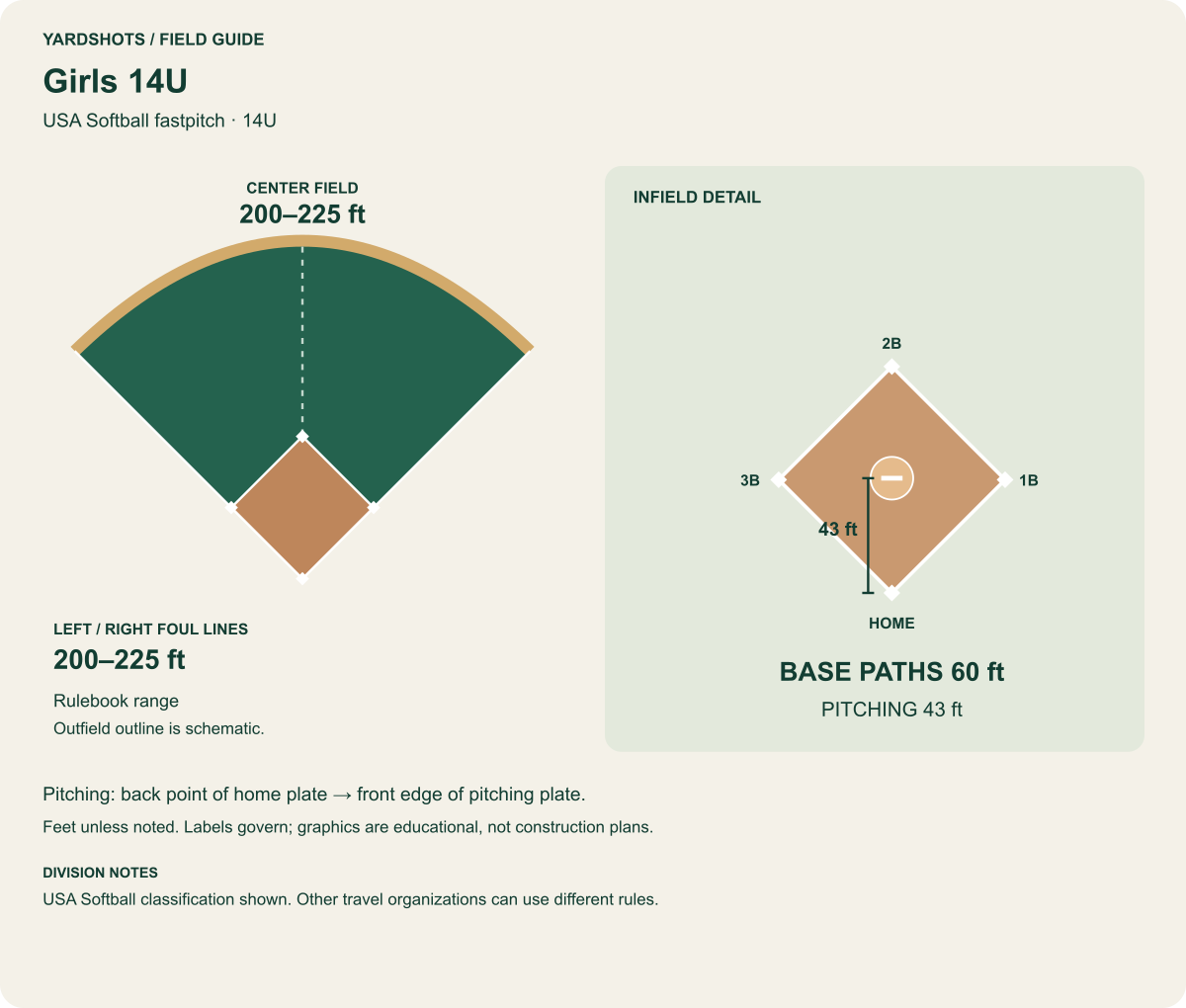
| Girls 14U | 14U | 60 ft | 43 ft | 200–225 | 200–225 | Rulebook range |
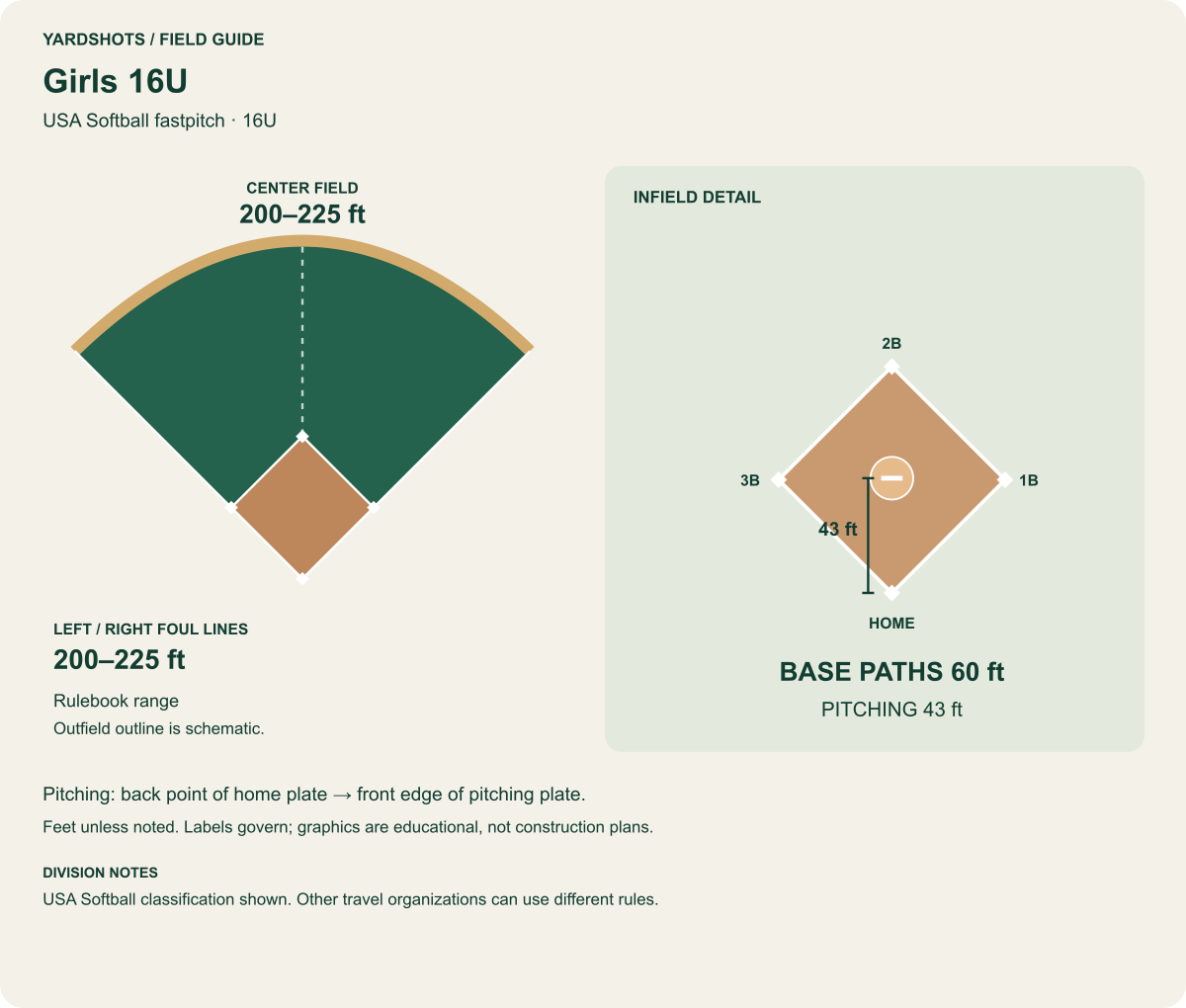
| Girls 16U | 16U | 60 ft | 43 ft | 200–225 | 200–225 | Rulebook range |
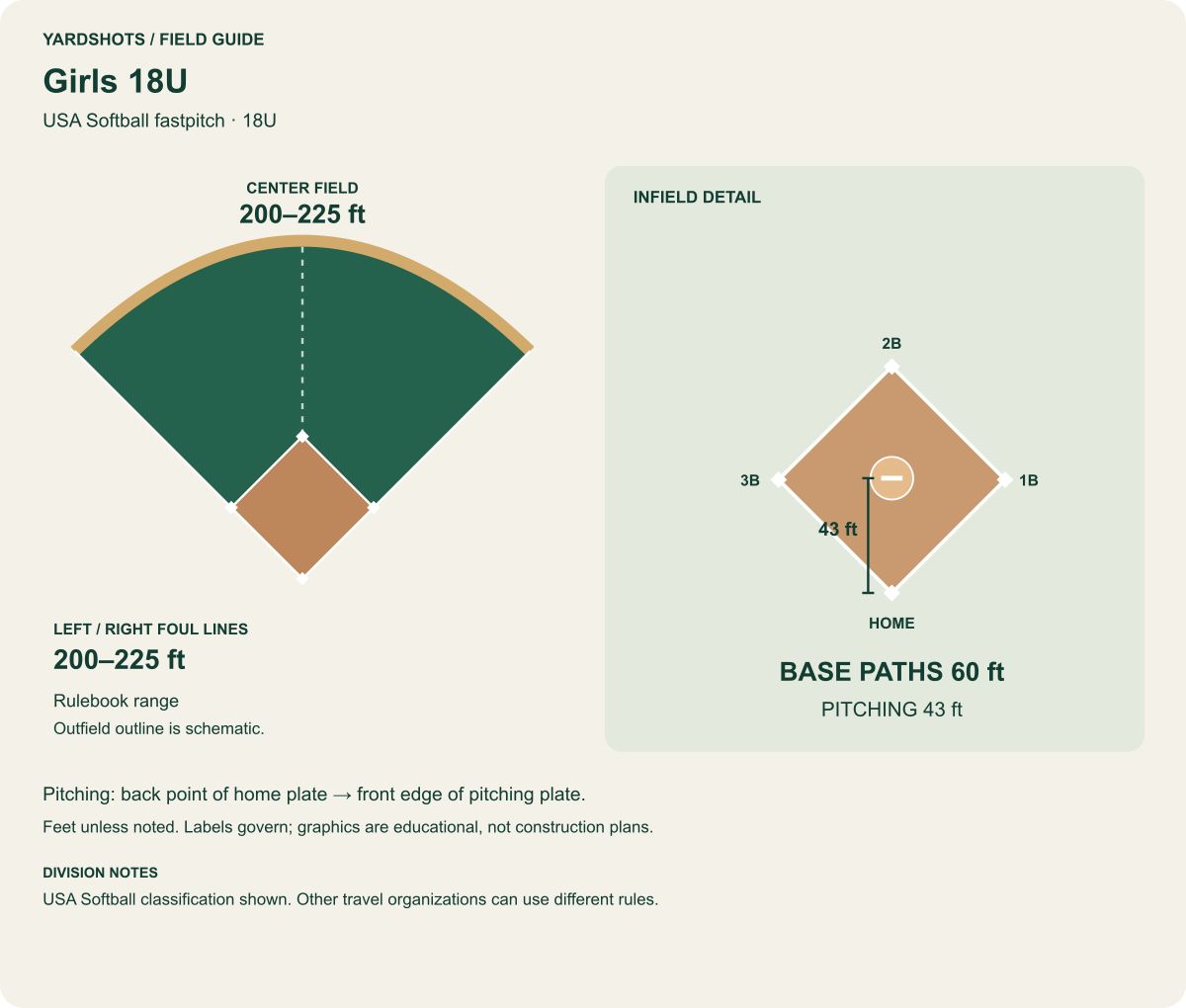
| Girls 18U | 18U | 60 ft | 43 ft | 200–225 | 200–225 | Rulebook range |
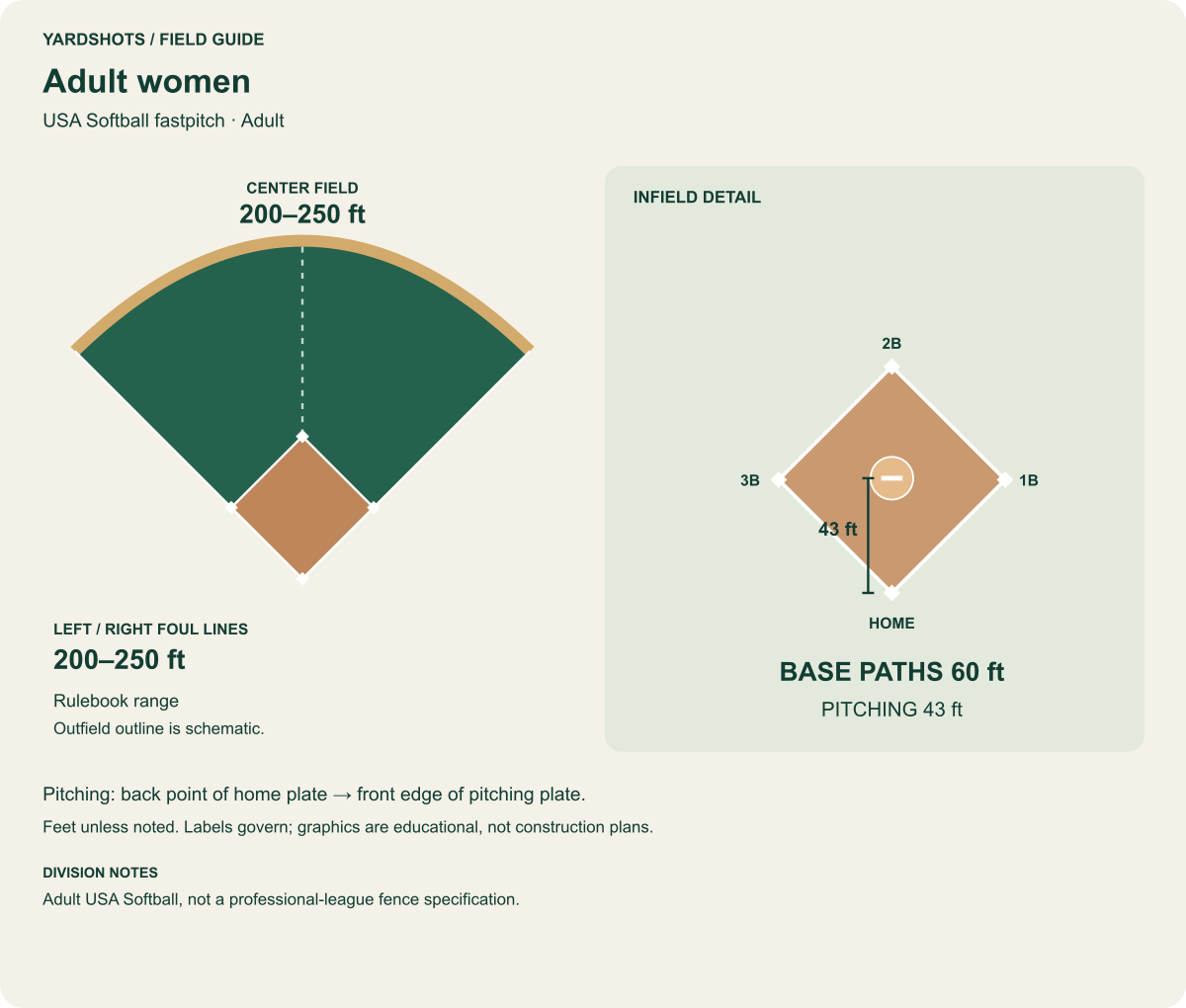
| Adult women | Adult | 60 ft | 43 ft | 200–250 | 200–250 | Rulebook range |
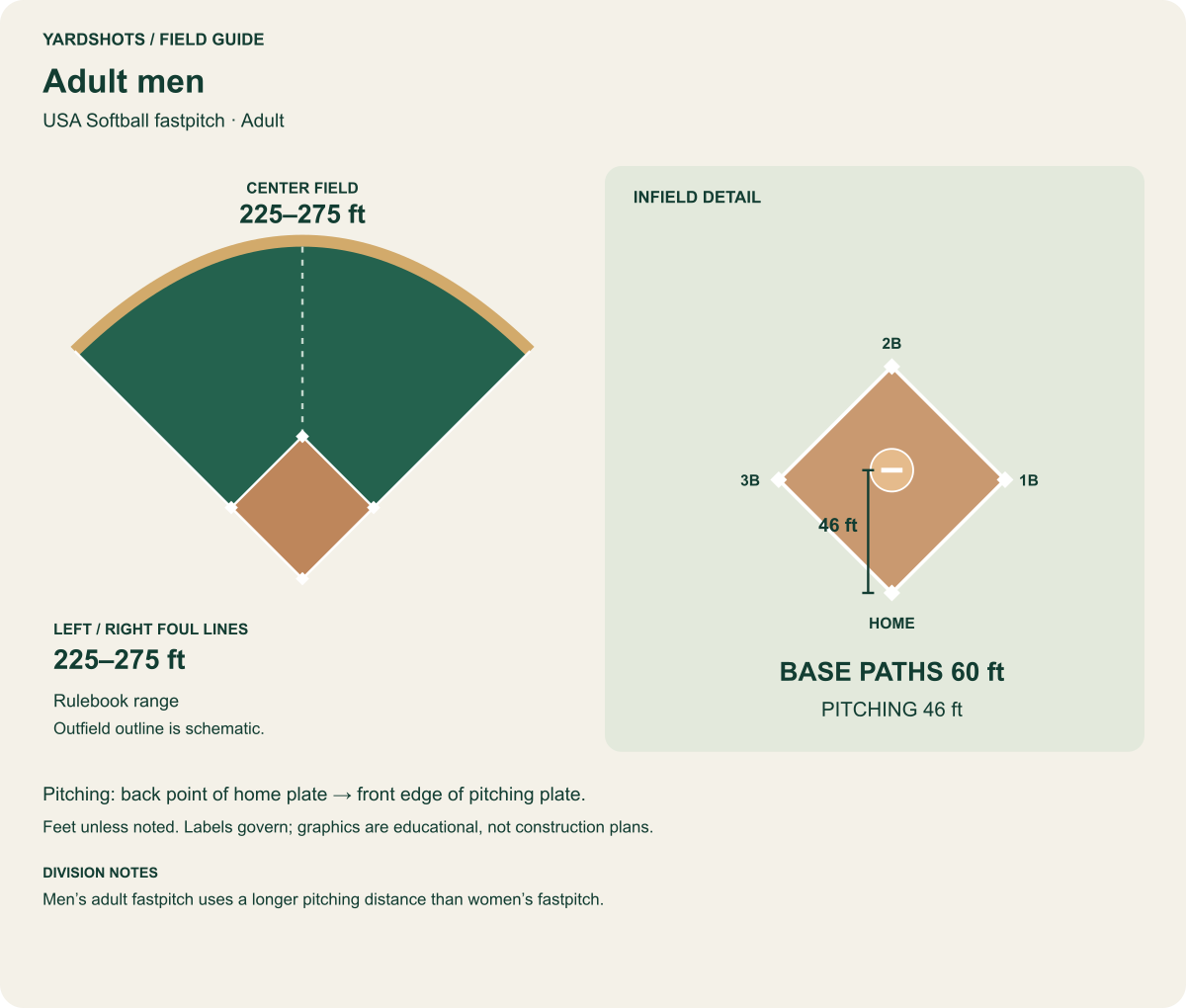
| Adult men | Adult | 60 ft | 46 ft | 225–275 | 225–275 | Rulebook range |
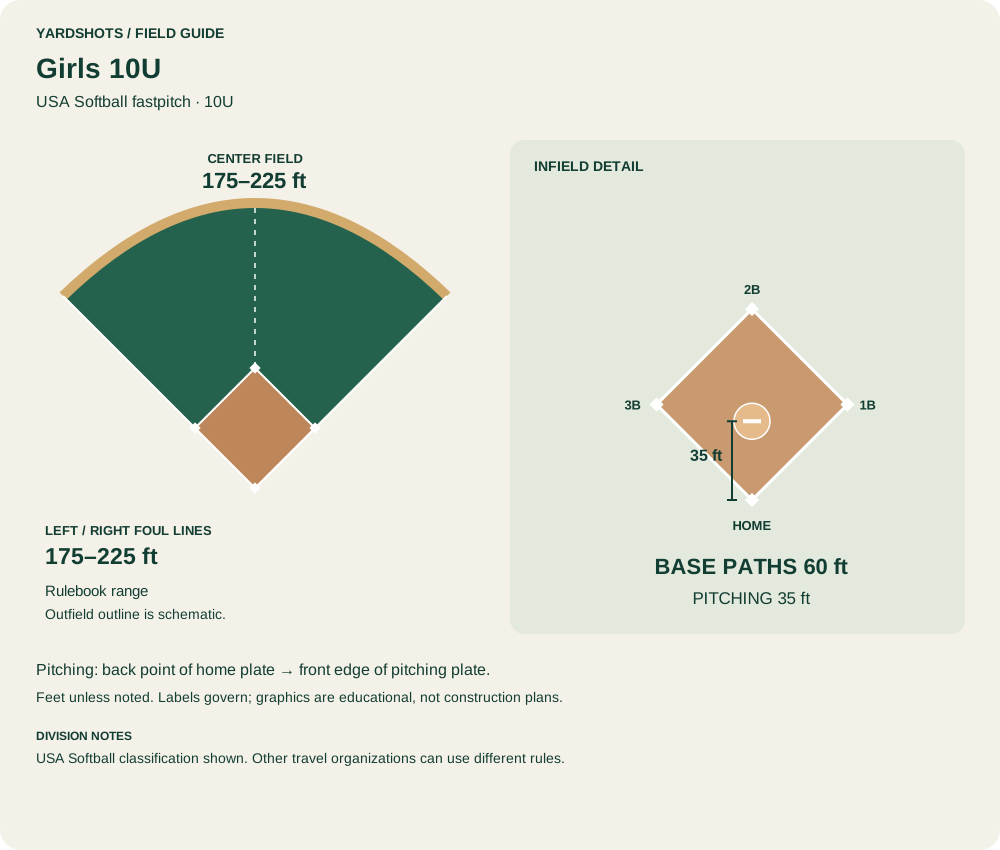
USA Softball classification shown. Other travel organizations can use different rules.
USA Softball rules, 2026, Rule 2 distance table
Download SVG · Download PNG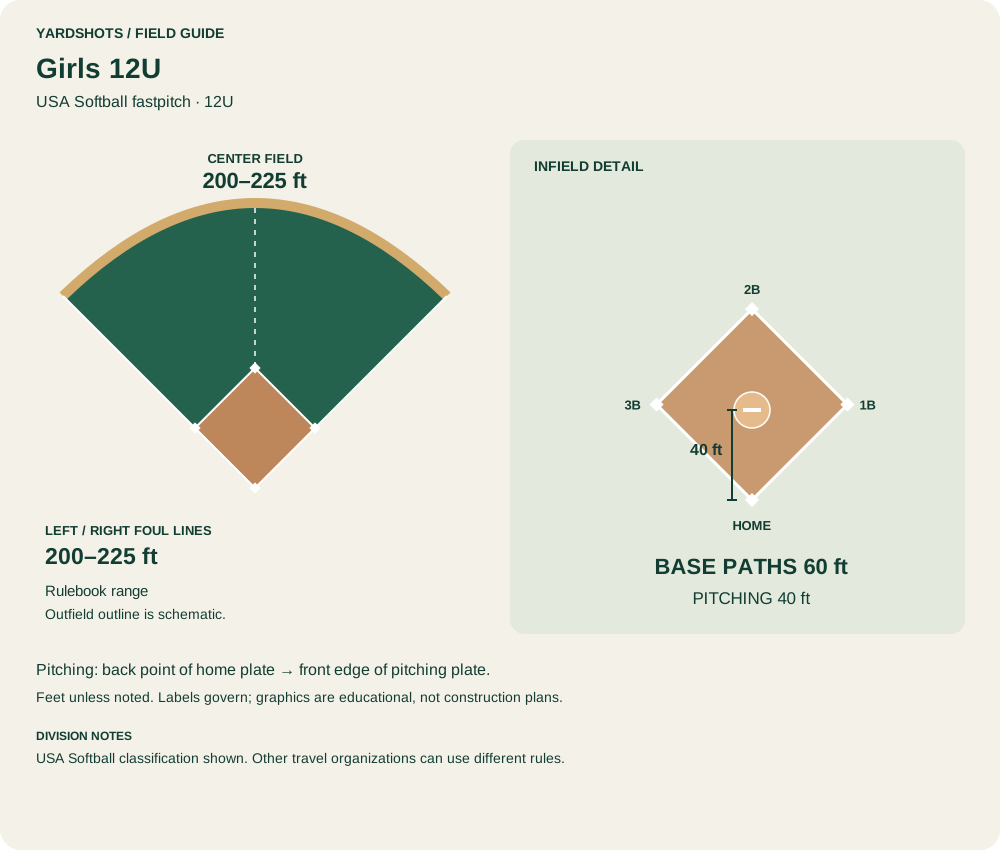
USA Softball classification shown. Other travel organizations can use different rules.
USA Softball rules, 2026, Rule 2 distance table
Download SVG · Download PNG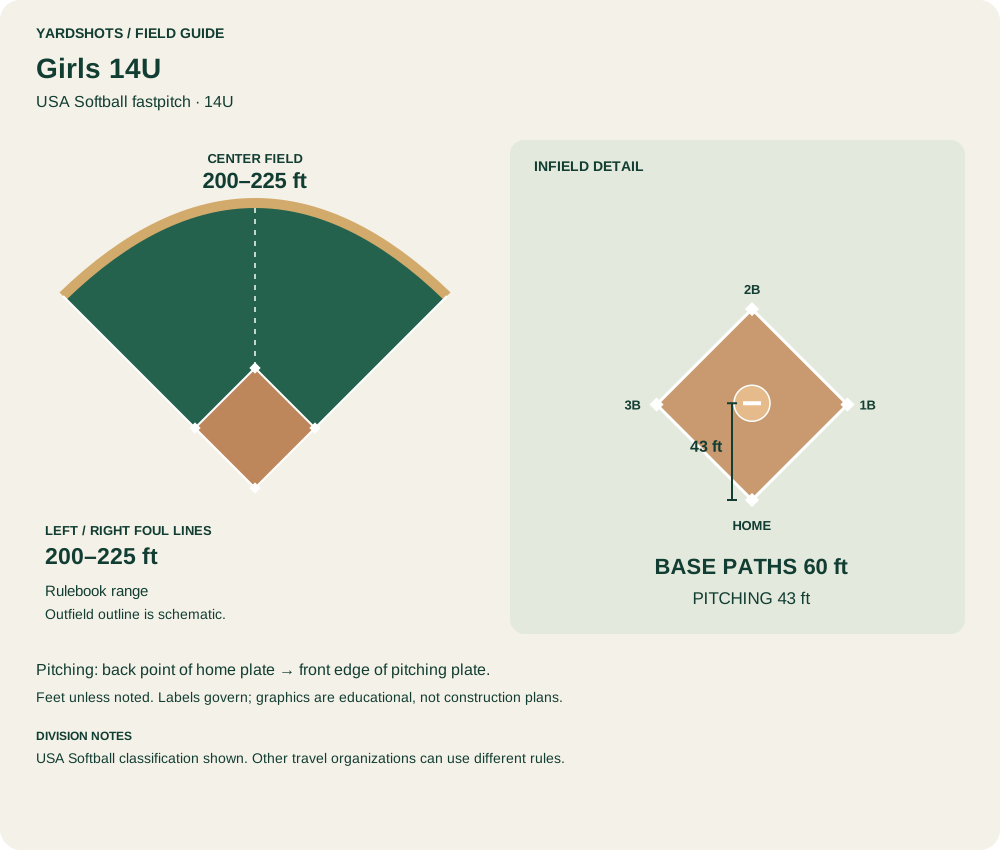
USA Softball classification shown. Other travel organizations can use different rules.
USA Softball rules, 2026, Rule 2 distance table
Download SVG · Download PNG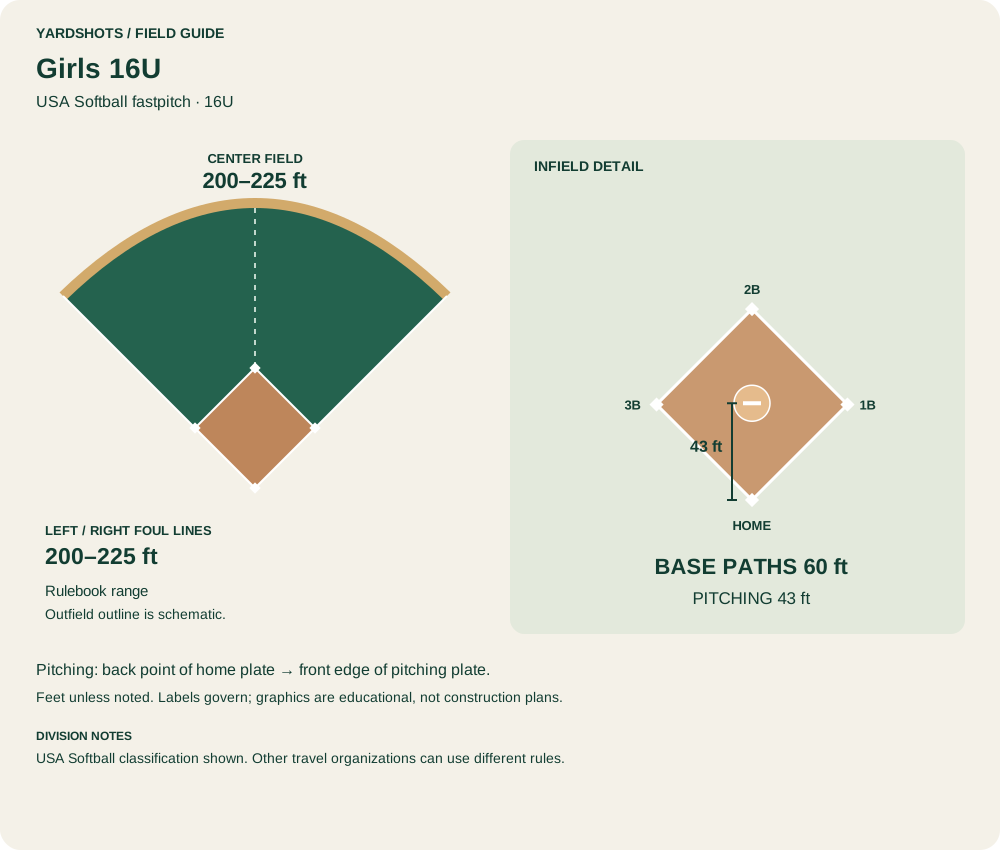
USA Softball classification shown. Other travel organizations can use different rules.
USA Softball rules, 2026, Rule 2 distance table
Download SVG · Download PNG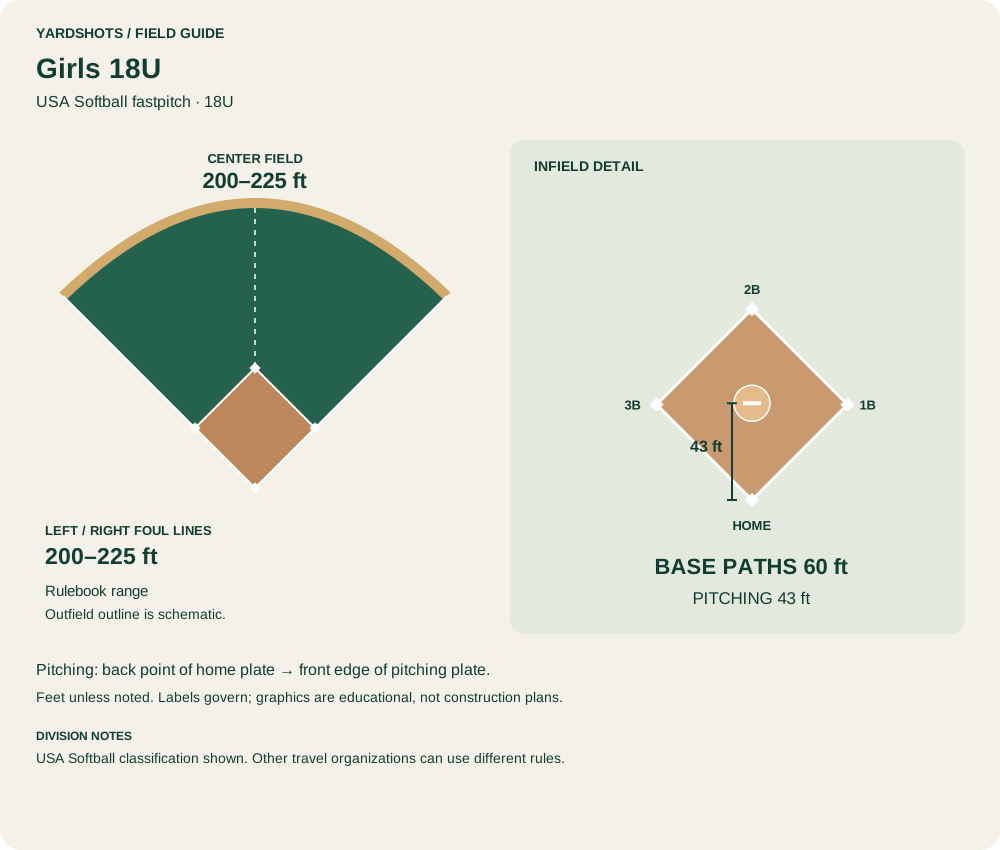
USA Softball classification shown. Other travel organizations can use different rules.
USA Softball rules, 2026, Rule 2 distance table
Download SVG · Download PNG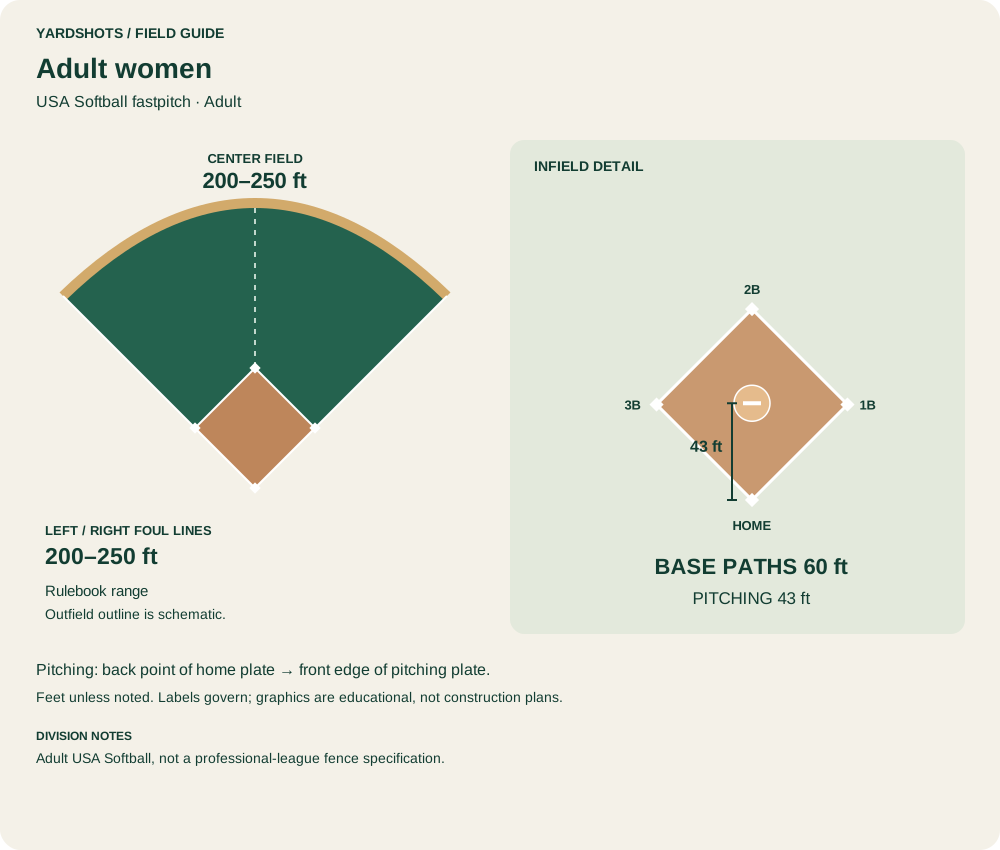
Adult USA Softball, not a professional-league fence specification.
USA Softball rules, 2026, Rule 2 distance table
Download SVG · Download PNG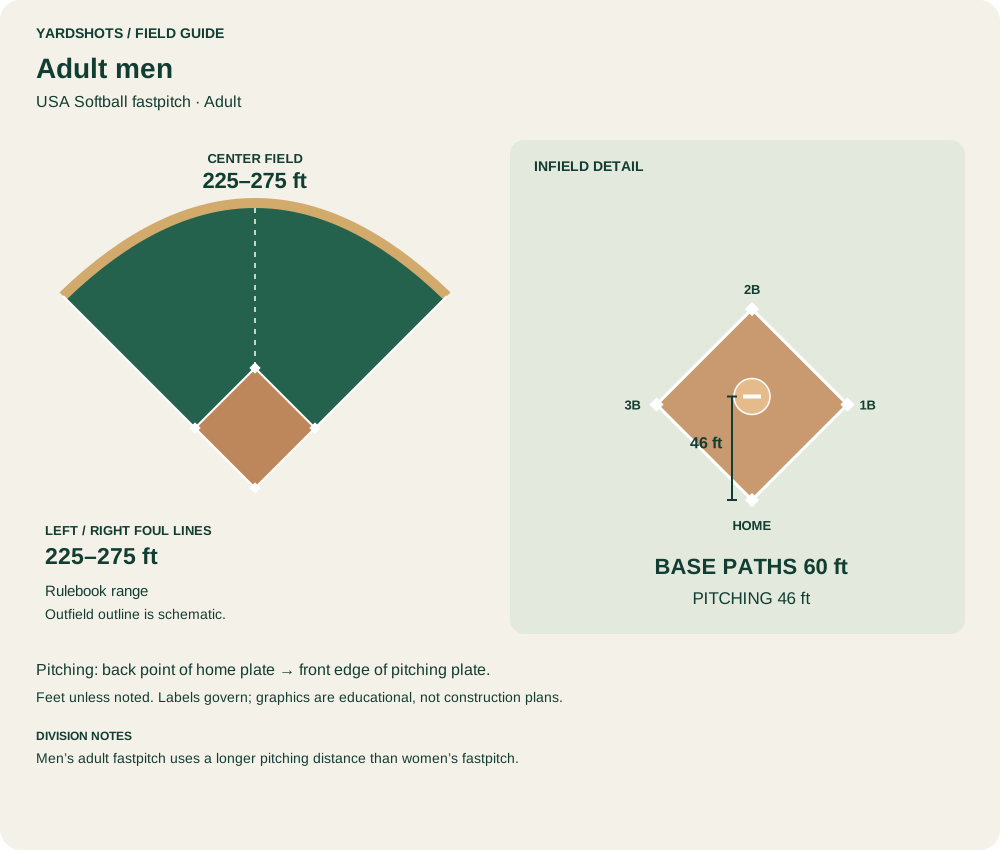
Men’s adult fastpitch uses a longer pitching distance than women’s fastpitch.
USA Softball rules, 2026, Rule 2 distance table
Download SVG · Download PNG| Division | Age / level | Bases | Pitching | Foul lines | Center | Fence status |
|---|---|---|---|---|---|---|
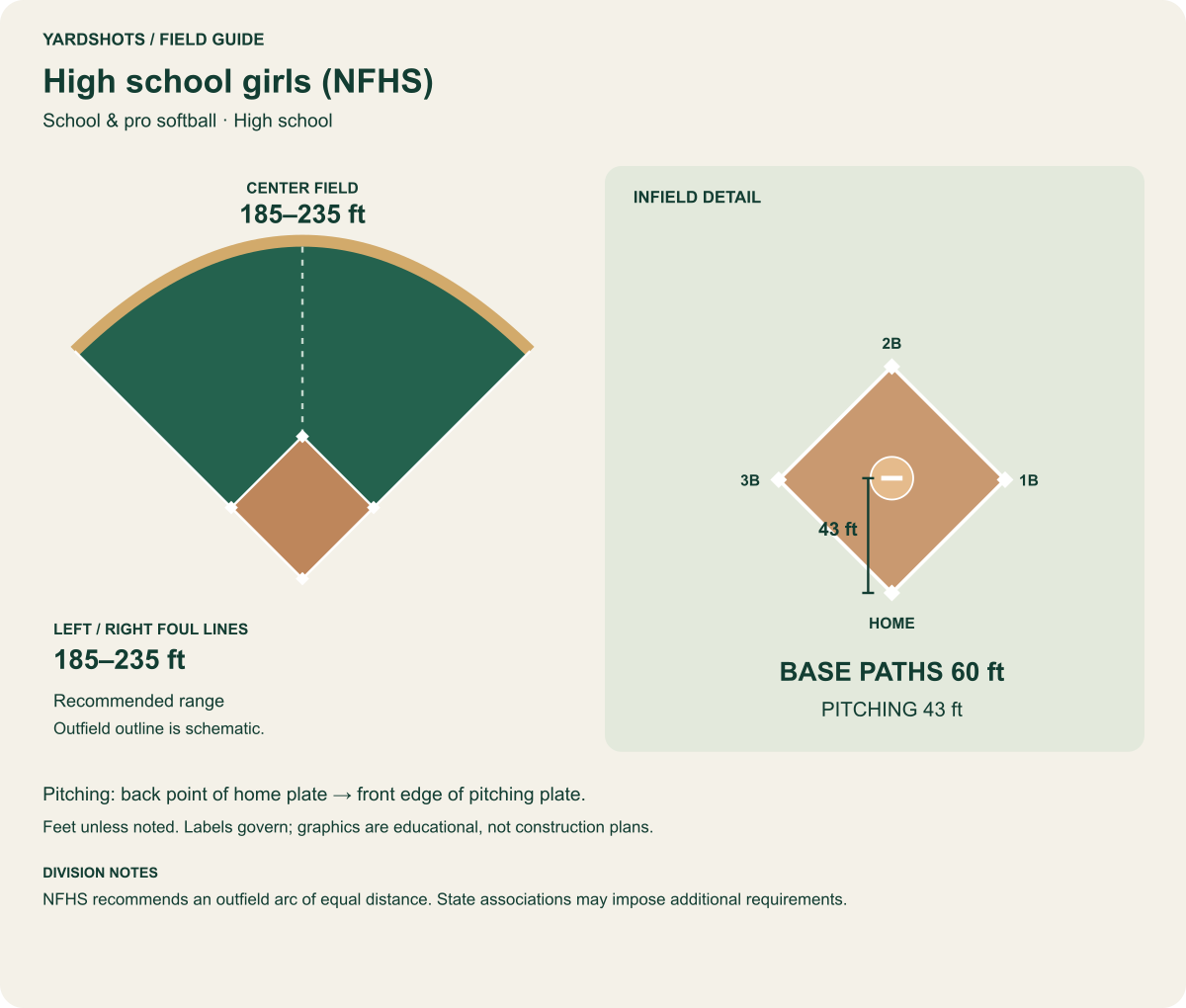
| High school girls (NFHS) | High school | 60 ft | 43 ft | 185–235 | 185–235 | Recommended range |
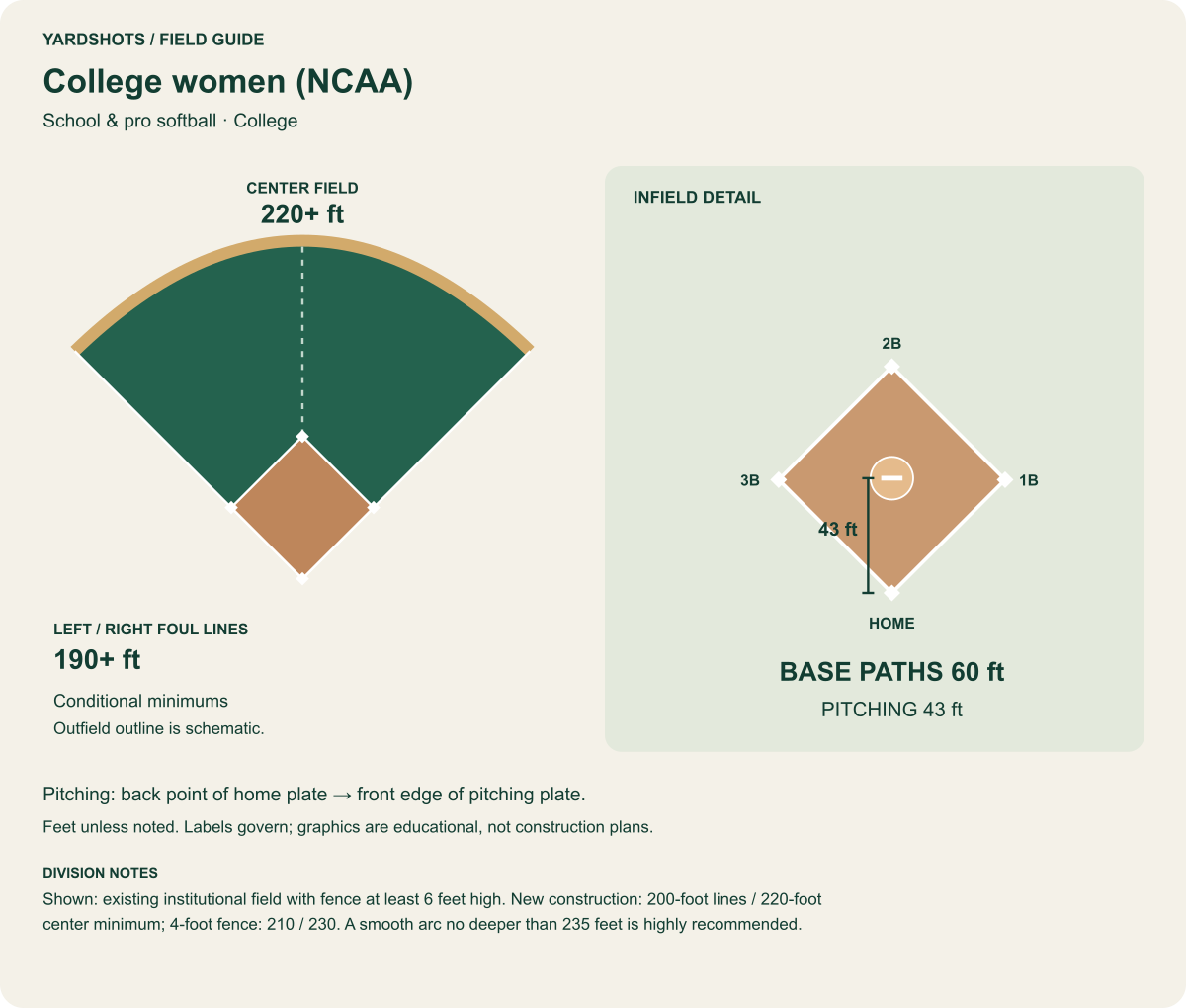
| College women (NCAA) | College | 60 ft | 43 ft | 190+ | 220+ | Conditional minimums |
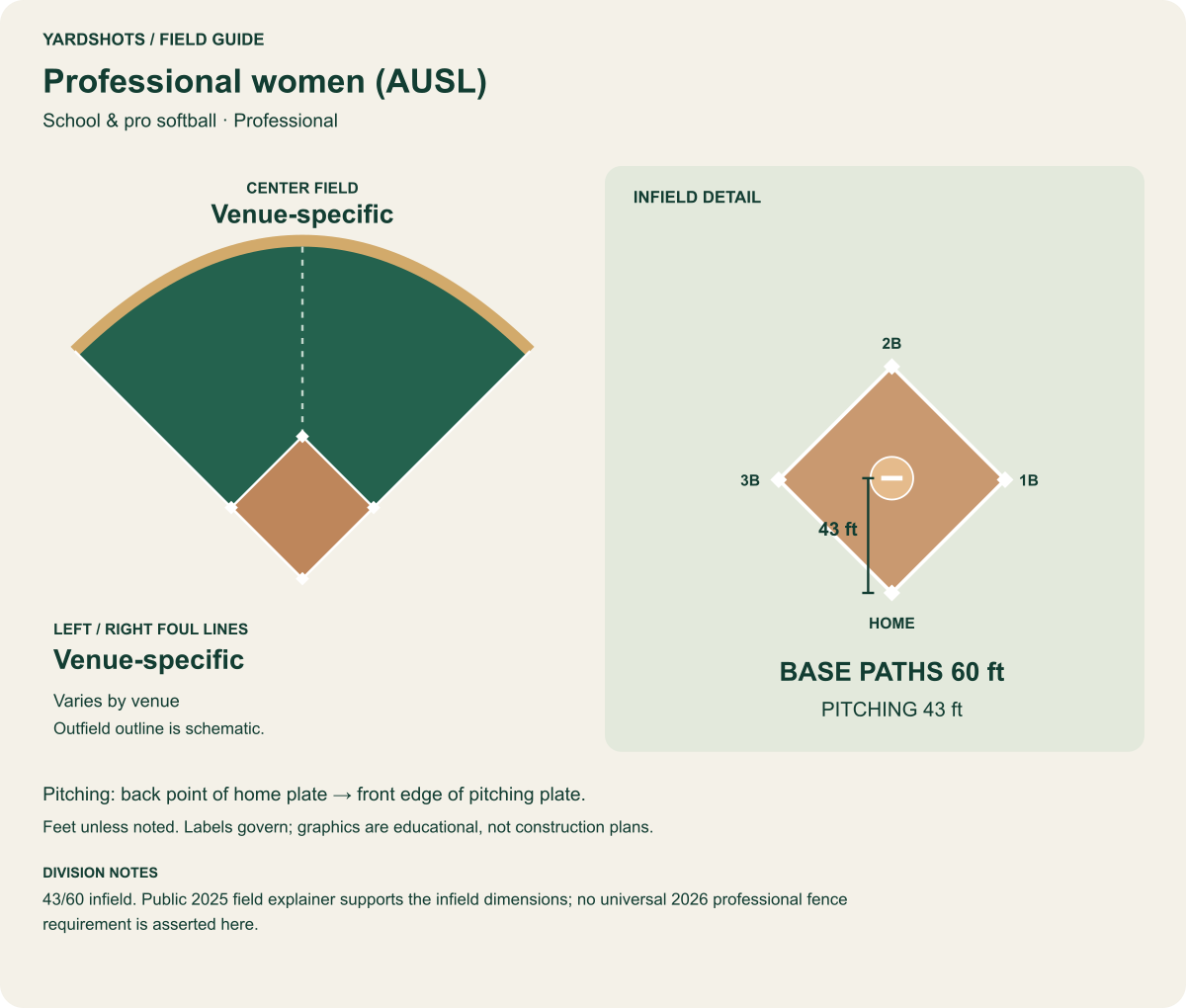
| Professional women (AUSL) | Professional | 60 ft | 43 ft | Venue-specific | Venue-specific | Varies by venue |
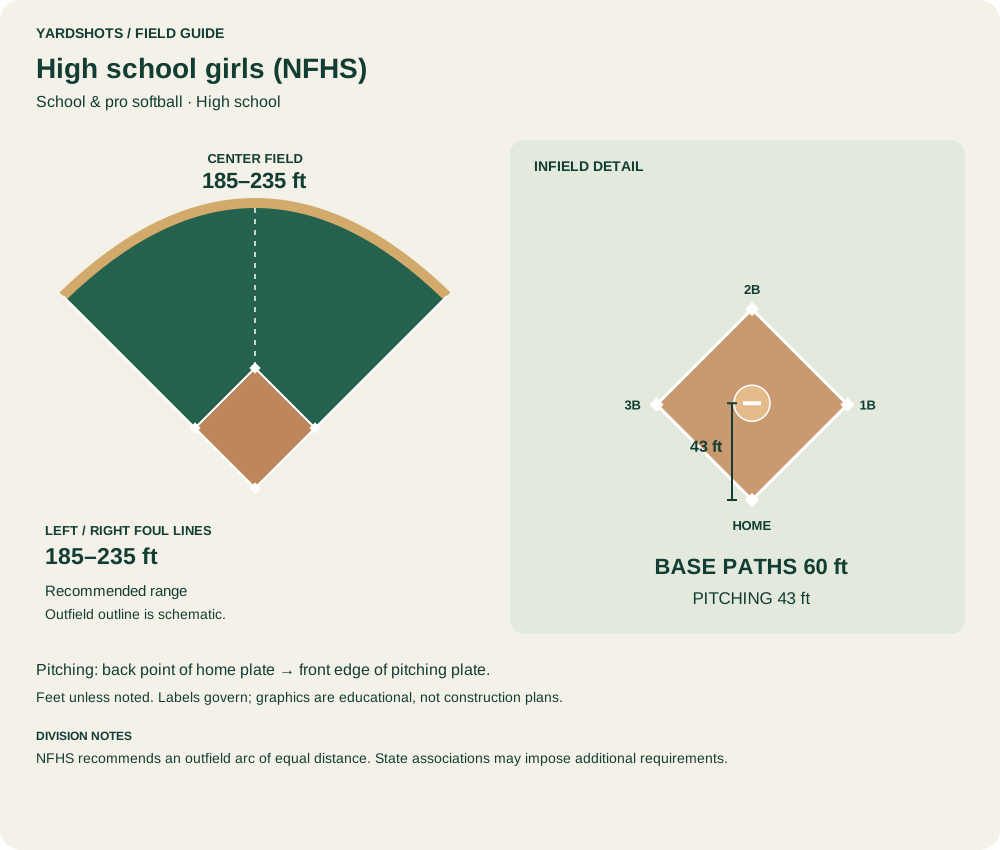
NFHS recommends an outfield arc of equal distance. State associations may impose additional requirements.
NFHS softball field diagrams, 2025
Download SVG · Download PNG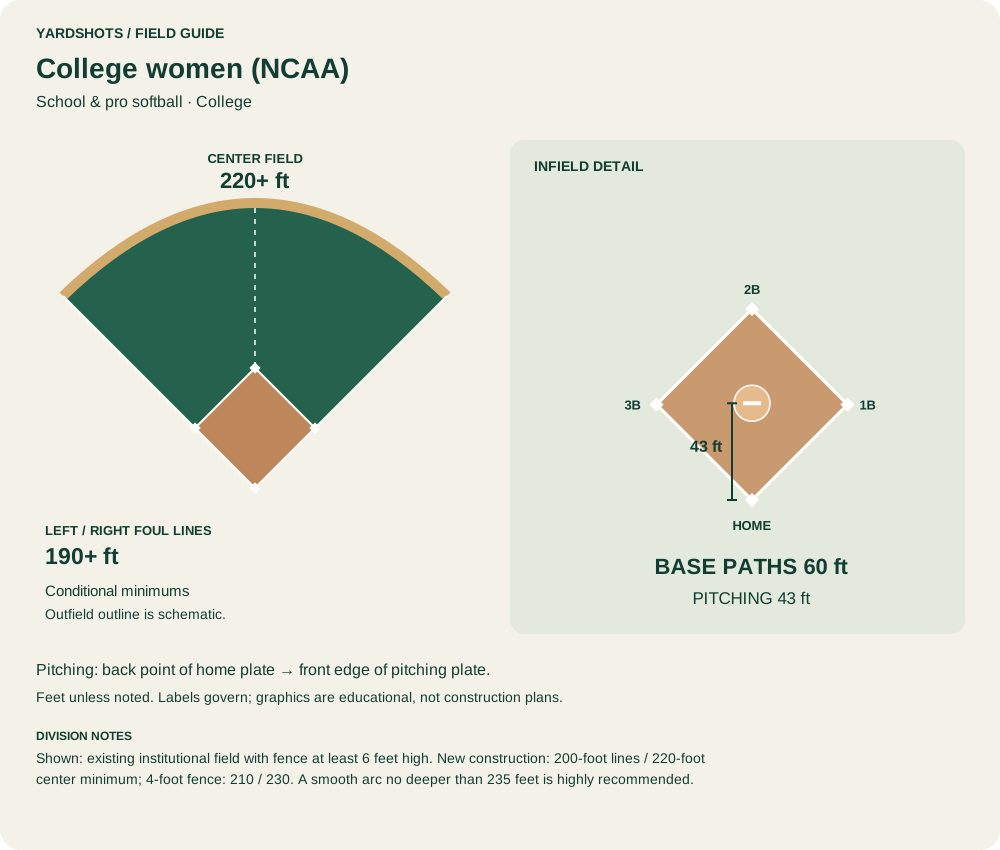
Shown: existing institutional field with fence at least 6 feet high. New construction: 200-foot lines / 220-foot center minimum; 4-foot fence: 210 / 230. A smooth arc no deeper than 235 feet is highly recommended.
NCAA softball rules, 2026–27, Rule 2
Download SVG · Download PNG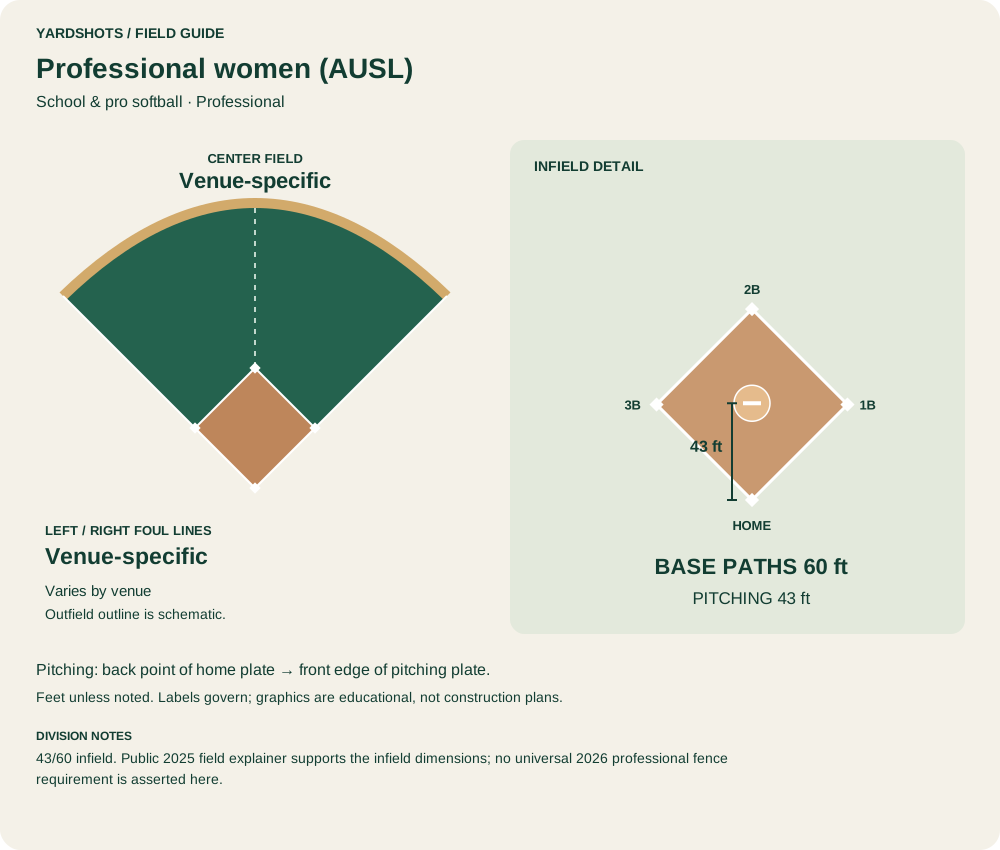
43/60 infield. Public 2025 field explainer supports the infield dimensions; no universal 2026 professional fence requirement is asserted here.
AUSL field explainer, FanSided, July 2025
Download SVG · Download PNG| Division | Age / level | Bases | Pitching | Foul lines | Center | Fence status |
|---|---|---|---|---|---|---|
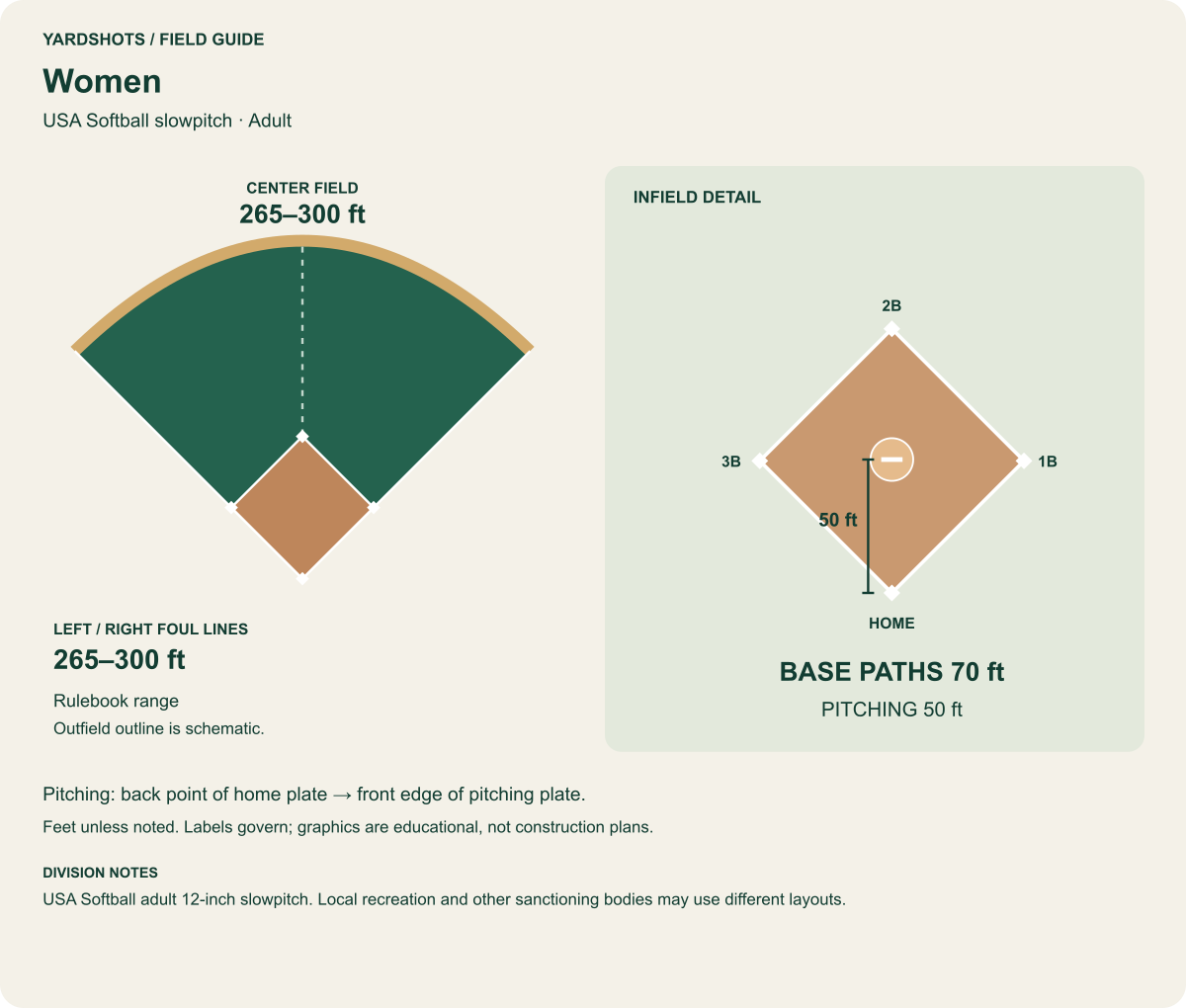
| Women | Adult | 70 ft | 50 ft | 265–300 | 265–300 | Rulebook range |
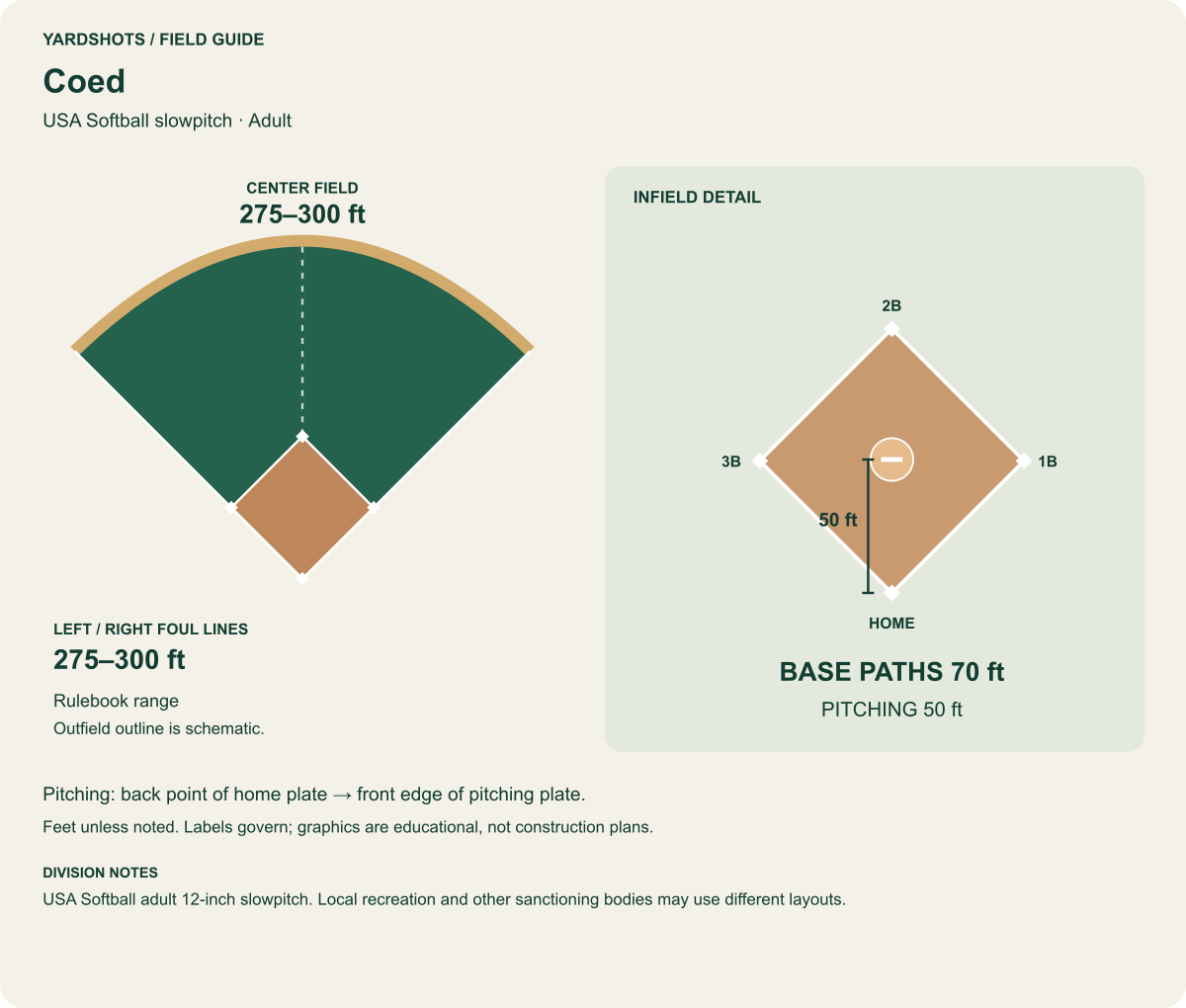
| Coed | Adult | 70 ft | 50 ft | 275–300 | 275–300 | Rulebook range |
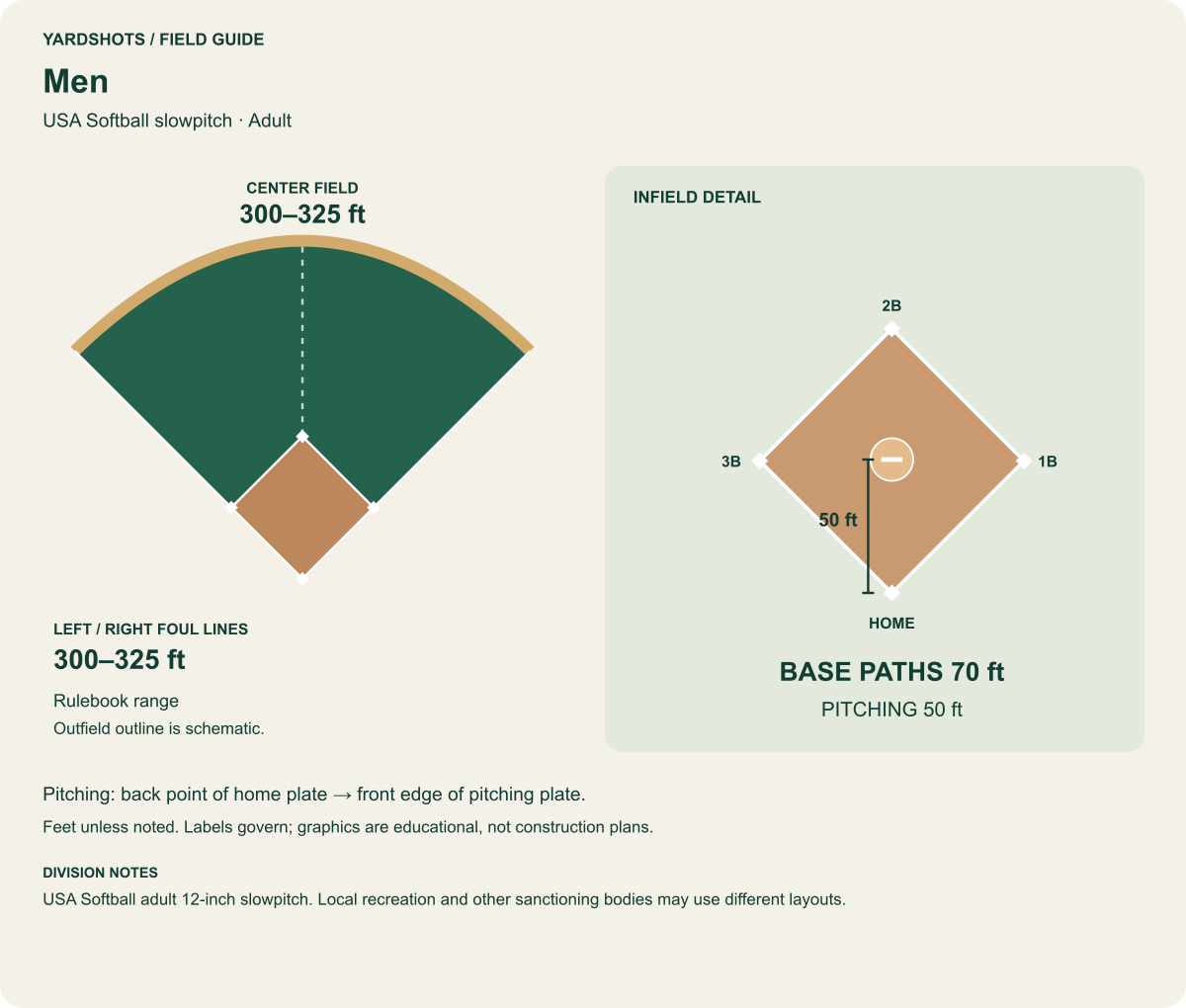
| Men | Adult | 70 ft | 50 ft | 300–325 | 300–325 | Rulebook range |
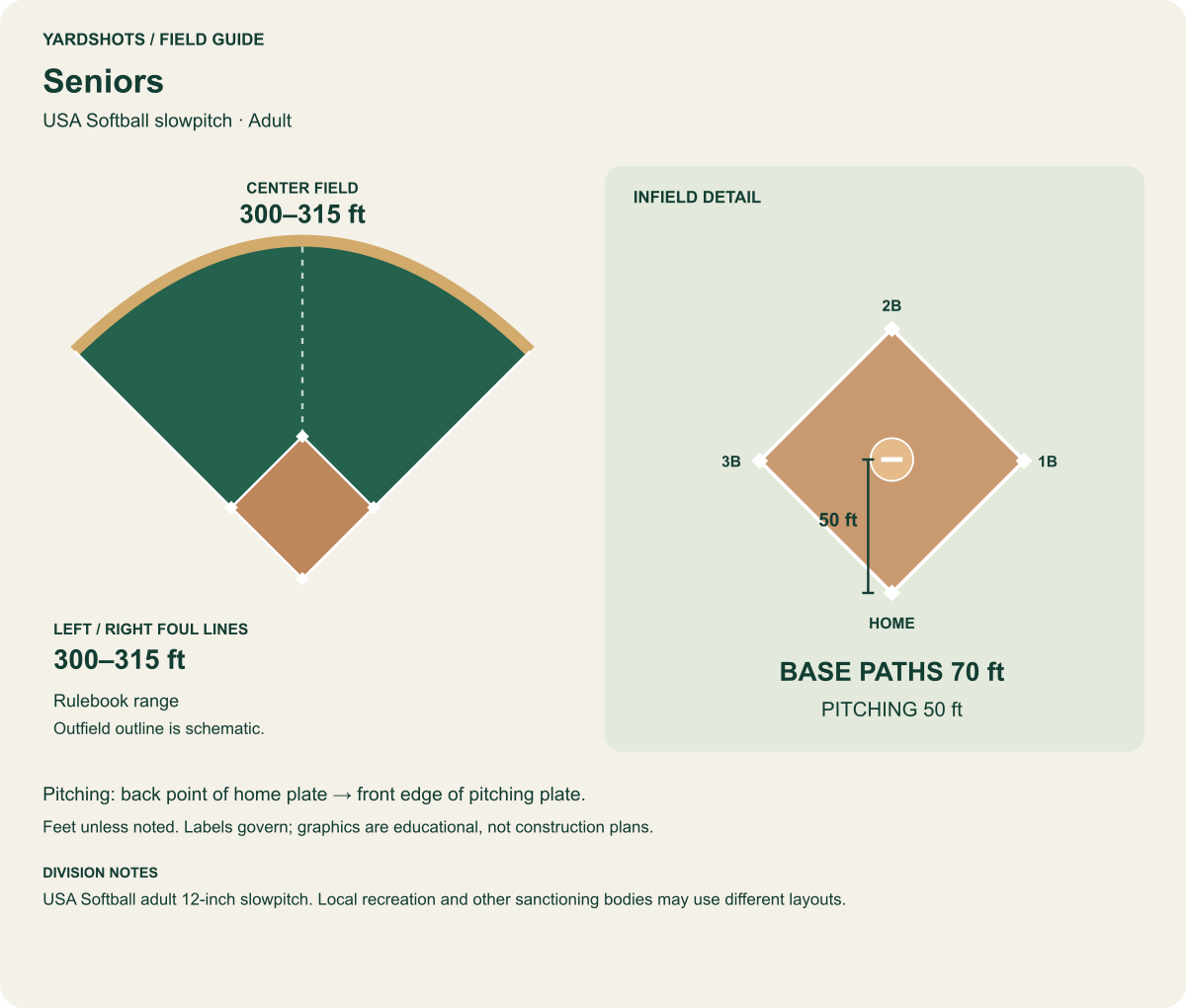
| Seniors | Adult | 70 ft | 50 ft | 300–315 | 300–315 | Rulebook range |
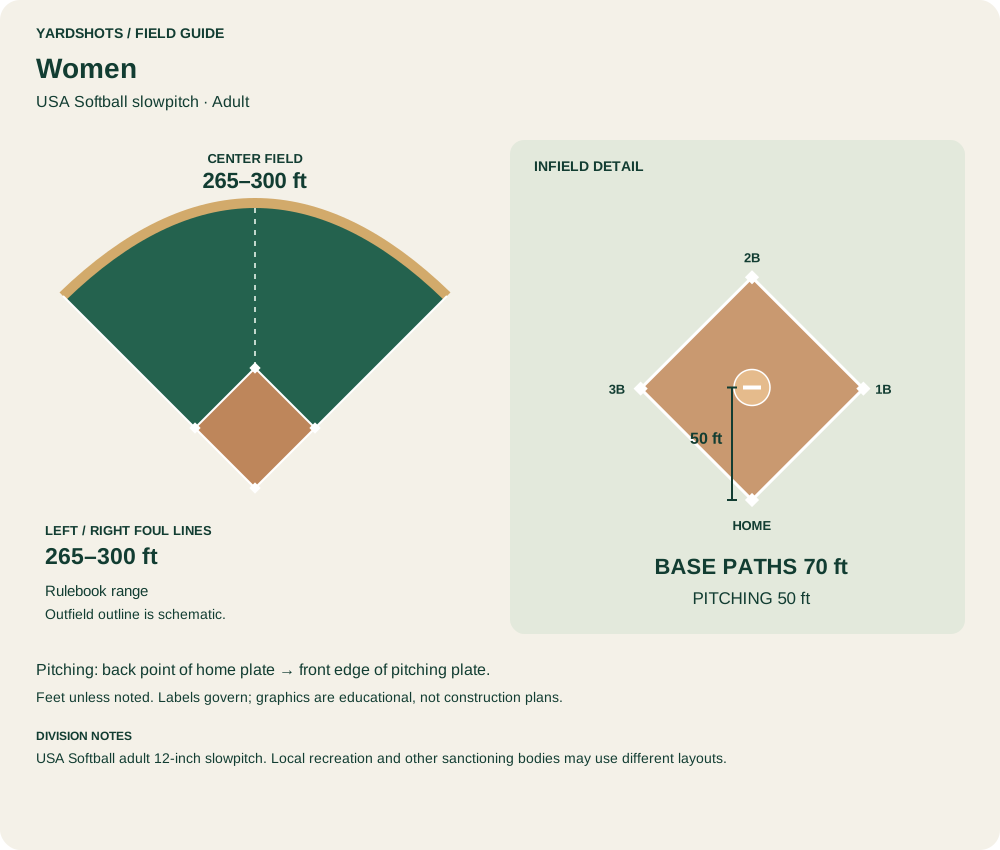
USA Softball adult 12-inch slowpitch. Local recreation and other sanctioning bodies may use different layouts.
USA Softball rules, 2026, Rule 2 distance table
Download SVG · Download PNG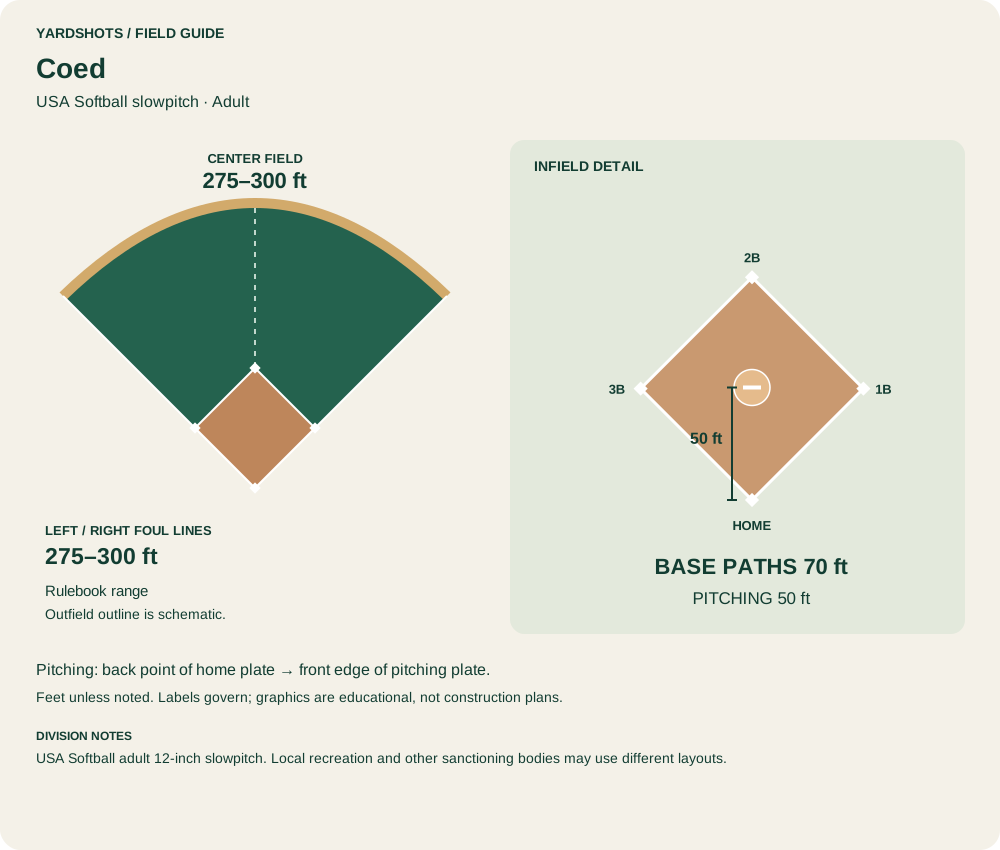
USA Softball adult 12-inch slowpitch. Local recreation and other sanctioning bodies may use different layouts.
USA Softball rules, 2026, Rule 2 distance table
Download SVG · Download PNG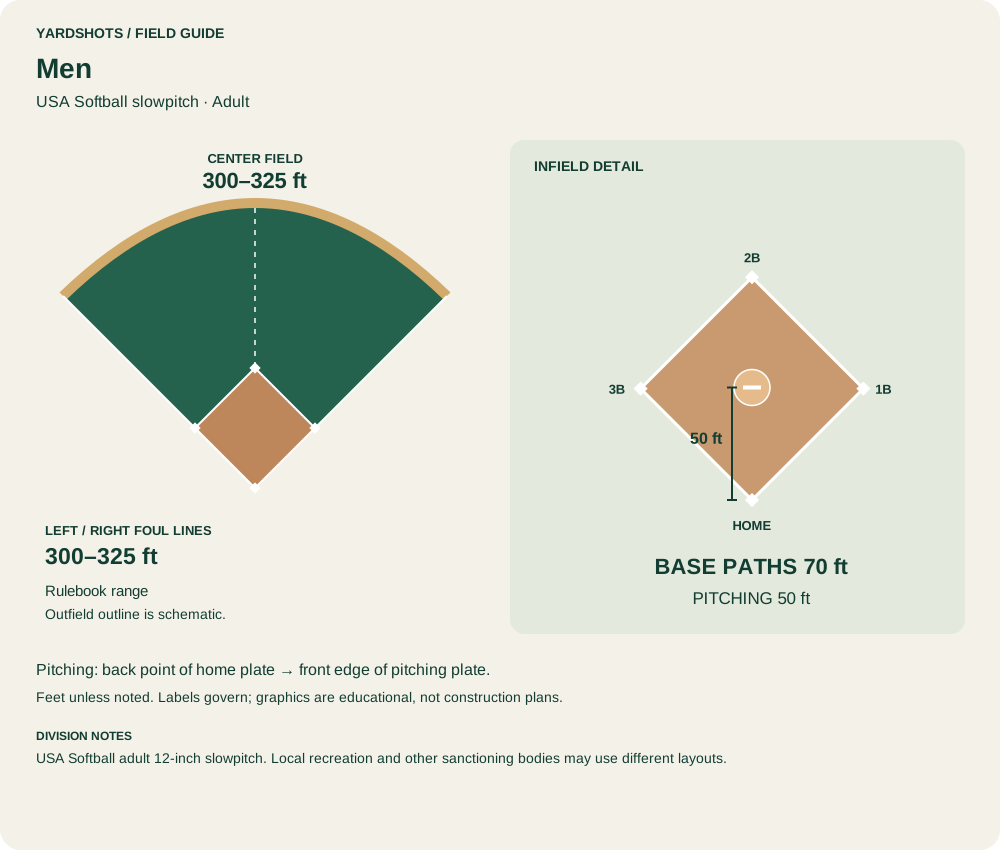
USA Softball adult 12-inch slowpitch. Local recreation and other sanctioning bodies may use different layouts.
USA Softball rules, 2026, Rule 2 distance table
Download SVG · Download PNG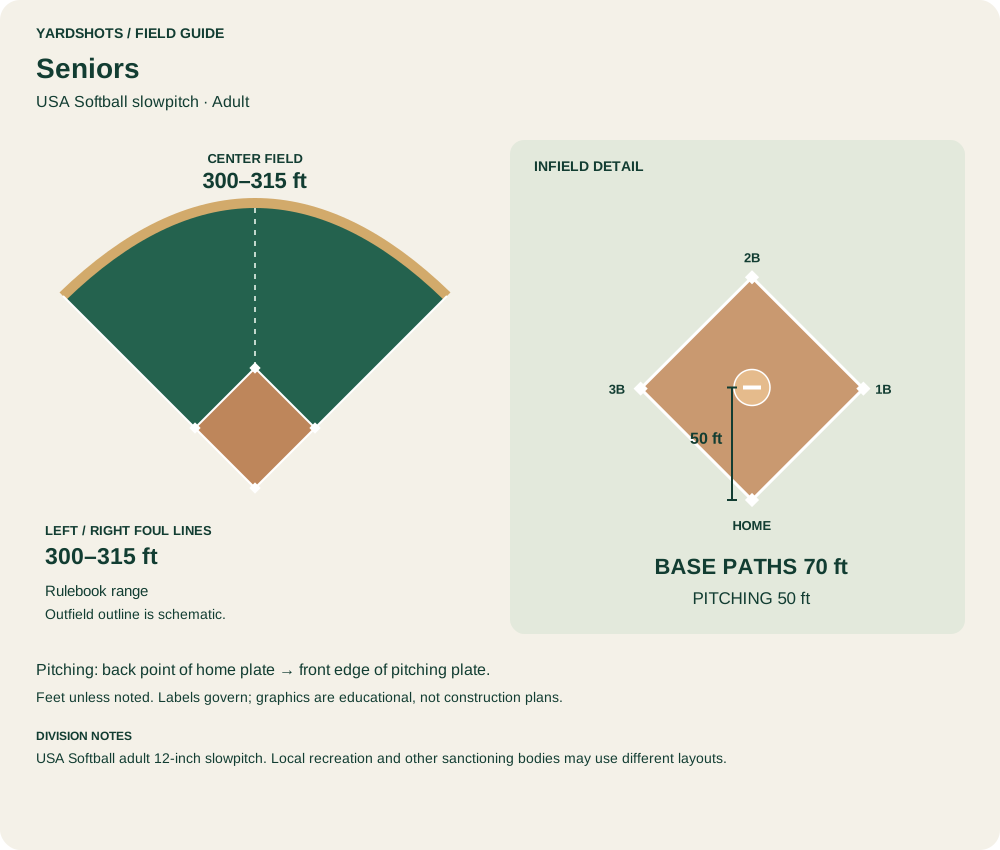
USA Softball adult 12-inch slowpitch. Local recreation and other sanctioning bodies may use different layouts.
USA Softball rules, 2026, Rule 2 distance table
Download SVG · Download PNG| Division | Age / level | Bases | Pitching | Foul lines | Center | Fence status |
|---|---|---|---|---|---|---|
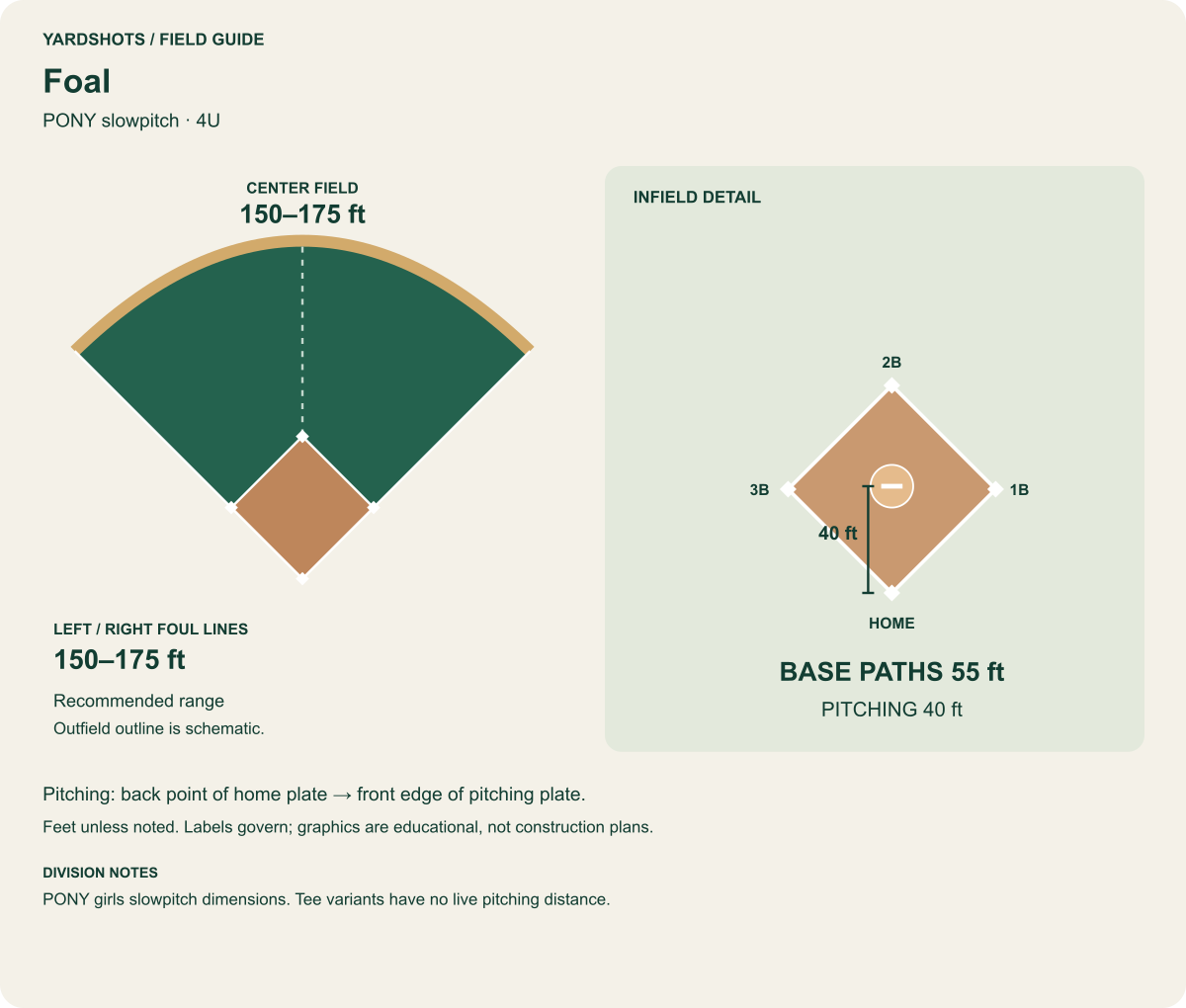
| Foal | 4U | 55 ft | 40 ft | 150–175 | 150–175 | Recommended range |
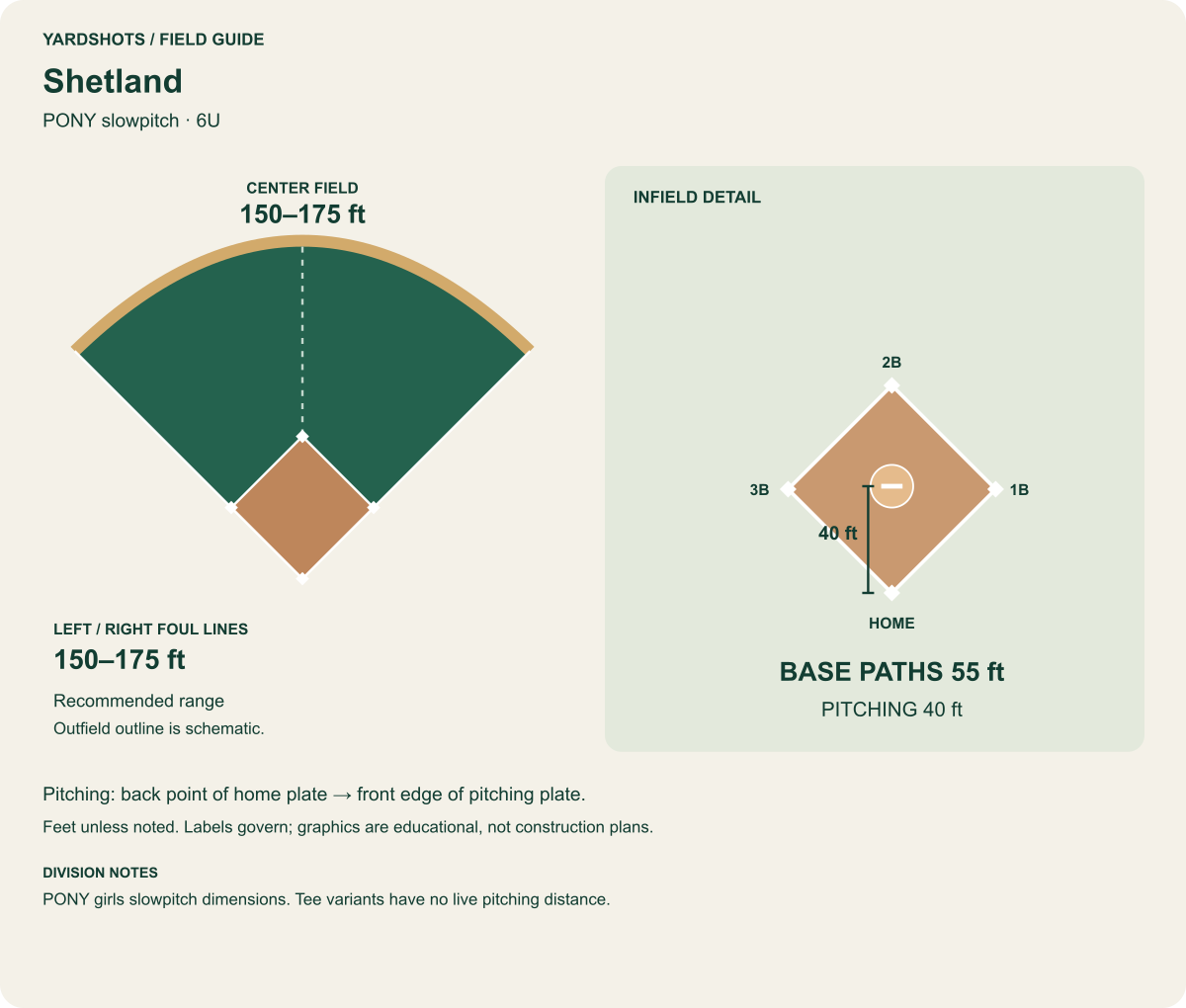
| Shetland | 6U | 55 ft | 40 ft | 150–175 | 150–175 | Recommended range |
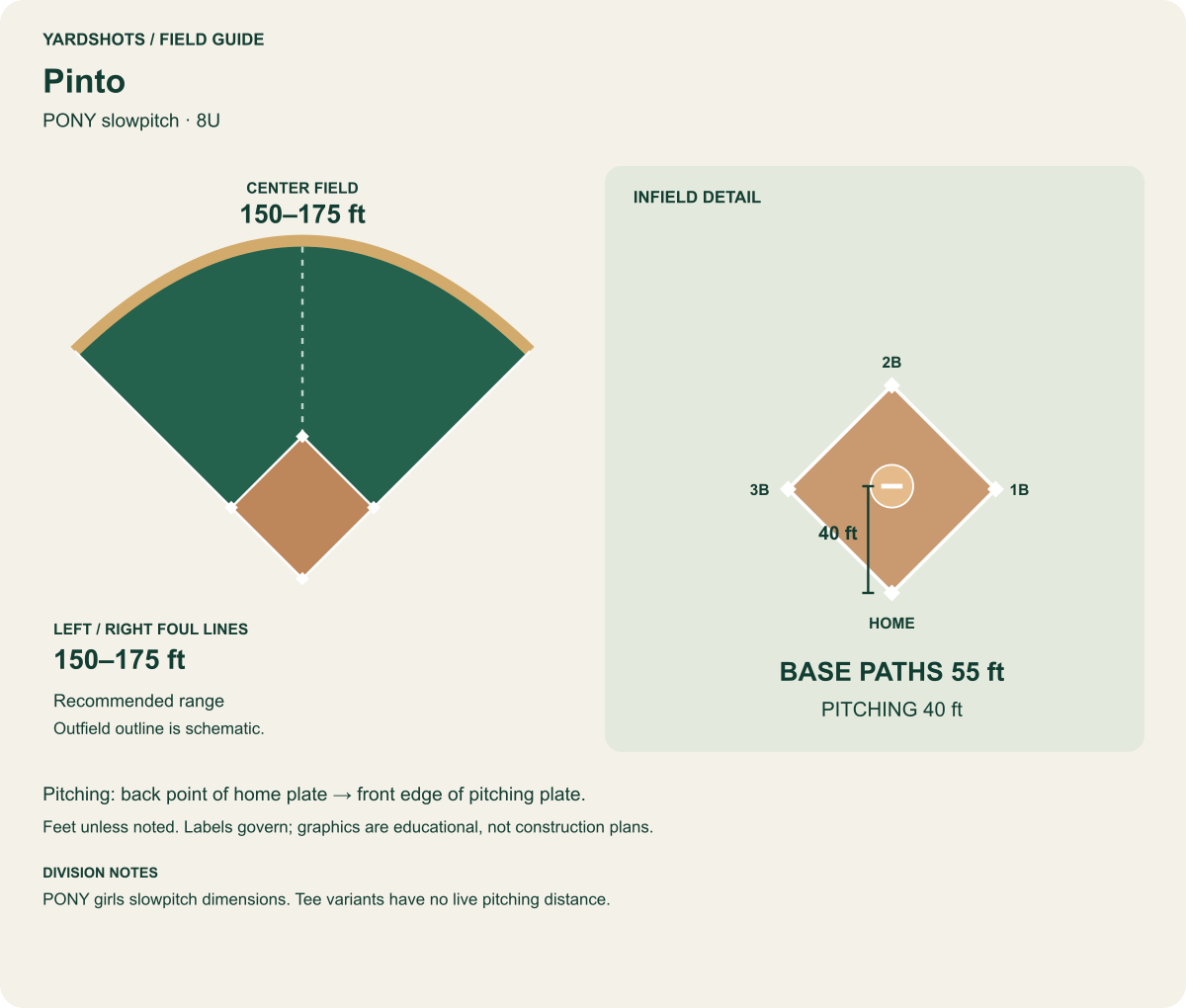
| Pinto | 8U | 55 ft | 40 ft | 150–175 | 150–175 | Recommended range |
| Mustang | 10U | 60 ft | 40 ft | 150–175 | 150–175 | Recommended range |
| Bronco | 12U | 65 ft | 46 ft | 175–200 | 175–200 | Recommended range |
| Pony | 14U | 65 ft | 50 ft | 175–200 | 175–200 | Recommended range |
| Colt | 16U | 65 ft | 50 ft | 175–200 | 175–200 | Recommended range |
| Palomino | 18U | 65 ft | 50 ft | 175–200 | 175–200 | Recommended range |
| Thorobred | 23U | 65 ft | 50 ft | 175–200 | 175–200 | Recommended range |
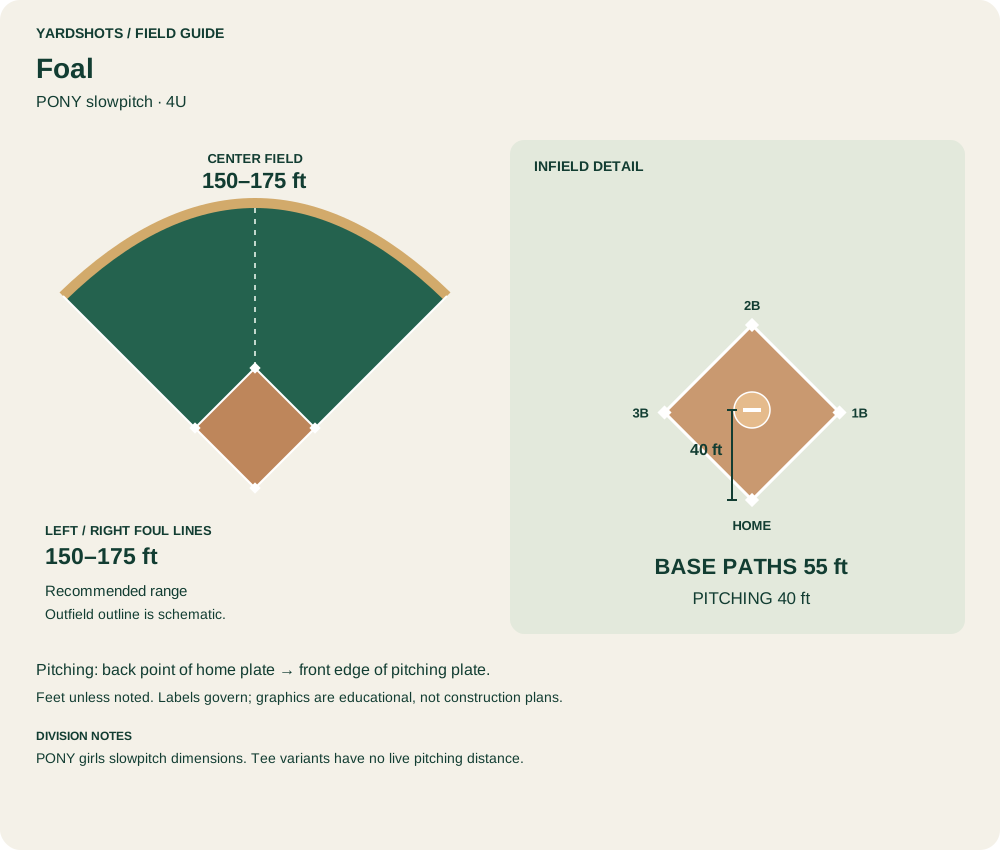
PONY girls slowpitch dimensions. Tee variants have no live pitching distance.
2026 PONY Girls Softball Rulebook, distance chart and Rule 2 (public copy)
Download SVG · Download PNG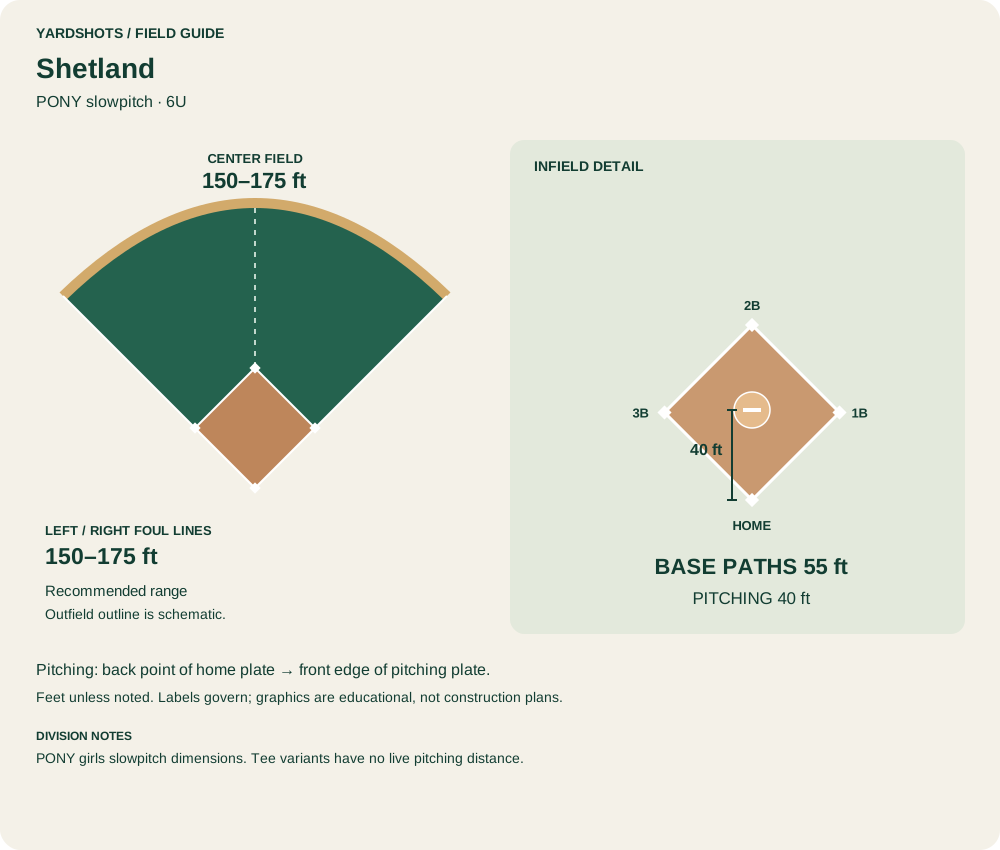
PONY girls slowpitch dimensions. Tee variants have no live pitching distance.
2026 PONY Girls Softball Rulebook, distance chart and Rule 2 (public copy)
Download SVG · Download PNG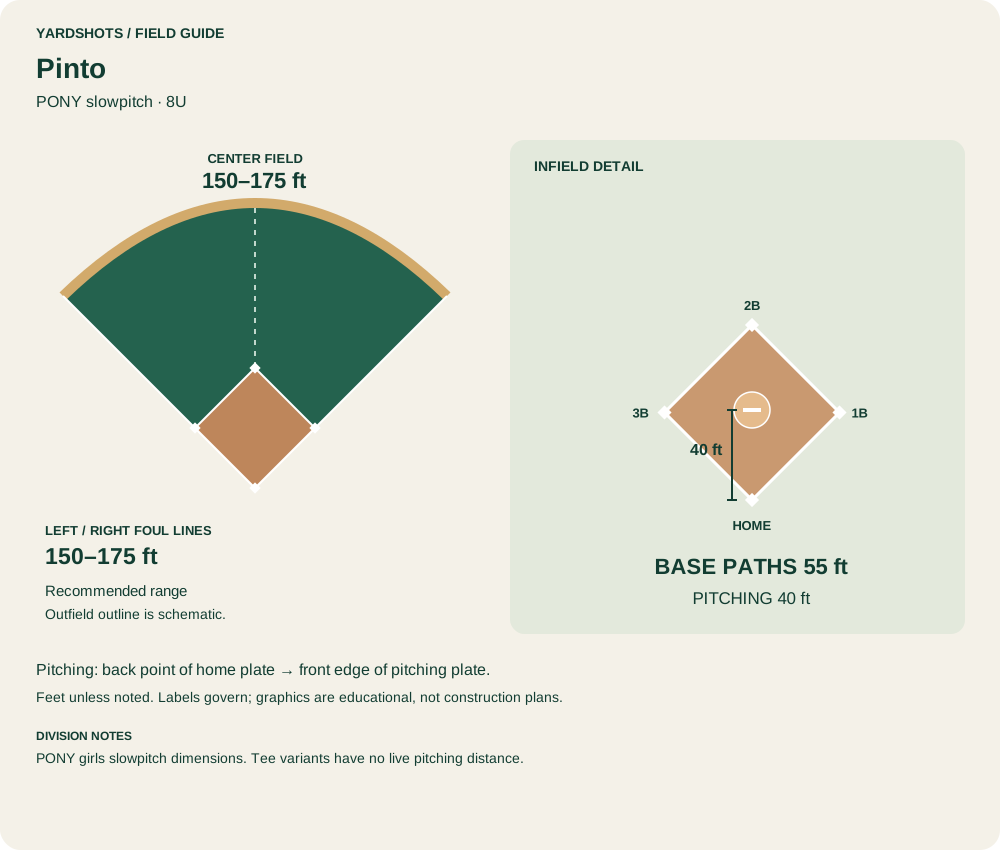
PONY girls slowpitch dimensions. Tee variants have no live pitching distance.
2026 PONY Girls Softball Rulebook, distance chart and Rule 2 (public copy)
Download SVG · Download PNG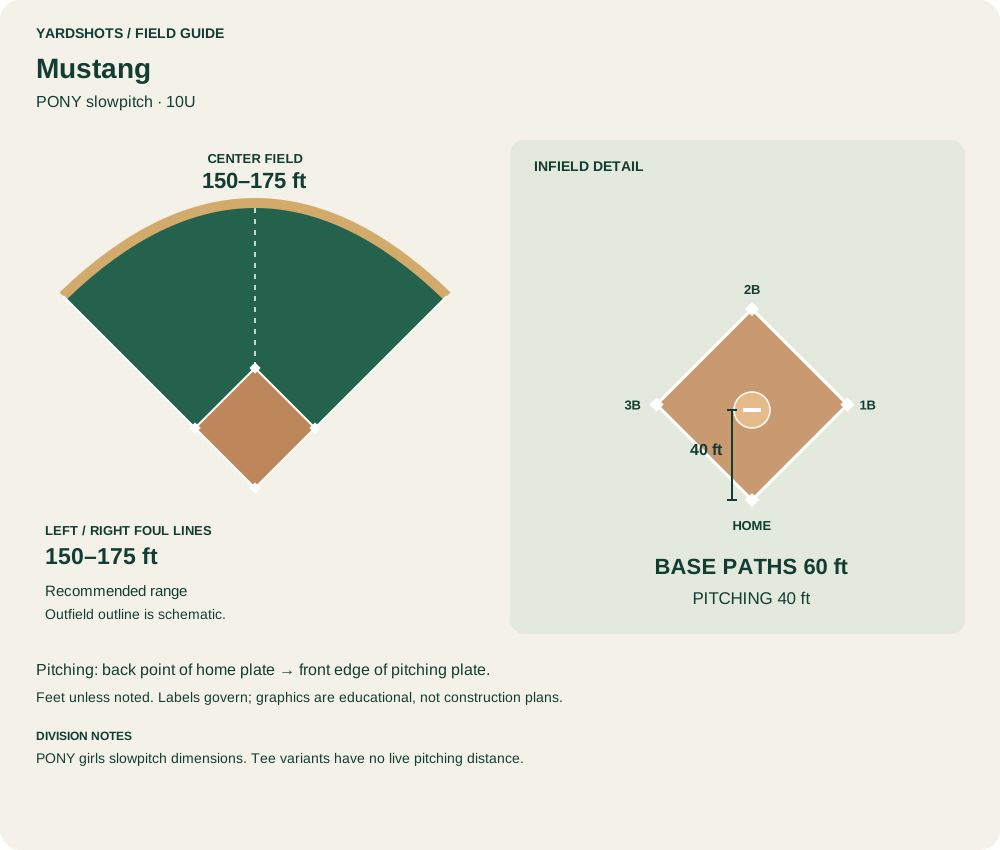
PONY girls slowpitch dimensions. Tee variants have no live pitching distance.
2026 PONY Girls Softball Rulebook, distance chart and Rule 2 (public copy)
Download SVG · Download PNG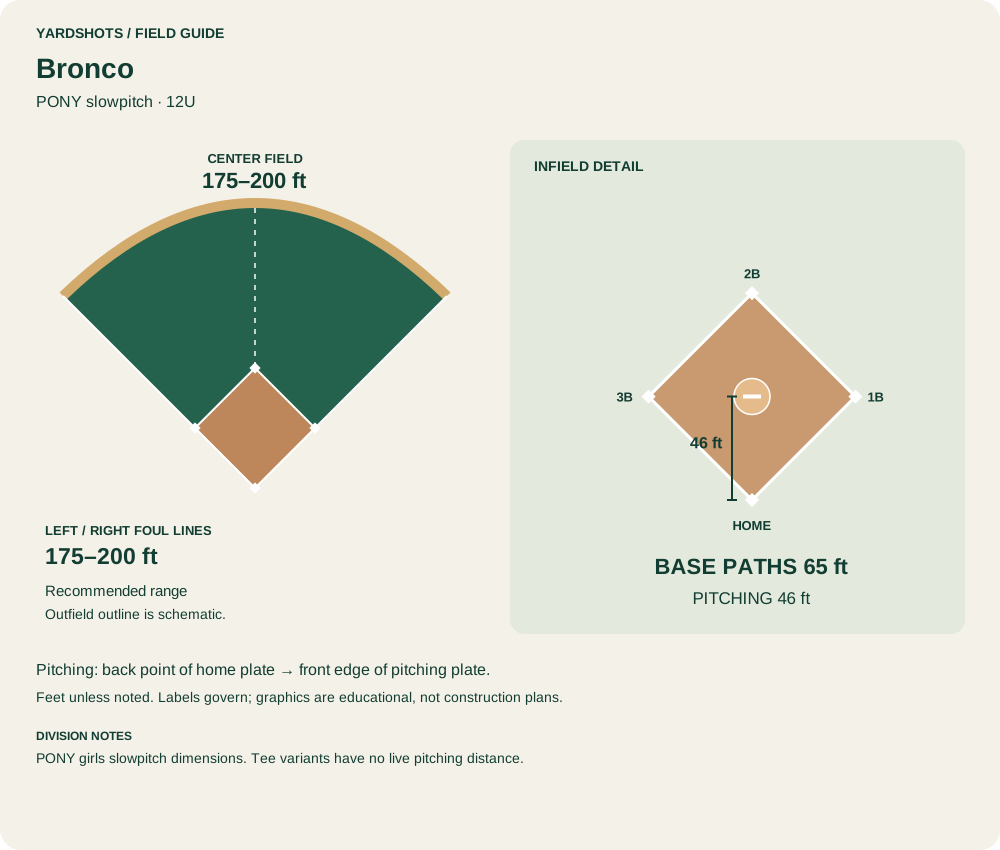
PONY girls slowpitch dimensions. Tee variants have no live pitching distance.
2026 PONY Girls Softball Rulebook, distance chart and Rule 2 (public copy)
Download SVG · Download PNG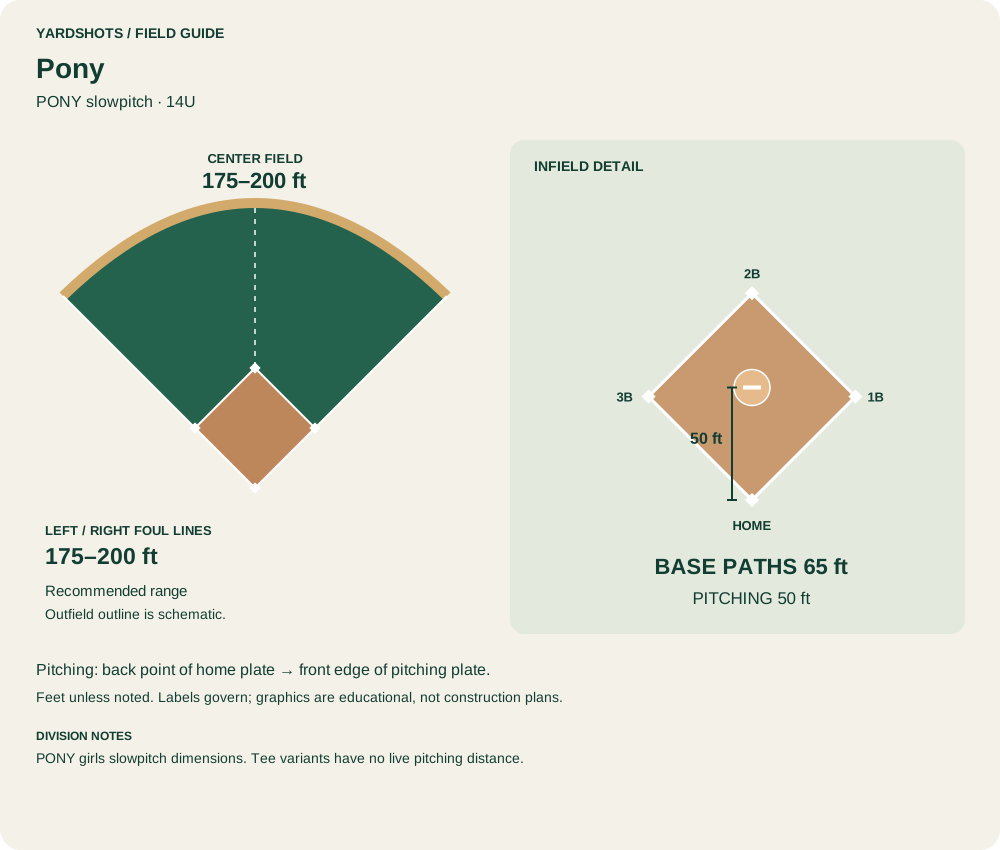
PONY girls slowpitch dimensions. Tee variants have no live pitching distance.
2026 PONY Girls Softball Rulebook, distance chart and Rule 2 (public copy)
Download SVG · Download PNG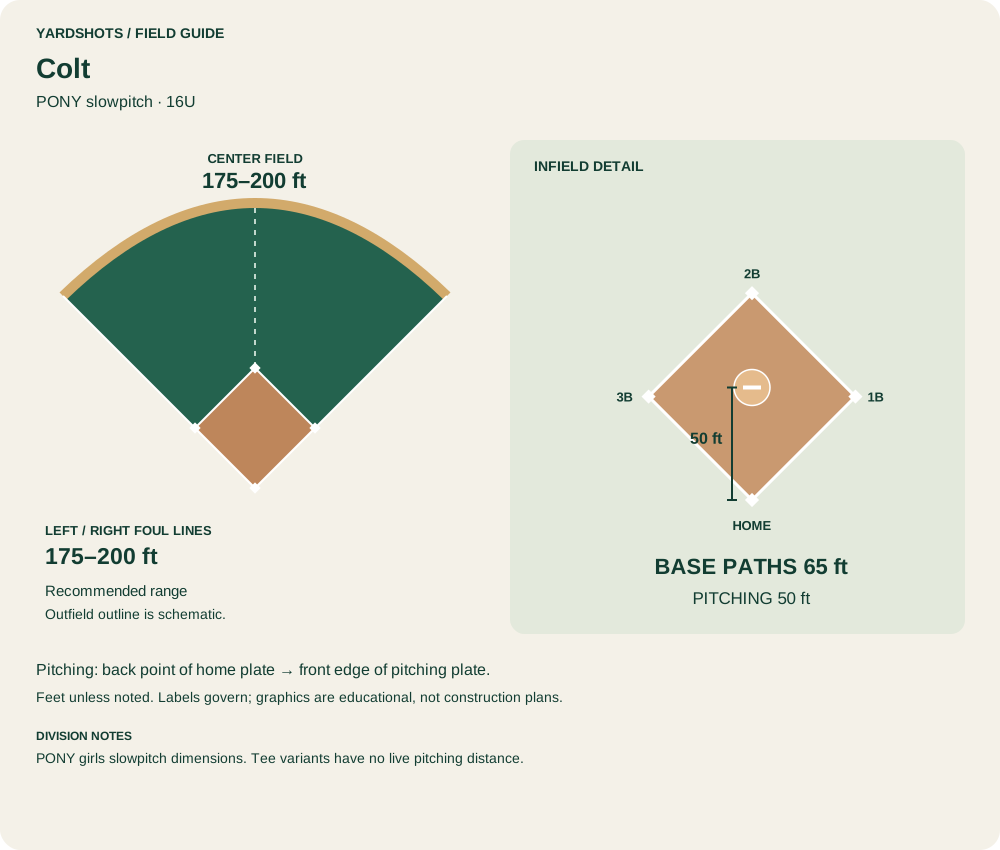
PONY girls slowpitch dimensions. Tee variants have no live pitching distance.
2026 PONY Girls Softball Rulebook, distance chart and Rule 2 (public copy)
Download SVG · Download PNG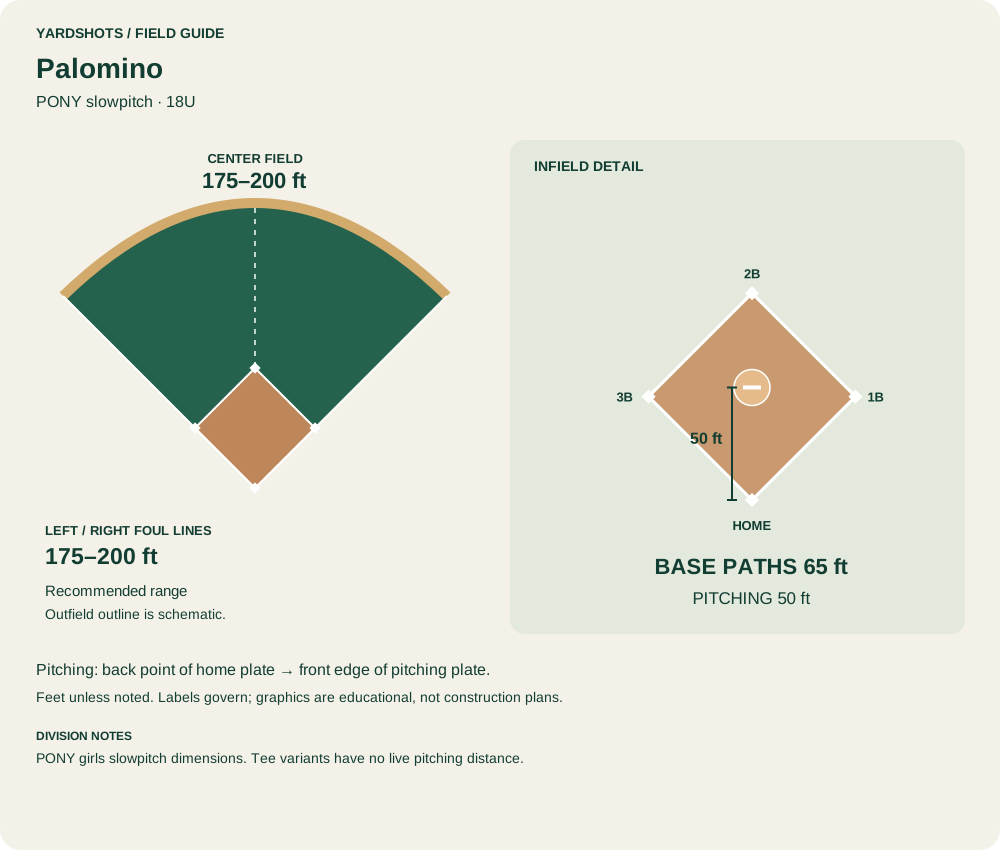
PONY girls slowpitch dimensions. Tee variants have no live pitching distance.
2026 PONY Girls Softball Rulebook, distance chart and Rule 2 (public copy)
Download SVG · Download PNG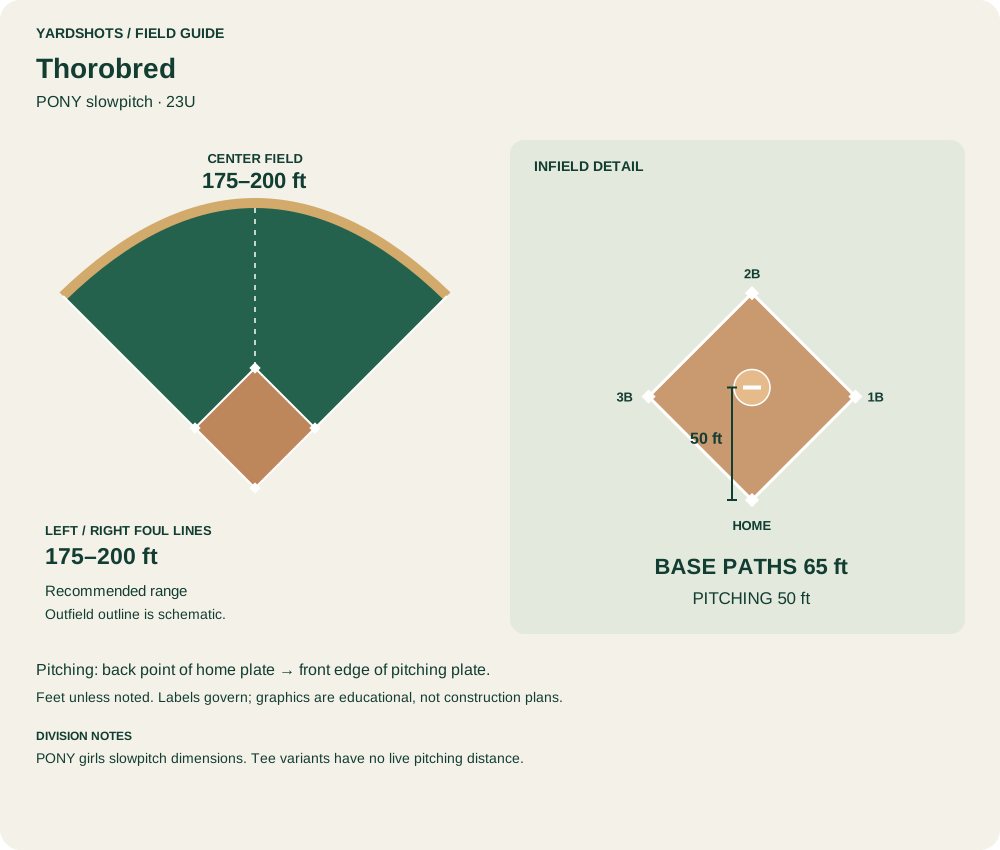
PONY girls slowpitch dimensions. Tee variants have no live pitching distance.
2026 PONY Girls Softball Rulebook, distance chart and Rule 2 (public copy)
Download SVG · Download PNGIn a field-size chart, the side length of the infield square between the prescribed base-layout points. It is not the same as the runner’s actual route during a play.
The straight-line distance from the back point (apex) of home plate to the front edge of the pitching plate. It is not measured from the center of the mound or the pitcher’s release point.
The square formed by home, first, second, and third. “A 60-foot diamond” means each side is 60 feet, not that the entire field is 60 feet wide.
The diagonal across the square: base distance × √2. A 60-foot diamond is about 84 feet 10¼ inches across; a 90-foot diamond is about 127 feet 3⅜ inches.
Distance from the back point of home plate down the left- or right-field line to the outfield boundary. Left and right need not match at an actual park.
Distance from home plate straight through second base to the outfield boundary.
The outfield between left and center, or right and center. A park can be deeper in the gaps than along its foul lines.
The rectangular plate from which a pitcher delivers. Its front edge supplies the pitching-distance reference.
Baseball commonly uses a raised mound. Fastpitch softball uses a level pitching plate and a marked circle; the circle is not an elevated mound.
The fence, screen, or wall behind home plate. Its clearance is separate from pitching distance and outfield depth.
A surface strip near a fence that helps fielders recognize the boundary. Its width is separate from home-run distance.
An eligibility classification, not necessarily the player’s age today. “12U” means 12-and-under under that organization’s age rules.
A recommendation is a preferred reference layout. A required minimum or range is a competition rule, sometimes with exceptions. Neither is a statistical average.
Local rules describing how a particular field’s boundaries and obstructions are handled.
Sometimes. Little League Majors and PONY Mustang share a 46/60 infield. PONY Bronco uses 50/70, and PONY’s 14U division uses 54/80. An age label alone does not tell you the field dimensions.
No. Organization and format matter. Little League Majors uses 60-foot bases, while PONY Bronco uses 70-foot bases. Cal Ripken offers both Major/60 and Major/70.
Both use 90-foot base paths and a pitching distance of 60 feet, 6 inches. Outfield shape and depth can differ substantially.
It has its own layout and pitching rules. Women’s college fastpitch uses a level pitching plate 43 feet from home and 60-foot bases. Adult slowpitch can use 70-foot bases and 50-foot pitching.
Start with the actual fence distance in the direction the ball traveled, then consider fence height. The same distance may clear one park and stay in play at another. Field dimensions alone cannot predict a home run.
No. Tournament books, local options, state associations, and venue ground rules may modify a regular-season reference. Confirm the exact organization, division, season, and format.
Scope. This U.S.-focused reference covers the named Little League and PONY divisions, selected Cal Ripken formats, high school, NCAA, professional baseball, girls/women’s fastpitch, adult men’s fastpitch, and adult/PONY slowpitch. It is not a catalog of every travel-ball or international rule set.
Youngest divisions. A tee has no pitching distance. For coach and machine formats, the delivery position may be governed by supplemental rules. PONY Foal baseball is illustrated as tee play; its Rule 7 also lists a 38-foot delivery layout.
PONY softball update. The 2026 change notice and revised distance chart set Pinto 8U coach pitch at 35 feet. A 40-foot entry remains in the body of Rule 2. The guide follows the explicit 2026 amendment. Player pitch remains a separate 30-foot format.
NCAA softball fences. Existing institutional fields with fences at least 6 feet high have 190-foot left/right and 220-foot center minimums. New construction uses 200/220 minimums and fences at least 6 feet high. Fields with a 4-foot fence use 210/230 minimums. Do not reduce this to a universal 200-foot fence.
Adaptive baseball. Little League Challenger and Senior Challenger are adaptive programs, rather than additional fixed-size competitive diamonds. Select field layout and accommodations with the program. PONY Champions arrangements should likewise be confirmed locally.
Source dates. Reviewed September 30, 2026. NCAA baseball uses the 2025–26 book; NCAA softball uses 2026–27. NFHS public diagrams are older editions, and the baseball fence recommendation is documented in the linked 2023 book. The AUSL infield reference is a 2025 secondary explainer, not a verified 2026 facility rule. PONY public rulebook copies are linked alongside the official rulebook hubs.
YARDSHOTS FIELD GUIDE · Reviewed September 30, 2026. Original educational graphics. League names identify the rules referenced and do not imply affiliation.